On this page
At low tide on the mudflats of the Sundarbans, Bhitarkanika in Odisha and the Gujarat coast, small goggle-eyed fish haul themselves out of the water and stay out. These are mudskippers. Mongabay India reports that 9 of the world's 10 mudskipper genera live in India, on both coasts, and that in Gujarat and Maharashtra the fish is known locally as levata.
A fish in air has three problems: getting oxygen, getting around and not drying out. How mudskippers solve them hints at how backboned animals first moved onto land.
How do mudskippers breathe out of water?
Through several surfaces at once. A 2020 study in the Journal of Experimental Biology lists the mouth, throat, gill and gill-cover cavities, plus the gills and the skin, as places where mudskippers take up oxygen when breathing air.
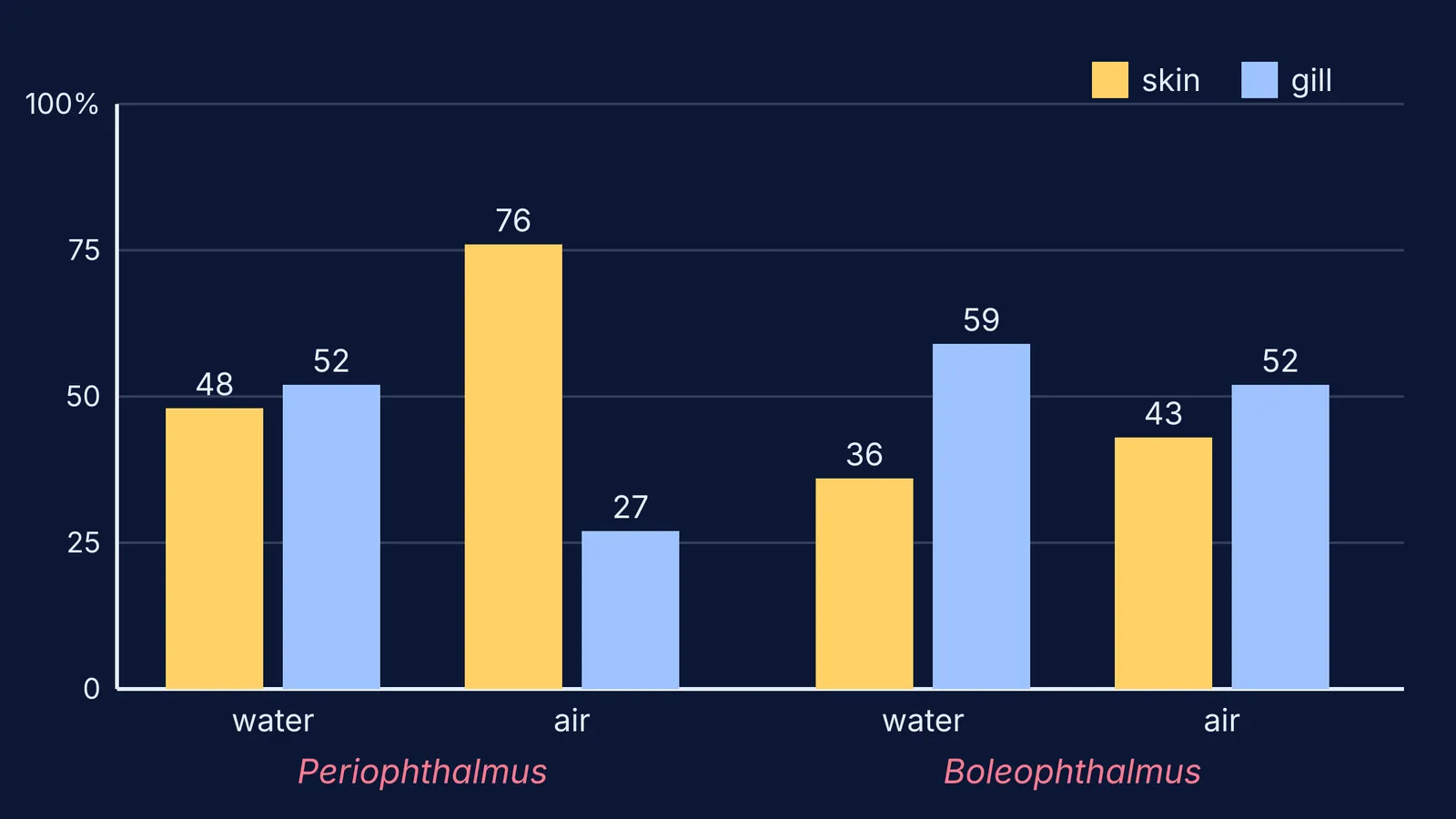
The skin does more than you might expect. In a 1976 study of two mudskipper genera, *Periophthalmus* took 76% of its oxygen through its skin in air, against 48% in water. The other genus, *Boleophthalmus*, took 43% through its skin in air. The authors concluded that on land *Periophthalmus* relies mainly on its skin and *Boleophthalmus* mainly on its gills.
The mouth matters too. Mudskippers come onto land with their mouth and gill chambers filled with water, according to a 2015 study in Proceedings of the Royal Society B. The team filmed *Periophthalmus barbarus* pushing that water out over food and drawing it back in, a "hydrodynamic tongue".
Earthworms face the same rule, which is why they breathe through moist skin and surface after rain.
How do mudskippers move on land?
Mostly on their front fins. A 2009 high-speed imaging study found that mudskippers use their pectoral fins as their main way of moving on land, and move them differently in each setting. On land the fin reached further forward (1.8 cm against 1.3 cm in water), giving a longer stride.
A 2013 study of mudskipper fins calls this gait "crutching": the paired fins prop up the body, rather like crutches.
How do mudskippers stay moist at low tide?
They live in the mud. Mongabay India notes that basking lets mudskippers absorb moisture, particularly through their skin, and that males may dampen their nest sites so the eggs do not dry out.
Burrow water holds very little oxygen, so mudskippers bring their own air. A 1998 paper in Nature was titled, simply, Mudskippers store air in their burrows. A 2007 study of the Japanese mudskipper found that its eggs are laid on the walls of an air-filled chamber in the burrow, and the guarding male carries mouthfuls of fresh air into it during each low tide. When the eggs are ready, on a rising tide at night, he removes the air, the chamber floods and the eggs hatch.
Why are mudskippers a model for how fish came onto land?
First, a caution: mudskippers are living gobies, not our ancestors. The real move onto land is recorded in fossils such as *Tiktaalik*, a Late Devonian fish from Arctic Canada that its discoverers described in Nature in 2006 as intermediate between fish with fins and tetrapods with limbs.
Fossils cannot be filmed or tested. Mudskippers can:
Genes. A 2014 study in Nature Communications sequenced the genomes of four mudskipper species. It found extra immune genes that may defend against land pathogens, and changes in genes for ammonia excretion and for seeing in air.
Limbs. The 2013 crutching study measured the forces under mudskipper fins and tiger salamander legs. The fins bore less vertical force, as a share of body weight, than the salamander's front legs.
Feeding. The 2015 authors suggest the water tongue may be a transitional step before land animals evolved sticky tongues.
For other fish that gulp air, see how magur, climbing perch and mudskippers breathe air, and compare how frogs live a dual life.
How do you write this up in a biology exam?
Use four headings: Breathe, Move, stay Wet, Reproduce (BMWR). Here is a worked answer to "How is the mudskipper adapted to life on mudflats?"
Breathe: takes in oxygen through moist skin, the lining of the mouth and gill chambers, and the gills; holds water in the mouth and gill chambers on land.
Move: uses strong pectoral fins as props to crutch across mud.
Wet: lives in burrows and wet mud, and absorbs moisture through its skin while basking.
Reproduce: lays eggs in an air-filled burrow chamber that the male refills with air at low tide.
Close with one line: mudskippers show how a fish can solve problems early land vertebrates also faced.
If gas exchange across skin, gills and lungs still feels fuzzy, the Fermi Concept Library gives each biology concept its own lesson and its place in the map.