On this page
If a match-the-column question pairs Catla with "marine", would you spot the mistake in five seconds? The Animal Kingdom chapter of NCERT Class 11 Biology names 15 fish genera across three classes, counting the jawless cyclostomes, and only the bony fish come pre-sorted into marine, freshwater and aquarium. Here is every one, the rule behind each group, and a memory table you can redraw from a blank page.
Which fish does NCERT list as marine, freshwater and aquarium?
The habitat split sits in one line of the Class Osteichthyes section, the bony fish (NCERT, Animal Kingdom):
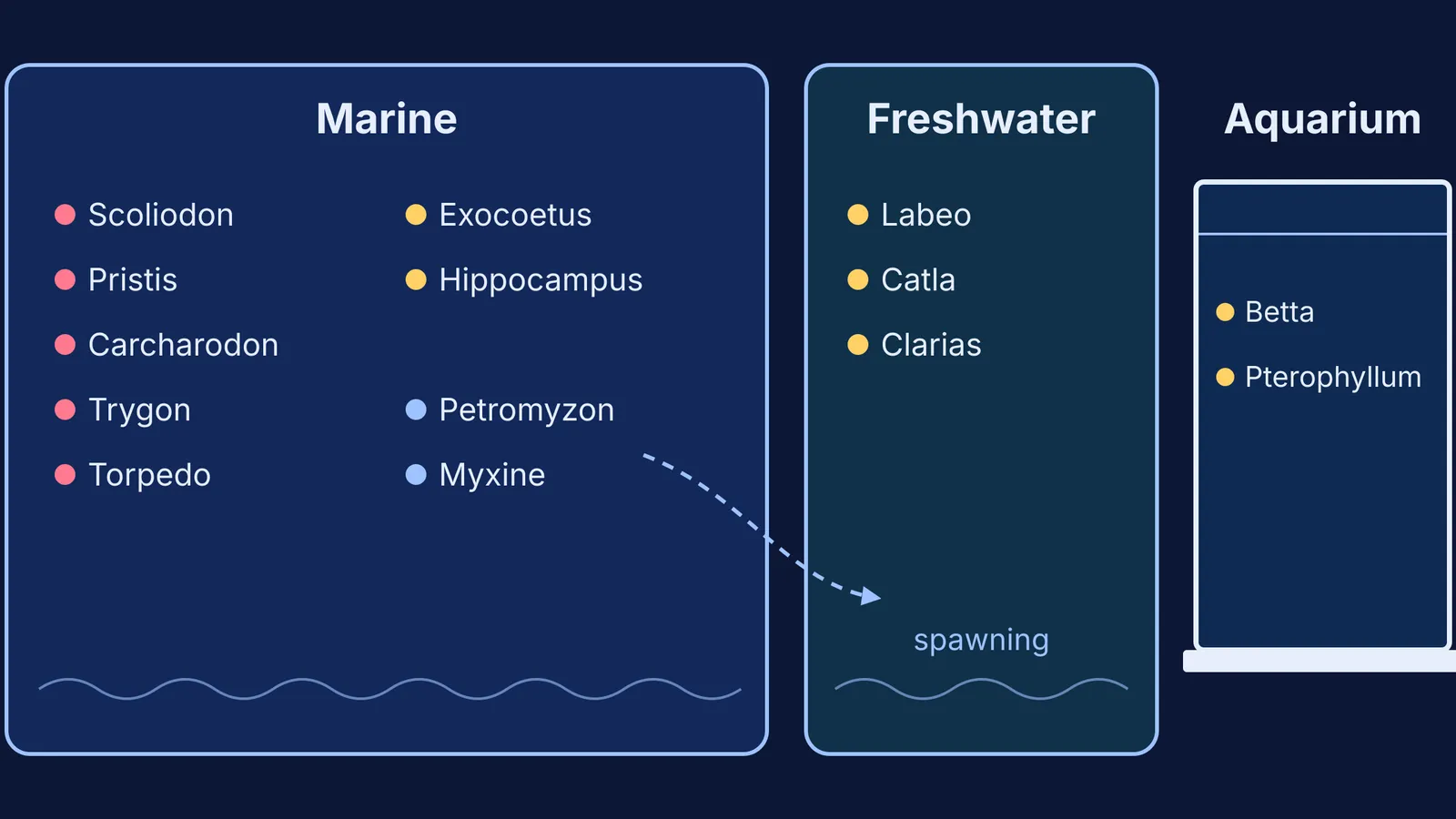
Marine: Exocoetus (flying fish), Hippocampus (sea horse)
Freshwater: Labeo (rohu), Catla (katla), Clarias (magur)
Aquarium: Betta (fighting fish), Pterophyllum (angel fish)
NCERT says Osteichthyes "includes both marine and fresh water fishes with bony endoskeleton", which is why it is the only fish class the chapter splits by habitat. "Aquarium" is not a third kind of water; it describes how people keep these two fish. NCERT lists it as its own group, so learn it as a third bin.
One NCERT figure shows Hippocampus and Catla side by side. Picture it and you have one anchor in each of the first two bins: the sea horse in the sea, the katla in the river.
Are all cartilaginous fish marine?
Yes, in NCERT's account. The Class Chondrichthyes section opens "They are marine animals", and the chapter summary repeats that Chondrichthyes "are marine" (NCERT, Animal Kingdom). The examples are Scoliodon (dog fish), Pristis (saw fish), Carcharodon (great white shark) and Trygon (sting ray). One more name hides in the description: Torpedo, given as the example of a fish with electric organs, while Trygon is the one with a poison sting.
So every cartilaginous name goes straight into the marine bin. If you mix up their common names, our guide to dog fish, saw fish and sting ray scientific names drills them one by one.
Where do Petromyzon and Myxine fit?
They are the awkward pair. NCERT says cyclostomes "are marine but migrate for spawning to fresh water"; within a few days of spawning they die, and their larvae return to the ocean after metamorphosis (NCERT, Animal Kingdom). The examples are Petromyzon (lamprey) and Myxine (hagfish), and NCERT adds that all living members of the class are ectoparasites on some fishes. The textbook states these points for the class as a whole, so give its answer for both genera.
For a one-word habitat answer, write marine. If the question is about where they breed, the answer is fresh water.
What is an easy way to memorise NCERT fish examples?
Use this memory table. Draw three columns on a blank page and fill them without looking:
Marine: Scoliodon, Pristis, Carcharodon, Trygon, Torpedo (cartilaginous); Exocoetus, Hippocampus (bony); Petromyzon, Myxine (jawless)
Freshwater: Labeo, Catla, Clarias (bony); Petromyzon and Myxine only to spawn
Aquarium: Betta, Pterophyllum (bony)
Three hooks stop the short columns from blurring:
"LCC goes fresh": Labeo, Catla, Clarias, with the common names rohu, katla and magur.
"EH, it's the sea": Exocoetus and Hippocampus, the only bony fish NCERT puts in the sea.
"B and P in the tank": Betta and Pterophyllum.
Check your page against the list, circle any miss, and the next day redraw only the column you got wrong. Two clean redraws in a row and the table is yours.
If a class name such as Osteichthyes still feels like a label rather than an idea, the Fermi Concept Library covers every concept in physics, chemistry, biology, mathematics and computing, each with its own lesson and its place in the map, so you can see where an idea fits before you learn its examples.
Which other NCERT "fish" are traps?
Some animals with "fish" in their common names are not fish at all (NCERT, Animal Kingdom):
Sepia (cuttlefish) and Octopus (devil fish) are molluscs.
Asterias (star fish) is an echinoderm.
Aurelia, the jelly fish, is the free-swimming medusa form of a cnidarian.
Our post on devil fish, sea hare and tusk shell covers the mollusc names.
Class 12 adds a few real fish in other contexts (NCERT Class 12 Biology, archived copy):
Gambusia, introduced into ponds to feed on mosquito larvae (Human Health and Disease). See how Gambusia controls mosquitoes, and why it is risky.
The African catfish Clarias gariepinus, whose illegal introduction for aquaculture threatens the indigenous catfishes in our rivers (Biodiversity and Conservation). Same genus as magur, different story.
The Nile perch, whose introduction into Lake Victoria led to the extinction of more than 200 species of cichlid fish (same chapter).
The clown fish, which lives among a sea anemone's stinging tentacles for protection (Organisms and Populations).
Before your next test, redraw the three columns once and add the traps underneath. It takes a few minutes, and the next Catla-in-the-sea option costs you nothing.