On this page
If a NEET question asks you to match *Pristis* to its common name, or to pick the odd one out from *Trygon*, *Torpedo*, *Hippocampus* and *Scoliodon*, you need two facts for each fish: what people call it, and which class it belongs to. Every genus on this page comes from the fish section of the NCERT Class 11 Biology chapter Animal Kingdom, and this page sorts them in one go.
What are the scientific names of dog fish, saw fish, sting ray and electric ray?
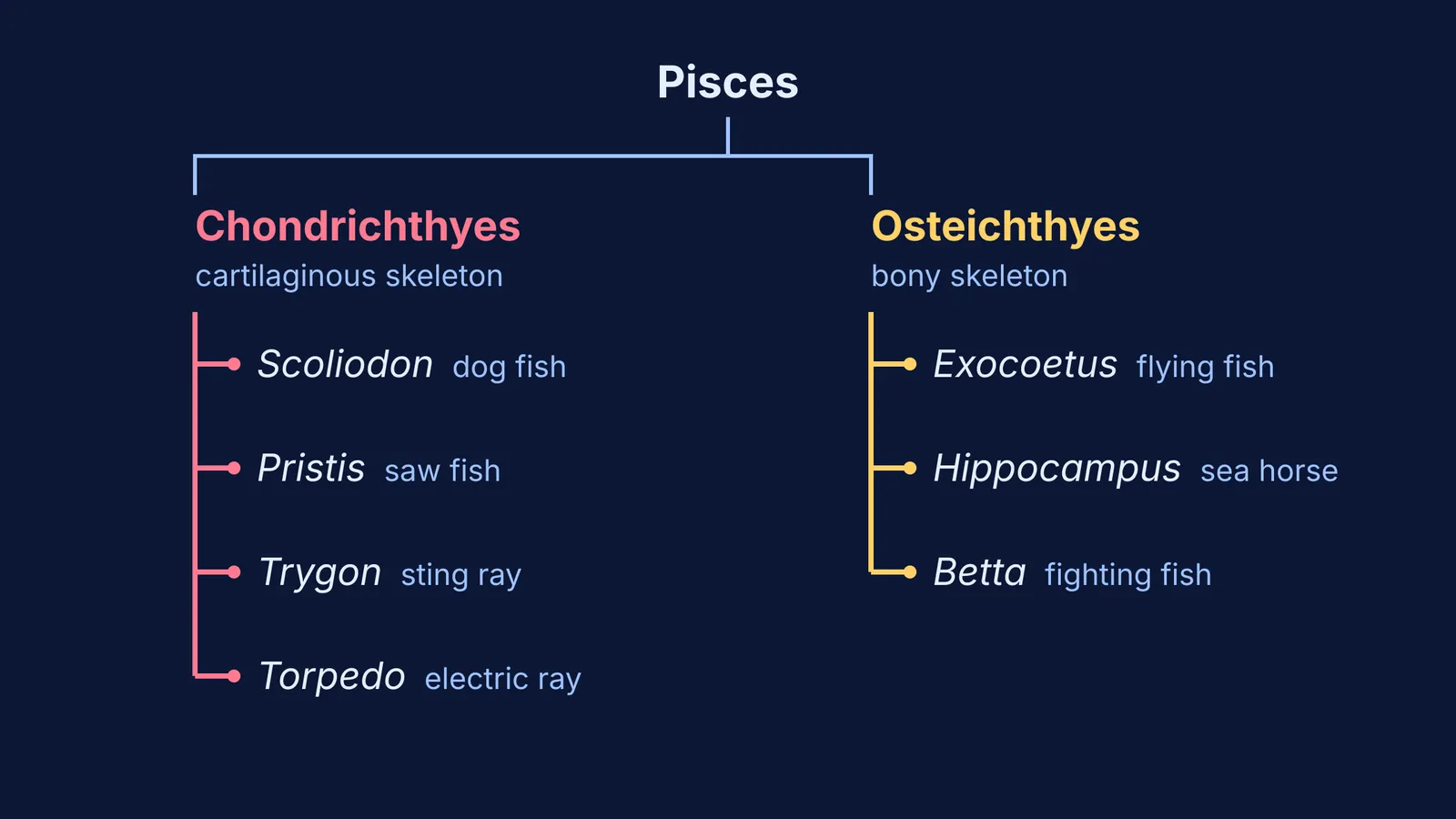
All four are cartilaginous fishes, class Chondrichthyes, in the NCERT Animal Kingdom chapter:
Dog fish is *Scoliodon*.
Saw fish is *Pristis*.
Sting ray is *Trygon*, which NCERT also gives as its example of a fish with a poison sting.
Electric ray is *Torpedo*, which NCERT gives as its example of a fish with electric organs.
The chapter's example list for this class also includes *Carcharodon*, the great white shark. *Torpedo* is not in that list; it sits inside the description paragraph, so a question can test whether you read the text and not only the examples. NCERT does not print a common name for it. The name electric ray comes from its family, Torpedinidae, which FishBase lists as the electric rays. FishBase records that one species, the marbled electric ray, can produce discharges of up to 200 volts.
Which NCERT fishes are bony and which are cartilaginous?
The same NCERT chapter splits its bony fishes, class Osteichthyes, by where they live:
Marine: *Exocoetus* (flying fish) and *Hippocampus* (sea horse)
Freshwater: *Labeo* (rohu), *Catla* (katla) and *Clarias* (magur)
Aquarium: *Betta* (fighting fish) and *Pterophyllum* (angel fish)
The features that separate the two classes, from the same chapter:
Skeleton: cartilaginous endoskeleton versus bony endoskeleton.
Gill cover: separate gill slits with no operculum, versus four pairs of gills covered by an operculum on each side.
Scales: placoid scales versus cycloid or ctenoid scales.
Air bladder: absent in cartilaginous fishes, so they must swim constantly to avoid sinking; present in bony fishes, where it regulates buoyancy.
Mouth: ventral versus mostly terminal.
Fertilisation: internal, with claspers on the pelvic fins of males, versus usually external.
For the reasoning behind the first four, see our post on shark features: cartilage, placoid scales and no air bladder.
Why do the common names confuse students?
Common names are loose labels, and three of these mislead:
Dog fish is a shark. FishBase calls *Scoliodon laticaudus* the spadenose shark, places it in the requiem shark family Carcharhinidae, and records that it gives birth to live young nourished through a placenta.
Saw fish is a ray, not a shark. FishBase places the common sawfish, *Pristis pristis*, in the order Rhinopristiformes (shovelnose rays) and lists it as Critically Endangered on the IUCN Red List.
*Trygon* is an older genus name. The World Register of Marine Species lists *Trygon* Cuvier, 1816 as unaccepted, with *Dasyatis* as the accepted name. For the common stingray, *Dasyatis pastinaca*, FishBase describes a barbed venomous tail spine up to 35 cm long. In an NCERT-based exam, still write *Trygon*.
The bony three look unusual but are still bony fishes. In the spotted seahorse, *Hippocampus kuda*, the males carry the eggs in a brood pouch under the tail. Flying fish such as *Exocoetus volitans* leap out of the water and glide, and the Siamese fighting fish, *Betta splendens*, can breathe air and builds a bubble nest that the male guards.
How do you memorise these fish names for NEET?
Try this 10-minute plan with a blank sheet:
Minutes 0 to 3: write two headings, Chondrichthyes and Osteichthyes. Put the five sharks and rays under the first and the seven bony examples under the second, grouped as marine, freshwater and aquarium.
Minutes 3 to 6: cover the common names and say each one from the genus name. Then cover the genus names and go the other way.
Minutes 6 to 8: for each class, write three features from memory: skeleton, gill cover and air bladder.
Minutes 8 to 10: answer the worked question below without looking back.
Worked question. Which pair is wrongly matched? (a) *Pristis*: saw fish (b) *Exocoetus*: flying fish (c) *Hippocampus*: Chondrichthyes (d) *Trygon*: sting ray.
Answer: (c). Options (a), (b) and (d) match NCERT. *Hippocampus*, the sea horse, is a marine bony fish in class Osteichthyes. The trap is its shape: it does not look like a typical fish, but its skeleton is bone, not cartilage.
Repeat step 2 the next day. Any name that still slips is the one to write out again.
If the class features keep blurring together, the Fermi Concept Library gives each biology concept its own lesson and its place in the map. For practice, the Fermi Problem Library has worked problems with a step-by-step solver that explains the reasoning rather than printing an answer.
For every other name in the syllabus, use our chapter-wise list of scientific names in NCERT biology, and see the birds sorted the same way in NCERT bird examples from Corvus to Neophron.