On this page
What does a JEE Advanced paragraph question look like?
The official JEE Advanced 2026 syllabus lists "tangents and normals, increasing and decreasing functions, derivatives of order two, maximum and minimum values of a function, Rolle's theorem and Lagrange's mean value theorem" under differential calculus.
In JEE Advanced 2021 Paper 2, mathematics Section 3 had two paragraphs with two single-correct questions each, marked +3, 0 if unanswered and −1 otherwise. The pattern can change from year to year, so check the current paper. The three paragraphs below are original, written to that pattern. Try each before reading on.
Paragraph 1: how do a cubic's turning points decide its roots?
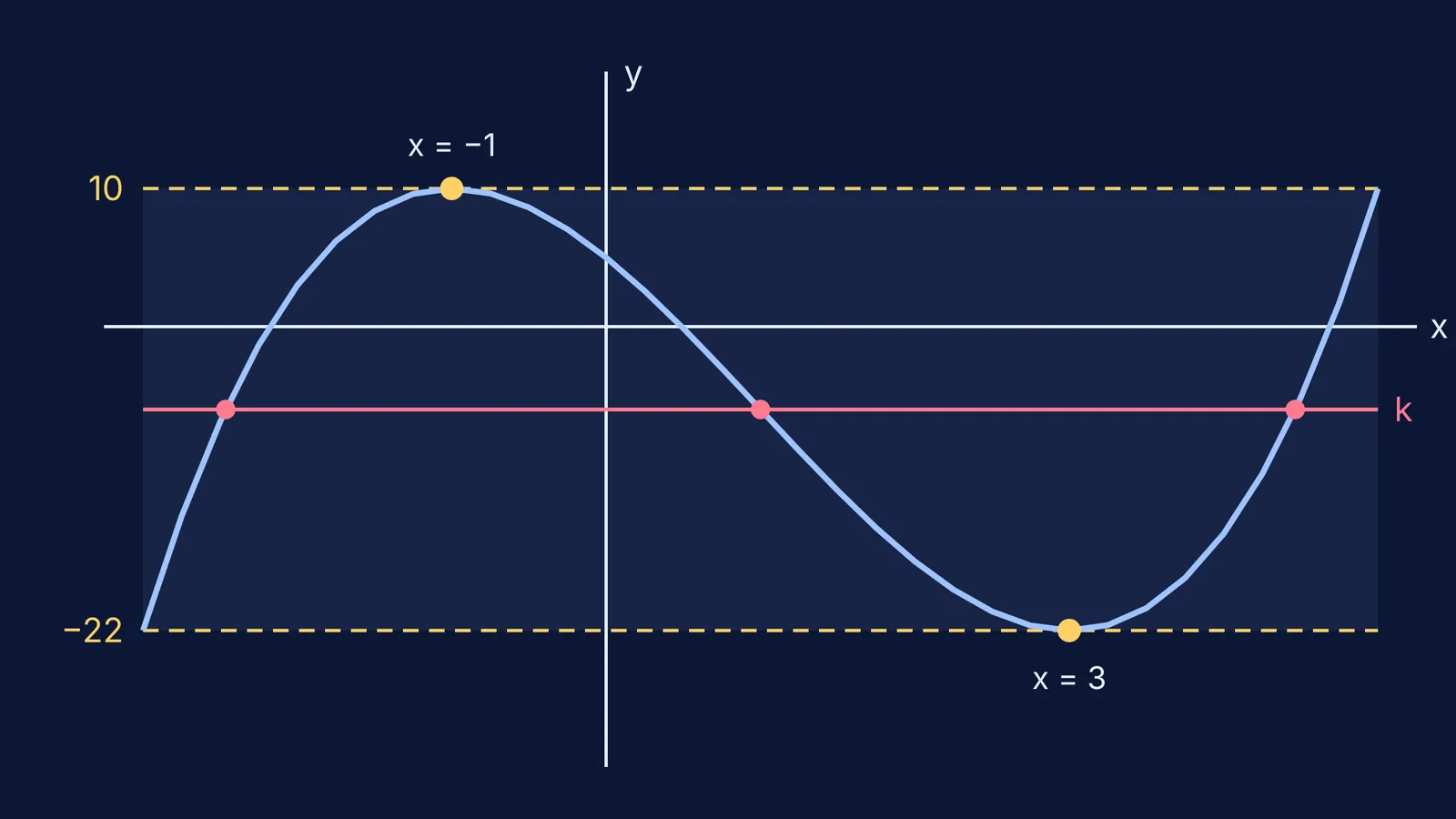
Paragraph. Let f(x) = x³ − 3x² − 9x + 5 for all real x.
Q1. Find the local maximum value of f minus its local minimum value.
f′(x) = 3x² − 6x − 9 = 3(x + 1)(x − 3). The sign of f′ goes + to − at x = −1 and − to + at x = 3, so the local maximum is f(−1) = 10 and the local minimum is f(3) = −22. Answer: 10 − (−22) = 32.
Tempting wrong answer: −32, from assuming the larger x gives the maximum. For a cubic with a positive leading coefficient, the maximum comes first.
Q2. For how many integers k does f(x) = k have three distinct real roots?
The line y = k cuts the graph three times only when it lies strictly between the turning values from Q1: −22 < k < 10. The integers −21 to 9 give 31.
Tempting wrong answers: 33, from including k = 10 and k = −22, where the line touches a turning point and two roots merge; or 32, Q1's number reused.
Paragraph 2: where does a normal to a parabola meet it again?
Paragraph. P(t, t²), with t > 0, is a point on y = x². The normal to the curve at P meets the curve again at Q.
Q1. The x-coordinate of Q is (A) −t − 1/(2t) (B) 1/(2t) − t (C) −1/(2t) (D) t + 1/(2t).
The tangent slope at P is 2t, so the normal slope is −1/(2t), and the normal is y − t² = −(x − t)/(2t). Put y = x²: (x − t)(x + t) = −(x − t)/(2t). Cancel x − t (the root at P): x = −t − 1/(2t). Answer (A).
The tempting option is (B): a normal slope that lost its minus sign.
Q2. The least possible y-coordinate of Q is (A) 0 (B) 1 (C) 2 (D) 4.
From Q1, Q's y-coordinate is h(t)², where h(t) = t + 1/(2t). Then h′(t) = 1 − 1/(2t²) = 0 at t = 1/√2, and h″ > 0, so h has minimum √2 there. The least y-coordinate is 2: option (C).
Option (A) is tempting because the vertex is the parabola's lowest point, but Q's x-coordinate is at least √2 in size.
Paragraph 3: what can ln x / x decide?
Paragraph. Let φ(x) = (ln x)/x for x > 0.
Q1. φ is increasing on (A) (1/e, ∞) (B) (0, e) (C) (e, ∞) (D) (1, ∞).
φ′(x) = (1 − ln x)/x², positive exactly when ln x < 1. So φ increases on (0, e), decreases on (e, ∞), and has its largest value 1/e at x = e. Answer (B). Option (C) comes from a sign slip in φ′.
Q2. Which is true? (A) e^π > π^e (B) e^π < π^e (C) e^π = π^e (D) the data cannot decide.
Take logs: compare π with e ln π, that is, 1/e with (ln π)/π. From Q1, 1/e is the largest value φ takes, so (ln π)/π < 1/e, which gives π^e < e^π. Answer (A).
The tempting option is (B), from the habit that the bigger base wins.
Q3. Find the number of positive real solutions of 2^x = x².
For x > 0, take logs: x ln 2 = 2 ln x, so φ(x) = (ln 2)/2. φ is negative on (0, 1), where ln x < 0, and by Q1 every value between 0 and 1/e is taken exactly twice: once on (1, e) and once on (e, ∞). Since (ln 2)/2 ≈ 0.35 is below 1/e ≈ 0.37, there are 2 solutions: x = 2 and x = 4.
Tempting wrong answers: 1, stopping at x = 2; or 3, counting the negative solution near x = −0.77, which the word positive rules out.
How do you read an applications of derivatives paragraph quickly?
Read every question in the set first. The last one shows what to keep from the first.
Underline conditions such as t > 0, distinct and positive. Each removes a root or a case.
Sketch the graph once: turning points and intervals of increase answer most linked questions.
Keep Q1's general expression, not only its value.
Next, try the chapter's JEE Advanced practice set with solutions and its numerical answer questions.
If a step loses you, the Fermi Problem Library has a step-by-step solver that explains the reasoning. To plan the rest of your preparation, start at Fermi Test Prep for JEE Main and Advanced.