On this page
A paragraph question in JEE Advanced gives you one short passage and two or three questions built on it. In probability they usually chain, so one slip can cost the whole set. Here are three original paragraphs, solved fully, with the tempting wrong option explained.
The paper pattern can change from year to year, so check it on the official JEE (Advanced) website, which currently announces JEE (Advanced) 2027 for 23 May 2027.
Paragraph 1: which box did the red ball come from?
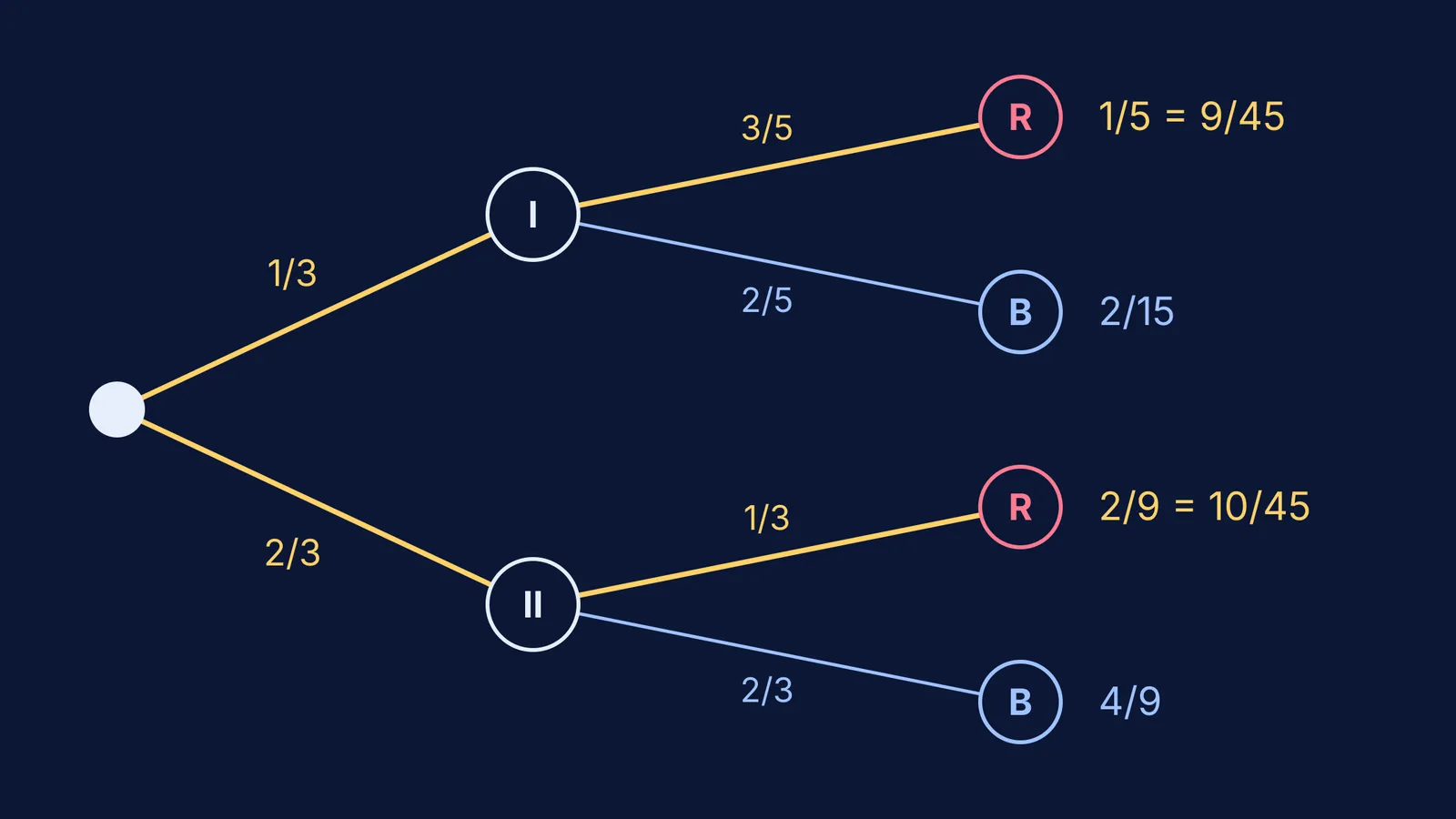
Passage. Box I has 3 red and 2 black balls; Box II has 2 red and 4 black balls. A fair die is rolled. If it shows 1 or 2, a ball is drawn from Box I; otherwise it is drawn from Box II.
Q1. What is the probability that the ball is red? By total probability: (1/3)(3/5) + (2/3)(2/6) = 1/5 + 2/9 = 19/45.
Q2. Given that the ball is red, what is the probability it came from Box I? (A) 3/5 (B) 9/14 (C) 9/19 (D) 1/3
By Bayes' theorem, (1/5) ÷ (19/45) = 9/19, option (C). There are two traps. 3/5 is P(red | Box I), the condition turned round. 9/14 = (3/5) ÷ (3/5 + 1/3) treats the boxes as equally likely and forgets the die.
Q3. The red ball is kept out and a second ball is drawn from the same box. What is the probability it is red? (A) 3/10 (B) 13/38 (C) 7/20 (D) 9/38
Now the boxes carry the weights from Q2, 9/19 and 10/19. Box I has 2 red of 4 left; Box II has 1 red of 5 left. So (9/19)(1/2) + (10/19)(1/5) = 9/38 + 4/38 = 13/38, option (B). The trap is 3/10, which keeps the old weights 1/3 and 2/3, though the red ball has already changed them.
Paragraph 2: how many shots make at least one hit likely?
Passage. A shooter hits a target with probability 1/3 on each shot, independently of the other shots. X is the number of hits.
Q1. What is the least number of shots for which P(at least one hit) > 0.9? (A) 3 (B) 5 (C) 6 (D) 7
P(no hit in n shots) = (2/3)^n must fall below 0.1. (2/3)^5 = 32/243, about 0.13, and (2/3)^6 = 64/729, about 0.088, so n = 6, option (C). The trap is 3, from n × 1/3 > 0.9. Hits on different shots are not mutually exclusive, so their probabilities do not add.
Q2. With 6 shots, what is P(X = 2)? (A) 16/729 (B) 80/243 (C) 1/3 (D) 64/729
C(6,2)(1/3)²(2/3)⁴ = 15 × 16/729 = 240/729 = 80/243, option (B). The trap is 16/729, the probability of one particular order of hits and misses; C(6,2) = 15 counts the orders.
Q3. Given at least one hit in the 6 shots, what is P(X = 2)? Divide Q2's answer by the probability from Q1: (240/729) ÷ (1 − 64/729) = 240/665 = 48/133. Stopping at 80/243 ignores the condition.
Paragraph 3: what is the distribution of the larger number drawn?
Passage. Two balls are drawn together from a bag of four balls numbered 1, 2, 3 and 4. Let X be the larger of the two numbers drawn.
Q1. What is P(X = 4)? (A) 1/4 (B) 1/2 (C) 7/16 (D) 3/8
There are C(4,2) = 6 equally likely pairs, and X = 4 for the three pairs that contain 4, so P(X = 4) = 3/6 = 1/2, option (B). In general P(X = k) = (k − 1)/6, giving 1/6, 2/6 and 3/6 for k = 2, 3 and 4. The traps: 1/4 assumes the larger number is equally likely to be any ball, and 7/16 = 1 − (3/4)² is the answer with replacement, which "together" rules out.
Q2. What is E(X)? Use the distribution from Q1: (2 × 1 + 3 × 2 + 4 × 3)/6 = 20/6 = 10/3. The trap is 5/2, the average of 1 to 4, which ignores that X is the larger number.
Q3. What is Var(X)? E(X²) = (4 × 1 + 9 × 2 + 16 × 3)/6 = 70/6 = 35/3, so Var(X) = 35/3 − (10/3)² = 105/9 − 100/9 = 5/9. The trap is 25/3, from subtracting 10/3 instead of its square.
How do you read a probability paragraph quickly and pull out what it defines?
Underline what the passage defines: the random variable (X = the larger number), the rule for choosing a box, the word "independently". These are your tools.
Read every question before solving Q1, so you know which numbers to keep.
Keep exact fractions, not decimals; 19/45 and 9/19 were reused, and rounding drifts.
Watch the direction of a condition: P(A | B) and P(B | A) often both sit among the options.
Distrust a fast match with an option. Traps answer a nearby wrong reading, such as with replacement for without.
Next, work through the probability JEE Advanced practice set with solutions, the multiple-correct probability questions for JEE Advanced and the numerical-answer probability questions.
If you are preparing for JEE, Fermi Test Prep is our JEE Main and Advanced preparation. When a conditional probability keeps coming out as the trap answer, the Fermi Problem Library has a step-by-step solver that explains the reasoning rather than printing an answer.