On this page
Probability options look obviously right, which is why they cost marks. Judge each option as its own true-or-false claim, then tick only what you have checked. Here are eight original questions in that format.
How does partial marking work in JEE Advanced multiple-correct questions?
In the official JEE Advanced 2025 Paper 1 mathematics answer key, Section 2 has questions where one or more of four options is correct, marked like this:
+4 if you choose all the correct options and nothing else.
+3 if all four options are correct and you choose exactly three.
+2 if three or more options are correct and you choose two, both correct.
+1 if two or more options are correct and you choose one correct option.
0 if you leave it blank; −2 in all other cases.
The scheme is printed in each paper's instructions and can change between years, so read it again on exam day.
Eight probability questions, option by option
A′ means "not A".
Q1. P(A) = 1/2, P(B) = 1/3, P(A ∩ B) = 1/6. Which are true?
(A) A and B are independent. True: (1/2)(1/3) = 1/6.
(B) P(A ∪ B) = 2/3. True: 1/2 + 1/3 − 1/6.
(C) A and B are mutually exclusive. False: P(A ∩ B) is not 0.
(D) P(A′ ∩ B′) = 1/3. True: 1 − 2/3.
Answer: A, B, D. C is the classic wrong tick: independent and mutually exclusive are different ideas.
Q2. P(A) = 0.4, P(B) = 0.5, P(A | B) = 0.6. Which are true?
(A) P(B | A) = 0.75. True: P(A ∩ B) = 0.3, and 0.3/0.4 = 0.75.
(B) P(A ∪ B) = 0.9. False: it is 0.4 + 0.5 − 0.3 = 0.6.
(C) A and B are independent. False: 0.4 × 0.5 = 0.2, not 0.3.
(D) P(A | B′) = 0.2. True: P(A ∩ B′) = 0.1 and P(B′) = 0.5.
Answer: A, D. D is easy to skip because conditioning on a complement looks new; it is the same formula.
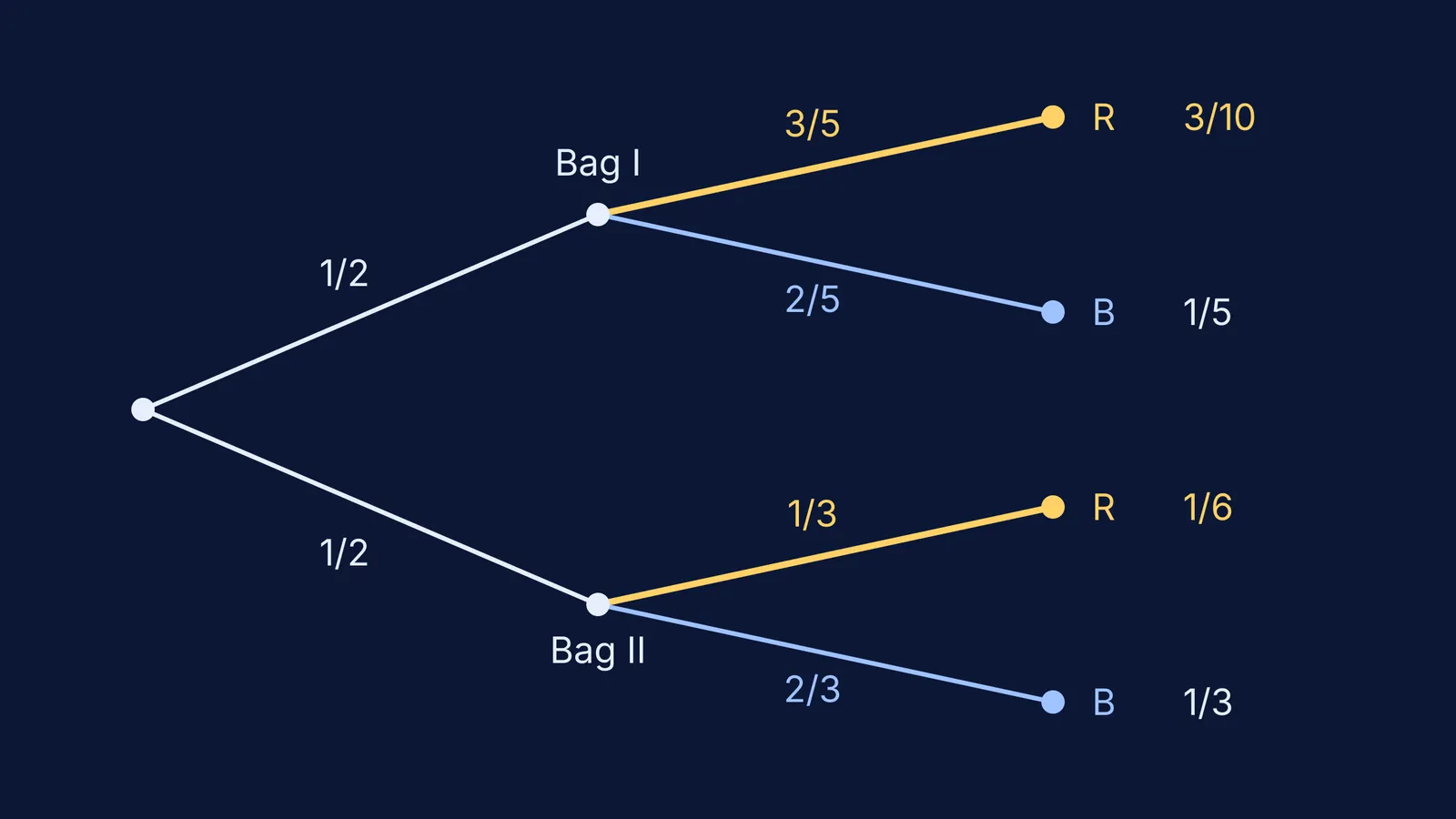
Q3. Bag I has 3 red and 2 black balls; Bag II has 2 red and 4 black. A fair coin picks the bag, and one ball is drawn. Which are true?
(A) P(red) = 7/15. True: (1/2)(3/5) + (1/2)(1/3).
(B) P(Bag I | red) = 9/14. True: (3/10) ÷ (7/15).
(C) P(Bag II | red) = 5/14. True: 1 − 9/14.
(D) P(Bag I | black) = 3/8. True: (1/5) ÷ (8/15).
Answer: A, B, C, D. Doubting that all four can be right and dropping one earns +3, not +4.
Q4. A fair coin is tossed 6 times; X is the number of heads. Which are true?
(A) Var(X) = 3. False: npq = 6 × 1/2 × 1/2 = 1.5.
(B) P(X = 3) = 5/16. True: 20/64.
(C) P(X ≥ 1) = 63/64. True: 1 − (1/2)⁶.
(D) P(X is even) = 1/2. True: C(6,0) + C(6,2) + C(6,4) + C(6,6) = 32, and 32/64 = 1/2.
Answer: B, C, D. Ticking A, the mean in place of the variance, is the costly slip.
Q5. X takes the values 0, 1, 2, 3 with probabilities k, 2k, 3k, 4k. Which are true?
(A) k = 1/10. True: 10k = 1.
(B) E(X) = 2. True: (0 + 2 + 6 + 12)/10.
(C) Var(X) = 1. True: E(X²) = 5, and 5 − 2² = 1.
(D) P(X > 1) = 0.3. False: that is P(X ≤ 1); P(X > 1) = 0.7.
Answer: A, B, C. Stopping at E(X²) = 5 and forgetting to subtract E(X)² is how C gets missed.
Q6. Two fair dice are thrown. E: the sum is 7. F: the first die shows 4. G: the sum is 8. Which are true?
(A) E and F are independent. True: (1/6)(1/6) = 1/36 = P(E ∩ F).
(B) F and G are independent. False: P(F ∩ G) = 1/36, but (1/6)(5/36) = 5/216.
(C) P(E | F) = 1/6. True: only (4, 3) works out of six.
(D) E and G are mutually exclusive. True: a sum cannot be 7 and 8.
Answer: A, C, D. A is easy to miss because dependence looks likely, and B is easy to tick by analogy with A.
Q7. A and B throw a fair die in turn, A first; the first to throw a six wins. Which are true?
(A) P(A wins) = 6/11. True: (1/6) ÷ (1 − 25/36).
(B) P(B wins) = 1/2. False: it is 5/11.
(C) P(the game ends on the third throw) = 25/216. True: (5/6)²(1/6).
(D) P(B wins on B's first throw) = 1/6. False: A must miss first, so it is 5/36.
Answer: A, C. D is the wrong tick; the same series appears in our post on why the first player wins 6/11.
Q8. A family has two children, each equally likely to be a boy or a girl. Which are true?
(A) P(both boys | at least one boy) = 1/3. True: BB out of BB, BG, GB.
(B) P(both boys | the elder is a boy) = 1/3. False: it is 1/2.
(C) P(at least one boy) = 1/2. False: it is 3/4.
(D) P(exactly one boy | at least one boy) = 1/3. False: it is 2/3.
Answer: A only. A multiple-correct question can have one correct option. B, which changes the condition, is the tempting wrong tick.
What should you do with options you cannot settle?
Mark each option T, F or ? before ticking anything.
Tick every T. Never tick a ?.
With one sure T and the rest unsure, tick it alone: it earns +1, or +4 if it is the only correct option.
Leave the question blank if you have no sure T; a guess risks −2.
For fully worked solutions, try the probability JEE Advanced practice questions, then the JEE Advanced numerical answer questions on probability. If one kind of option keeps fooling you, the Fermi Problem Library has a step-by-step solver that explains the reasoning. For the rest of your JEE Main and Advanced preparation, start at Fermi Test Prep.