On this page
A paragraph question gives you one setup, usually one curve and one special point, then asks two or three questions about it. The three original paragraphs below stay inside what the official JEE Advanced 2026 syllabus lists for conics: standard forms, foci, directrices, eccentricity, parametric equations, tangents and normals.
How do you solve a parabola paragraph with tangent and normal?
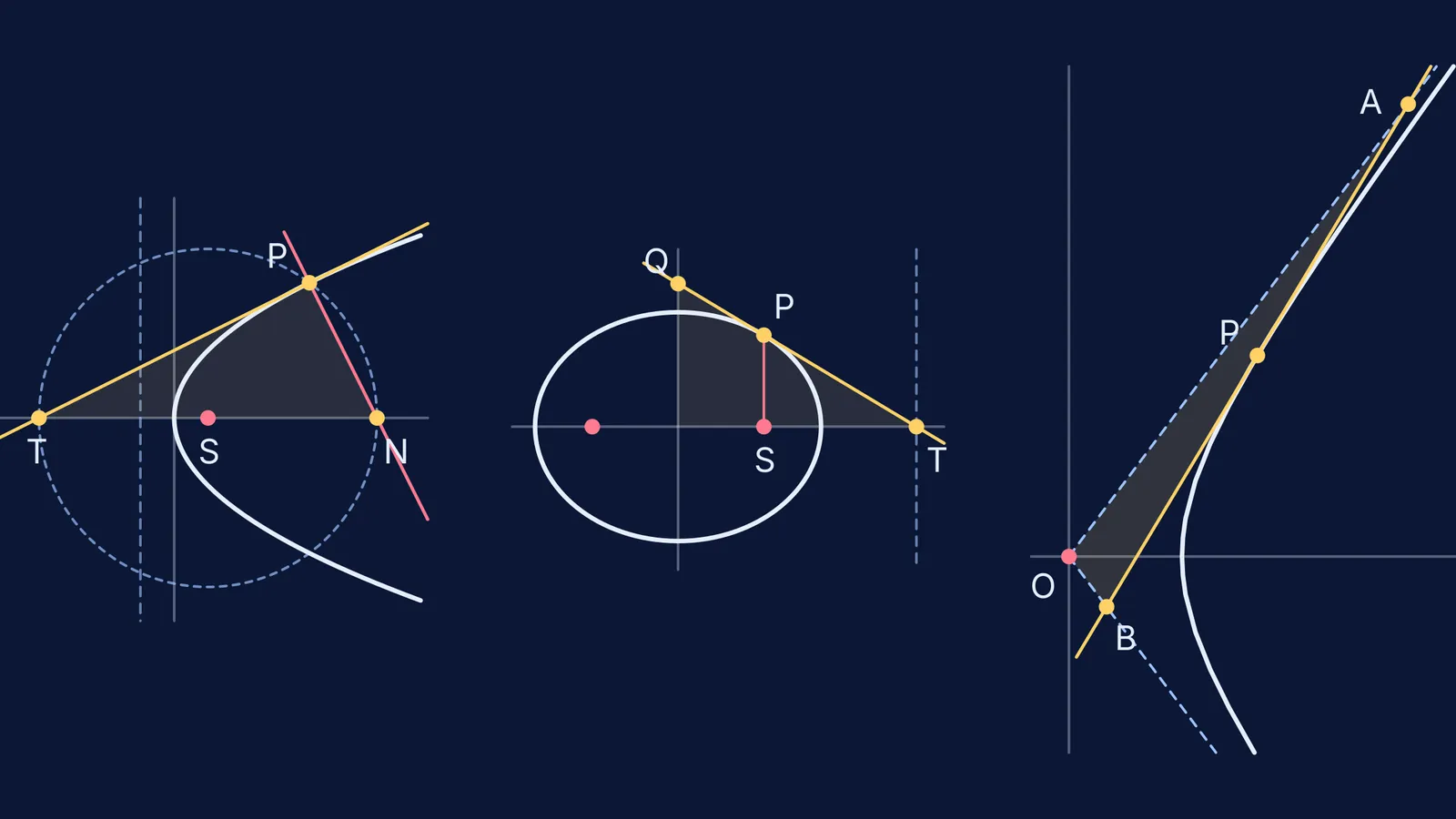
Paragraph 1. The point P(4, 4) lies on the parabola y² = 4x. The tangent at P meets the x-axis at T, and the normal at P meets the x-axis at N. S is the focus.
Q1. SP equals: (A) 4 (B) 5 (C) 6 (D) 8
Here a = 1, so S = (1, 0). The focal distance of a point on y² = 4ax is x + a = 4 + 1 = 5. Answer: (B).
Q2. The area of triangle PTN is: (A) 16 (B) 20 (C) 32 (D) 40
With P = (t², 2t), t = 2. The tangent ty = x + t² gives T = (−4, 0); the normal y = −tx + 2t + t³ is y = −2x + 12, giving N = (6, 0). Base 10, height 4, area 20. Answer: (B). The tempting (C) uses the subtangent 8 instead of the subnormal 2 for N, giving N = (12, 0) and base 16.
Q3. The radius of the circle through P, T and N is: (A) 4 (B) 5 (C) 2√5 (D) 10
Tangent and normal are perpendicular, so angle TPN = 90° and TN is a diameter: radius 5, centre (1, 0) = S. So ST = SN = SP = 5, Q1's answer returning. Answer: (B). (D) is the diameter.
Where does the tangent at a latus rectum end of an ellipse meet the axis?
Paragraph 2. For the ellipse x²/25 + y²/16 = 1, P is the end of a latus rectum in the first quadrant. The tangent at P meets the x-axis at T and the y-axis at Q. O is the origin.
Q1. P is: (A) (3, 4) (B) (3, 16/5) (C) (4, 12/5) (D) (3, 12/5)
e² = 1 − 16/25 = 9/25, so e = 3/5 and the focus is (3, 0). The semi-latus rectum is b²/a = 16/5. Answer: (B). Option (C) is on the ellipse, but not above a focus.
Q2. T lies on: (A) x = 5 (B) x = 25/4 (C) x = 25/3 (D) x = 16/3
The tangent xx₁/25 + yy₁/16 = 1 becomes 3x/25 + y/5 = 1. At y = 0, x = 25/3 = a/e, the directrix. Answer: (C). The trap is (A), the vertex.
Q3. The area of triangle OTQ is: (A) 50/3 (B) 125/6 (C) 25/2 (D) 40/3
Put x = 0 in Q2's tangent: Q = (0, 5). Area = ½ × 25/3 × 5 = 125/6. Answer: (B). Option (A) assumes the tangent passes through (0, b) = (0, 4).
Why is the hyperbola's asymptote triangle area always ab?
Paragraph 3. The point P(5, 16/3) lies on the hyperbola x²/9 − y²/16 = 1. The tangent at P meets the asymptotes y = 4x/3 and y = −4x/3 at A and B. O is the origin.
Q1. P is: (A) a vertex (B) an end of a latus rectum (C) on a directrix (D) on an asymptote
e² = 1 + 16/9, so e = 5/3 and a focus is (5, 0). P sits above it at height b²/a = 16/3. Answer: (B).
Q2. A, on y = 4x/3, is: (A) (9, 12) (B) (6, 8) (C) (3, 4) (D) (12, 16)
The tangent is 5x/9 − (16/3)y/16 = 1, or 5x − 3y = 9. With y = 4x/3, A = (9, 12); with y = −4x/3, B = (1, −4/3). Check: AB's midpoint is P. Answer: (A).
Q3. The area of triangle OAB is: (A) 6 (B) 12 (C) 12.5 (D) 24
Area = ½ |9 × (−4/3) − 1 × 12| = 12 = ab, the same for a tangent at any point. Answer: (B). The trap is (C): OA = 15, OB = 5/3, and ½ × OA × OB wrongly treats the asymptotes as perpendicular, true only for a rectangular hyperbola.
How do you read a conic sections paragraph quickly?
Write every object the paragraph defines (P, T, N, Q) as coordinates before reading Q1.
Fix a, b, e, foci and directrices in one line; every question uses them.
Notice special points. Latus rectum ends and vertices are chosen because the numbers come out clean.
Expect the chain. If Q3 feels new, look back at Q1 and Q2.
If Q1 stalls, try Q2 from the paragraph alone.
Next, work through the conic sections JEE Advanced practice questions with solutions, then the conic sections numerical answer questions, where there are no options to check against. If you reach the right picture but the wrong method, the Fermi Problem Library has a step-by-step solver that explains the reasoning rather than printing an answer. For the rest of your JEE Main and Advanced preparation, start at Fermi Test Prep.