On this page
A paragraph question gives you one short passage and two or three questions built on it. In permutations and combinations they usually chain, so one slip can cost the whole set. Here are three original paragraphs, solved fully, with the tempting wrong option explained.
Question formats change from year to year, so check the paper pattern on the official JEE (Advanced) website, which currently announces JEE (Advanced) 2027 for 23 May 2027.
Paragraph 1: how many ways can the letters of SUCCESS be arranged?
Passage. Consider all arrangements of the seven letters of the word SUCCESS, which has three S, two C, one U and one E.
Q1. How many distinct arrangements are there? (A) 5040 (B) 840 (C) 420 (D) 210
Divide 7! by the repeats: 7!/(3! × 2!) = 5040/12 = 420, option (C). The trap is 840, which divides by 3! for the S and forgets the two C.
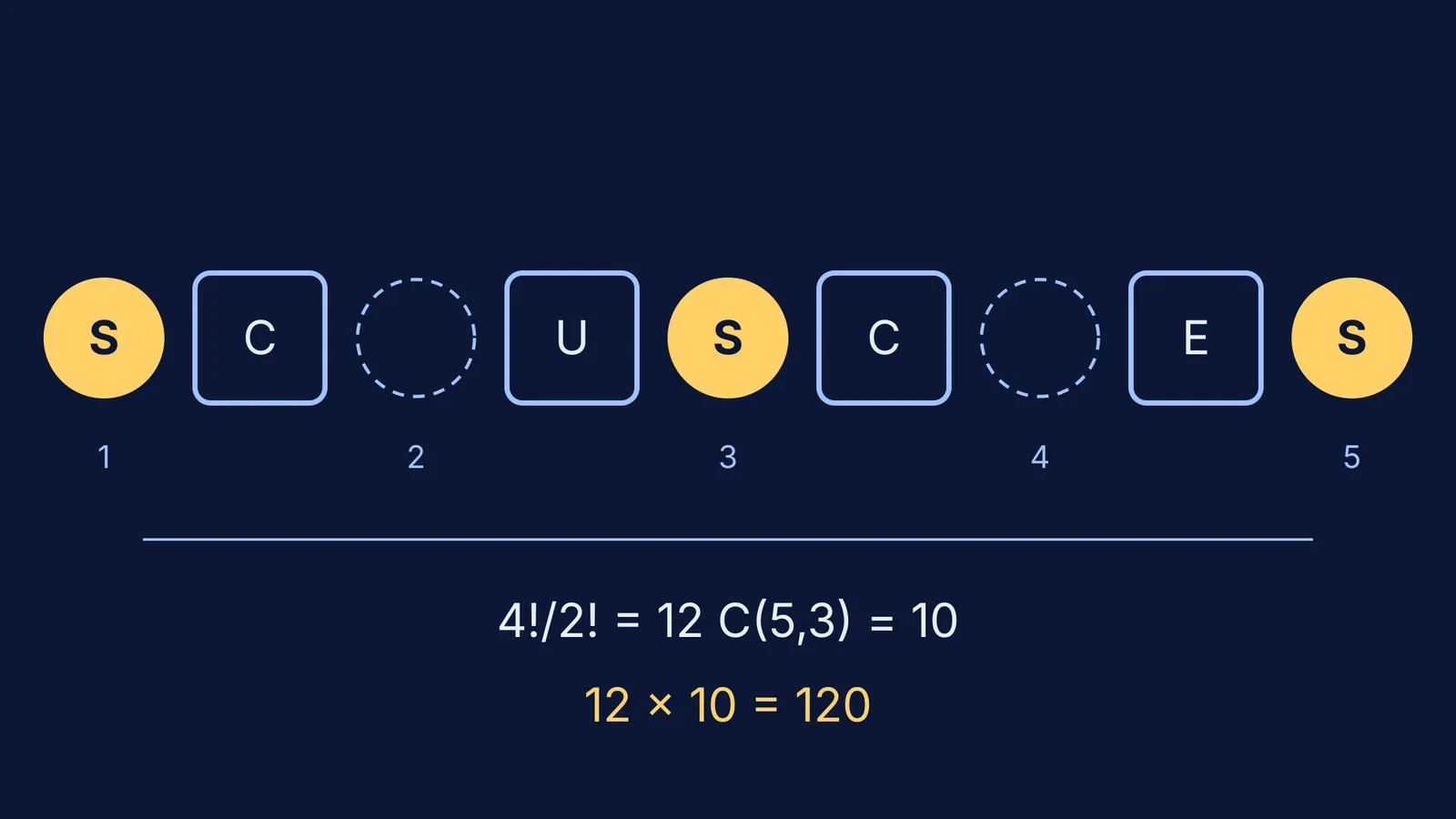
Q2. In how many arrangements are no two S adjacent? (A) 360 (B) 120 (C) 60 (D) 240
Arrange the other four letters first: C, U, C, E give 4!/2! = 12 orders. They leave five gaps (two ends and three between), and the three S must go in three different gaps: C(5,3) = 10. So 12 × 10 = 120, option (B). The trap is 360 = 420 − 60, which removes only the arrangements with all three S together (treat SSS as one block: 5!/2! = 60) and forgets those with exactly two S side by side.
Q3. In how many arrangements is at least one pair of S adjacent? Use Q1 and Q2 together: 420 − 120 = 300.
Paragraph 2: how many committees have at least two women?
Passage. A committee of 5 is chosen from 6 men and 4 women.
Q1. How many committees have exactly 2 women? C(4,2) × C(6,3) = 6 × 20 = 120.
Q2. How many have at least 2 women? (A) 336 (B) 186 (C) 192 (D) 252
Add the cases: 2 women gives 120 (from Q1), 3 women gives C(4,3) × C(6,2) = 60, 4 women gives C(4,4) × C(6,1) = 6. Total 186, option (B). Check with the complement: C(10,5) − C(6,5) − C(4,1) × C(6,4) = 252 − 6 − 60 = 186. The trap is 336 = C(4,2) × C(8,3): pick two women, then any three from the rest. It counts a 3-woman committee three times and a 4-woman committee six times (120 + 3 × 60 + 6 × 6 = 336).
Q3. Each committee then names a woman as chair. How many (committee, chair) pairs are there? Weight each case from Q2 by its number of women: 2 × 120 + 3 × 60 + 4 × 6 = 444. The trap is 186 × 4 = 744, which assumes every committee has four women to choose from.
Paragraph 3: what is a derangement, and how many are there?
Passage. A derangement is an arrangement in which no object is in its own place; write D(n) for the number of derangements of n objects. D(1) = 0, D(2) = 1 and D(n) = (n − 1)(D(n − 1) + D(n − 2)). Five letters are put into five addressed envelopes, one per envelope.
Q1. In how many ways does no letter reach its own envelope? D(3) = 2(1 + 0) = 2, D(4) = 3(2 + 1) = 9, D(5) = 4(9 + 2) = 44. These values match the derangement sequence in the OEIS entry A000166, which lists the same recurrence.
Q2. In how many ways are exactly two letters in the right envelopes? (A) 60 (B) 20 (C) 10 (D) 40
Choose the two correct letters, C(5,2) = 10, then derange the other three, D(3) = 2: 10 × 2 = 20, option (B). The trap is 60 = 10 × 3!, which lets the other three go anywhere and so counts cases with more than two correct.
Q3. In how many ways is at most one letter correct? None correct is 44 (Q1); exactly one is C(5,1) × D(4) = 5 × 9 = 45. Total 89.
How do you read a paragraph quickly and pull out what it defines?
Mark every defined term first: D(n), "distinct", "identical", "at least". The passage is naming your tool.
Read all the questions before solving Q1, so you see which answer feeds which.
Write case splits, not only totals; later questions often weight or restrict them.
Check each answer two ways, by complement or by adding all cases to the full count.
Treat a fast match with an option as a warning: trap options answer a nearby wrong reading.
Next, work through the Permutations and combinations JEE Advanced practice set with solutions, the numerical-answer questions on this chapter and the JEE Advanced preparation plan for permutations and combinations.
If you are preparing for JEE, Fermi Test Prep is our JEE Main and Advanced preparation. When a method keeps giving the trap answer, the Fermi Problem Library has a step-by-step solver that explains the reasoning rather than printing an answer.