

On this page
Eight new counting questions with no options to lean on. Each answer is a non-negative integer or a decimal rounded to two places, so you cannot work backwards from choices. Every solution gives the exact value, what to enter, a quick check, and the step where most students lose the mark.
What does JEE Advanced test in permutations and combinations?
The official JEE (Advanced) 2026 syllabus lists permutations and combinations under Algebra. Its Probability section adds the computation of probability of events using permutations and combinations, which is why Q6 and Q8 below are probabilities. For options-based practice on the same chapter, try our eight JEE Advanced permutations and combinations questions with solutions.
How should you attempt numerical-answer questions?
Cover the solutions and time yourself.
Before counting, write down whether the objects and places are identical or distinct, and whether order matters.
Keep the exact fraction until the last line, then round once.
Check every answer with a second method or a small case.
Easy to medium: can you count without options?
Q1. In how many arrangements of the letters of ASSASSIN are no two S's next to each other?
Arrange A, A, I, N first: 4!/2! = 12 ways. They leave 5 gaps; put the four S's in 4 of them: C(5, 4) = 5. Exact: 60. Enter 60. Check: choosing 4 non-adjacent positions out of 8 gives C(8 − 4 + 1, 4) = 5, and 5 × 12 = 60. Where the mark goes: using 4! for A, A, I, N and entering 120.
Q2. A committee of 5 is chosen from 6 men and 4 women. Let x be the number of committees with at least 2 women and y the number with exactly 2 women. Find x/y.
y = C(4, 2) × C(6, 3) = 120. Three women: 4 × 15 = 60; four women: 1 × 6 = 6. So x = 186 and x/y = 1.55. Exact: 31/20. Enter 1.55. Check: C(10, 5) = 252, minus 6 committees with no woman and 60 with one, leaves 186. Where the mark goes: picking 2 women first and then any 3 of the other 8, which counts some committees more than once.
Q3. How many ordered triples (a, b, c) of positive integers satisfy abc = 1800?
1800 = 2³ × 3² × 5². Each prime's exponent is shared among a, b, c on its own, by stars and bars: C(5, 2) = 10 for the 2's, C(4, 2) = 6 for the 3's and 6 for the 5's. Exact: 360. Enter 360. Check: for abc = 8 the same method gives 10, and listing (1, 1, 8), (1, 2, 4), (2, 2, 2) with their orders gives 3 + 6 + 1 = 10. Where the mark goes: treating the triples as unordered.
Q4. Fifteen identical sweets are shared among 4 children so that no child gets more than 6. In how many ways?
Without the cap: C(18, 3) = 816. Remove cases where a child gets 7 or more: 4 × C(11, 3) = 660. Add back two such children: 6 × C(4, 3) = 24. Exact: 180. Enter 180. Check: three children over 6 would need 21 sweets, so the series stops there. Where the mark goes: forgetting the add-back and entering 156.
Medium to hard: what changes when two ideas meet?
Q5. Five boys and five girls sit at a round table, boys and girls alternating. In how many arrangements are boy B₁ and girl G₁ not next to each other?
Fix B₁'s seat. The other boys fill their seats in 4! ways and the girls theirs in 5! ways: 2880. G₁ beside B₁: 2 seats × 4! × 4! = 1152. Exact: 1728. Enter 1728. Check: G₁ has 5 girl seats, 3 of them away from B₁, and 3/5 × 2880 = 1728. Where the mark goes: using 5! for the boys, as if a round table had a first seat.
Q6. Seven students hand in their phones before an exam and get them back at random. Find the probability that exactly two get their own phone.
Choose the two: C(7, 2) = 21. The other five must all be wrong, a derangement: D₅ = 44. Probability = 924/5040. Exact: 11/60 = 0.1833… Enter 0.18. Check: D₅ = 5!(1/2 − 1/6 + 1/24 − 1/120) = 60 − 20 + 5 − 1 = 44. Where the mark goes: letting the other five land anywhere, which gives 21 × 120/5040 = 0.5.
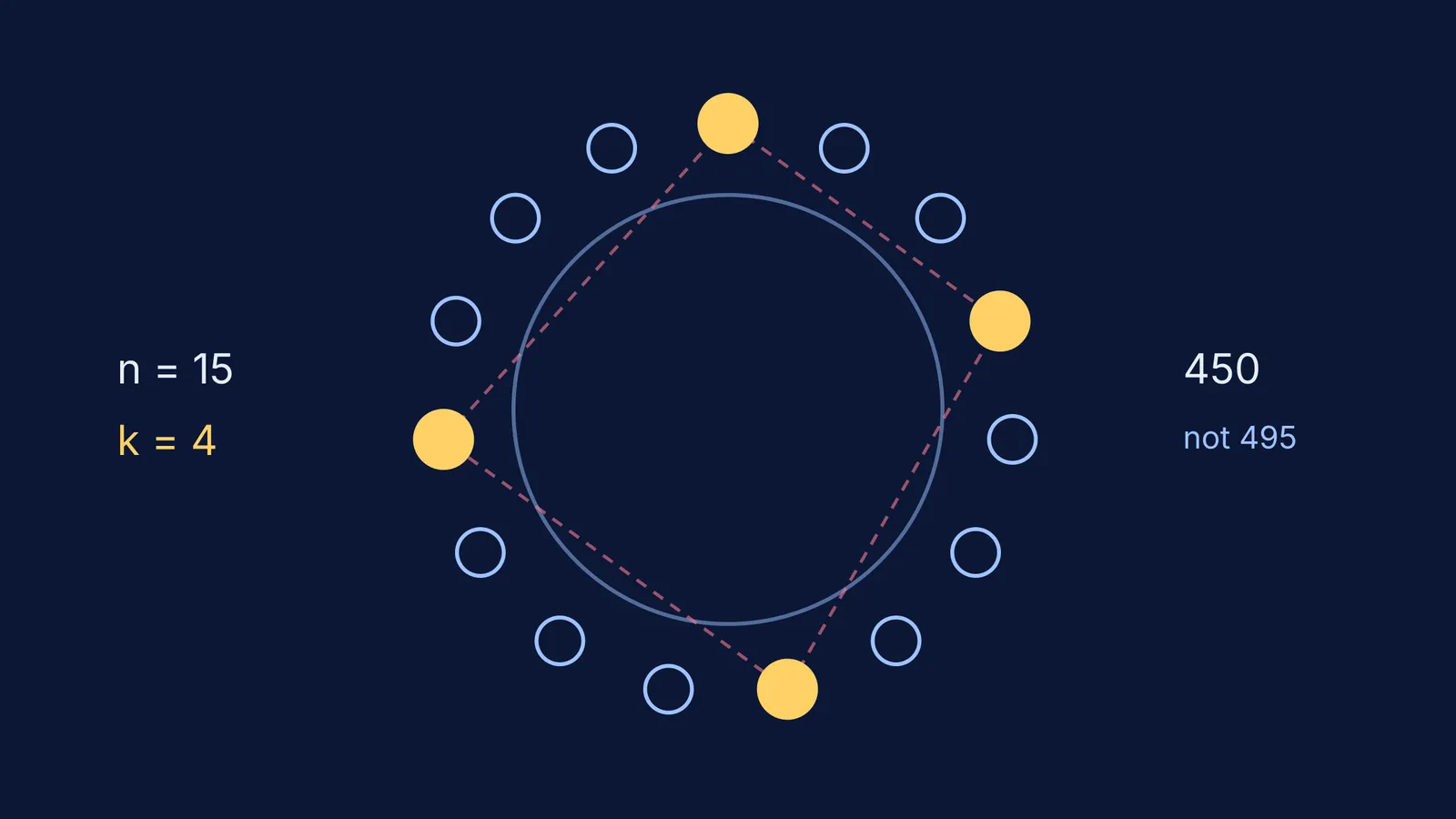
Q7. Four people pick seats at a round table of 15 seats so that no two sit next to each other. How many sets of 4 seats are possible?
Split on seat 1. If it is taken, seats 2 and 15 are blocked and 3 seats come from the row 3 to 14 with no two adjacent: C(10, 3) = 120. If not, 4 seats come from the row 2 to 15: C(11, 4) = 330. Exact: 450. Enter 450. Check: the circular formula n/(n − k) × C(n − k, k) = 15/11 × 330 = 450. Where the mark goes: using the straight-row answer C(12, 4) = 495, which lets seats 1 and 15 both be taken.
Q8. Six different books are each placed on one of four shelves, at random and independently. Find the probability that no shelf is empty.
All placements: 4⁶ = 4096. Inclusion-exclusion: 4096 − 4 × 3⁶ + 6 × 2⁶ − 4 × 1⁶ = 4096 − 2916 + 384 − 4 = 1560. Exact: 195/512 = 0.3808… Enter 0.38. Check: 1560 = 4! × 65, and 65 is the number of ways to split six books into four non-empty groups. Where the mark goes: stopping after two terms, which gives 0.29.
How did you do?
7 or 8 right: try the JEE Main numerical value questions on permutations and combinations against the clock.
4 to 6: redo each miss later in the week, using the check as a second method.
3 or fewer: go back to the Class 11 permutations and combinations formulas, then rework Q1, Q3 and Q4.
Preparing for JEE Main and Advanced? Start from Fermi Test Prep. If a count keeps coming out double, the Fermi Problem Library has worked problems with a step-by-step solver that explains the reasoning rather than printing an answer.


