On this page
Eight new JEE Advanced-style counting questions, easy to hard. Every option was checked in Python, and each solution names the trap: the wrong answer that looks most right.
What does JEE Advanced ask from permutations and combinations?
The official JEE (Advanced) 2026 syllabus lists "permutations and combinations" under Algebra, and its Probability section adds computing probabilities using permutations and combinations. For the theory, read our guide on how to prepare permutations and combinations for JEE Advanced.
How should you use this set?
Hide the solutions; allow 3 minutes per easy question, 6 per hard one.
First decide whether objects and boxes are identical or distinct.
In one-or-more-correct questions, judge every option on its own.
Redo each miss after three days.
New to these formats? See JEE Advanced question types.
Easy: can you turn the words into a count?
Q1 (easy, single correct). N = 2⁵ × 3⁴ × 7². How many positive divisors of N are multiples of 12?
(A) 36
(B) 48
(C) 60
(D) 90
Answer: (B). For 2ᵃ3ᵇ7ᶜ to be a multiple of 12, a runs 2 to 5, b runs 1 to 4 and c runs 0 to 2: 4 × 4 × 3 = 48. Trap: (C) lets a start at 1, counting multiples of 6.
Q2 (easy, single correct). How many six-digit numbers have digits that never increase from left to right (for example 997530)?
(A) 210
(B) 5004
(C) 5005
(D) 3003
Answer: (B). Each choice of six digits, repetition allowed, has exactly one non-increasing order: C(15, 6) = 5005 multisets. Only 000000 fails to be a six-digit number, since the first digit is the largest: 5004. Trap: (C) keeps 000000; (A) is C(10, 6), strictly decreasing digits only.
Q3 (easy, numerical value). Three vertices of a regular 11-sided polygon are chosen to form a triangle. In how many ways can this be done so that no side of the triangle is a side of the polygon? ____
Answer: 77. All triangles: C(11, 3) = 165. Two polygon sides (three consecutive vertices): 11. Exactly one side: 11 sides × 7 third vertices not next to either end = 77. So 165 − 11 − 77 = 77. Trap: 154 removes only the 11 triangles with two polygon sides.
Medium: when do you divide, and when do you subtract?
Q4 (medium, one or more options correct). Consider all arrangements of the letters of MARATHAS. Which statements are true?
(A) There are 6720 arrangements in all.
(B) In 4320 arrangements the three A's are together.
(C) In 2400 arrangements no two A's are next to each other.
(D) In 1120 arrangements M, R and T appear in that order.
Answer: (A), (C), (D). Three A's and five different letters: 8!/3! = 6720. A's glued together: 6! = 720, so (B) is false. For (C), arrange the other five letters (120 ways) and drop the A's into 3 of the 6 gaps: 120 × C(6, 3) = 2400. For (D), the 3! orders of M, R, T are equally common: 6720/6 = 1120. Trap: (B) multiplies by 3! as if the A's were different.
Q5 (medium, single correct). Seven letters are put at random into seven envelopes addressed to their seven different recipients, one letter per envelope. In how many ways do exactly three letters reach the right envelope?
(A) 840
(B) 315
(C) 1854
(D) 70
Answer: (B). Choose the three correct letters, C(7, 3) = 35; the other four must all be wrong, a derangement: 4!(1/2 − 1/6 + 1/24) = 9. Total 315. Trap: (A) is C(7, 3) × 4!, allowing extra correct letters.
Hard: can you hold several ideas at once?
Q6 (hard, numerical value). How many ordered pairs (a, b) of positive integers have lcm(a, b) = 7200? ____
Answer: 275. 7200 = 2⁵ × 3² × 5², and each prime acts alone: for exponent e, the exponent pair needs maximum exactly e: (e + 1)² − e² = 2e + 1 choices. So 11 × 5 × 5 = 275. Trap: 138 counts unordered pairs.
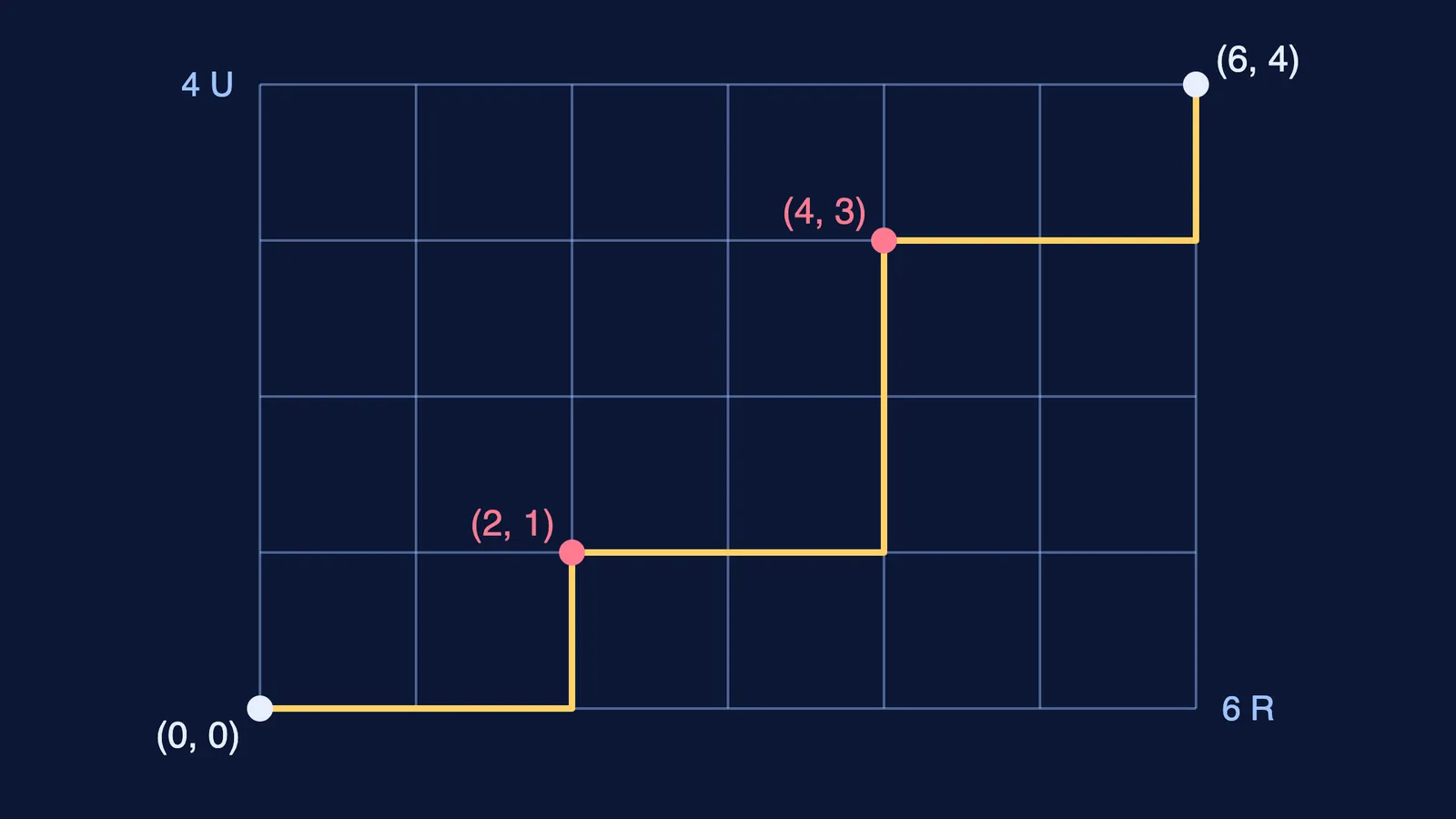
Q7 (hard, one or more options correct). Paths go from (0, 0) to (6, 4) by unit steps right (R) or up (U). Which statements are true?
(A) There are 210 such paths.
(B) Exactly 100 paths pass through (3, 2).
(C) Exactly 156 paths pass through (2, 1) or (4, 3).
(D) Exactly 70 paths start with R and end with U.
Answer: (A), (B), (C). A path is a word of 6 R's and 4 U's: C(10, 4) = 210. Through (3, 2): C(5, 2)² = 100. Through (2, 1): 3 × 35 = 105; through (4, 3): 35 × 3 = 105; through both: 3 × 6 × 3 = 54; so 105 + 105 − 54 = 156. For (D), the middle runs from (1, 0) to (6, 3): C(8, 3) = 56. Trap: 70 is C(8, 4), paths that start and end with R.
Q8 (hard, list match). Six balls go into three boxes, none left empty. Match List-I with List-II.
List-I: (P) distinct balls, distinct boxes; (Q) distinct balls, identical boxes; (R) identical balls, distinct boxes; (S) identical balls, identical boxes
List-II: (1) 3, (2) 10, (3) 90, (4) 540, (5) 729
(A) P→4, Q→3, R→2, S→1
(B) P→5, Q→3, R→2, S→1
(C) P→4, Q→3, R→1, S→2
(D) P→4, Q→4, R→2, S→1
Answer: (A). (P) Inclusion-exclusion: 3⁶ − 3 × 2⁶ + 3 = 540. (Q) With no empty box, each split appears 3! times in (P): 540/6 = 90. (R) Stars and bars: C(5, 2) = 10. (S) Only 4+1+1, 3+2+1 and 2+2+2: 3. Trap: (B) uses 3⁶ = 729, allowing empty boxes.
How did you do?
Score a one-or-more-correct question only if you chose every true option and nothing else.
7 or 8: move on to probability and statistics for JEE Advanced.
4 to 6: redo misses against a small case listed by hand.
3 or fewer: revise identical versus distinct objects and the gap method.
Count keeps coming out double? The Fermi Problem Library has worked problems with a step-by-step solver that explains the reasoning rather than printing an answer.