On this page
Eight original questions on lines, triangle centres and circles, each option judged on its own and the usual trap named.
How does partial marking work in JEE Advanced multiple-correct questions?
In JEE (Advanced) 2026 Paper 2, Section 2 had five questions where one or more than one of four options was correct. The scheme printed on the paper:
+4 if exactly the correct options are chosen
+3 if all four options are correct but only three are chosen
+2 if three or more are correct and only two are chosen, both correct
+1 if two or more are correct and only one is chosen, and it is correct
0 if unanswered
−1 in all other cases, which means any wrong tick
The official JEE (Advanced) site says JEE (Advanced) 2027 will be held on May 23, 2027. The pattern can change between years, so read the instructions on your own paper.
Can you solve these eight straight lines and circles questions?
Q1. The line 3x + 4y = 12
(A) its distance from the origin is 12/5 (B) it cuts off area 12 with the axes (C) the reflection of the origin in it is (72/25, 96/25) (D) (1, 1) and (2, 2) lie on opposite sides of it
(A) True: |−12|/5.
(B) False: intercepts 4 and 3 give ½ × 12 = 6.
(C) True: the foot is (36/25, 48/25); the image is twice that.
(D) True: 3 + 4 − 12 < 0 but 6 + 8 − 12 > 0.
Answer: A, C, D. The trap is (B), forgetting the half.
Q2. The family (x + y − 4) + λ(2x − y + 1) = 0
(A) every member passes through (1, 3) (B) the member through the origin has λ = 4 (C) λ = 1 gives a line parallel to the x-axis (D) the member farthest from the origin is x + 3y = 10
(A) True: x + y = 4 and 2x − y = −1 meet at (1, 3).
(B) True: −4 + λ = 0.
(C) False: λ = 1 gives 3x − 3 = 0, which is x = 1, parallel to the y-axis.
(D) True: it is perpendicular to the segment from O to (1, 3), and λ = −2/7 gives it.
Answer: A, B, D. The trap is (C): no y-term means a vertical line.
Q3. Triangle with vertices (0, 0), (6, 0), (0, 8)
(A) the circumcentre is (3, 4) (B) the orthocentre is (0, 0) (C) the incentre is (2, 2) (D) the circumcentre and incentre are √5 apart
(A) True: the midpoint of the hypotenuse.
(B) True: the right-angled vertex.
(C) True: r = (6 + 8 − 10)/2 = 2.
(D) True: (3, 4) to (2, 2) is √(1 + 4); Euler's OI² = R² − 2Rr = 25 − 20 agrees.
Answer: all four. Stopping at three to be safe earns +3, not +4.
Q4. Circle x² + y² − 6x + 8y = 0
(A) its centre is (−3, 4) (B) the tangent at the origin is 3x − 4y = 0 (C) it cuts a chord of length 6 on the x-axis (D) the tangent from (5, 5) has length 2√15
(A) False: the centre is (−g, −f) = (3, −4).
(B) True: T = 0 at (0, 0) gives −3x + 4y = 0.
(C) True: x² − 6x = 0 gives x = 0 and 6.
(D) True: S(5, 5) = 60, and the length is √60.
Answer: B, C, D. Ticking (A), a sign slip, costs the whole question.
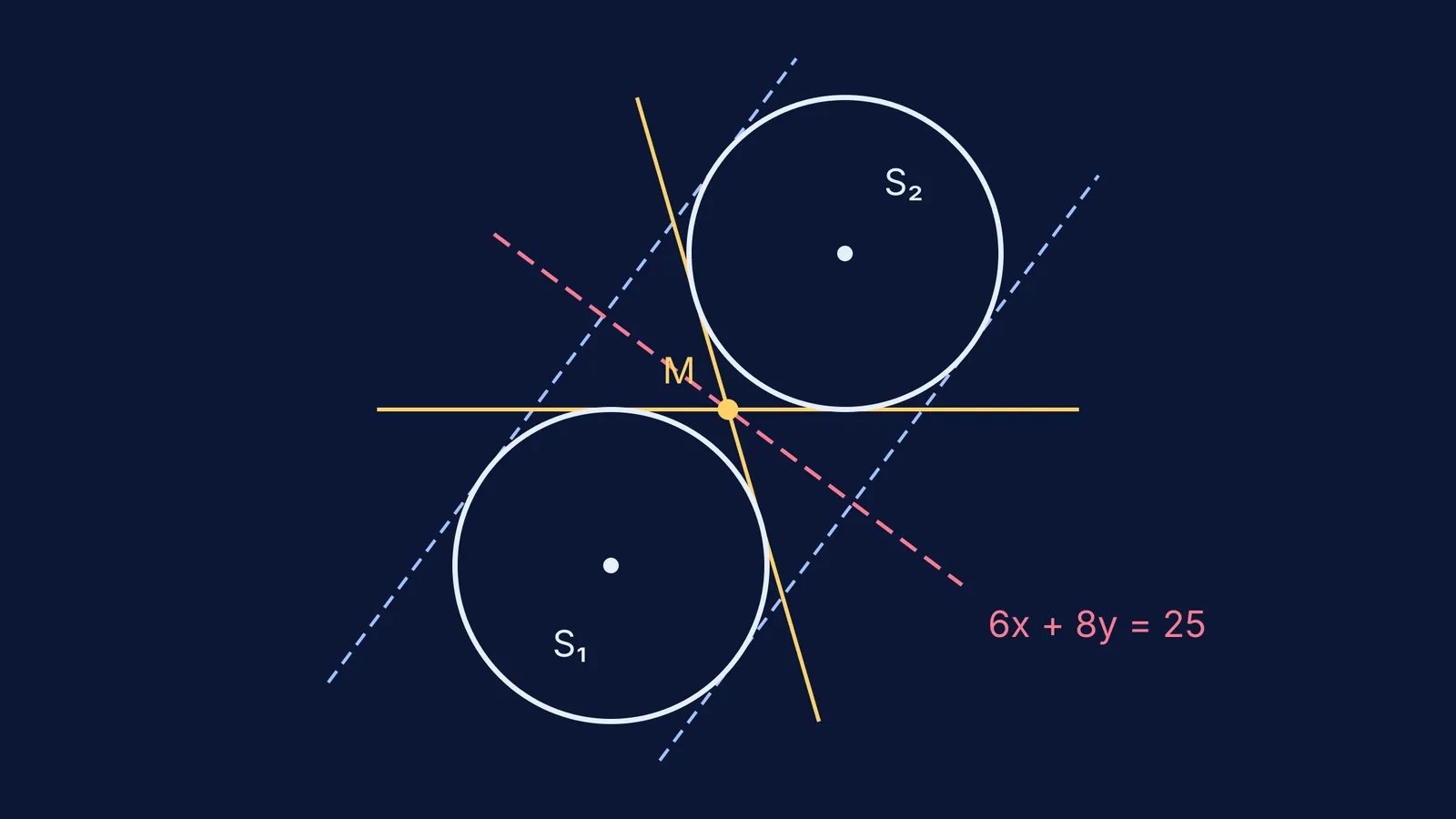
Q5. Circles x² + y² = 4 and x² + y² − 6x − 8y + 21 = 0
(A) they have exactly four common tangents (B) the radical axis is 6x + 8y = 25 (C) the transverse common tangents meet at (3/2, 2) (D) the direct common tangents meet at (−3/2, −2)
(A) True: both radii are 2 and the centres are 5 apart, more than 2 + 2.
(B) True: S₁ − S₂ = 0.
(C) True: equal radii put that point at the midpoint of the centres.
(D) False: with equal radii the direct tangents are parallel and never meet.
Answer: A, B, C. The trap is (D), applying the external-division formula with ratio 1 : 1.
Q6. Circle x² + y² − 4x − 6y + 9 = 0
(A) it touches the y-axis (B) it touches the x-axis (C) it cuts x² + y² = 9 orthogonally (D) the tangent from the origin has length 9
(A) True: centre (2, 3), radius 2, and the centre is 2 from the y-axis.
(B) False: the centre is 3 from the x-axis.
(C) True: 2g₁g₂ + 2f₁f₂ = 0 = c₁ + c₂ = 9 − 9.
(D) False: the length is √9 = 3.
Answer: A, C. The easy one to skip is (C), which needs the orthogonality test written out.
Q7. Circle x² + y² = 25 and line y = x + 1
(A) the chord has length 7√2 (B) its midpoint is (1/2, −1/2) (C) it subtends a right angle at the centre (D) the tangents at its ends meet at (25, −25)
(A) True: the line is 1/√2 from O, so 2√(25 − 1/2) = 7√2.
(B) False: the foot from O is (−1/2, 1/2).
(C) False: that needs a distance of 5/√2.
(D) False: the pole of −x + y = 1 is (−25, 25).
Answer: A only. One or more includes one.
Q8. Lines 3x − 4y + 7 = 0 and 12x + 5y − 2 = 0
(A) 11x − 3y + 9 = 0 bisects the angle containing the origin (B) 21x + 77y − 101 = 0 is a bisector (C) the origin lies in the obtuse angle (D) the two bisectors are perpendicular
(A) True: with both constants made positive, take the + sign in (3x − 4y + 7)/5 = ±(−12x − 5y + 2)/13.
(B) True: the − sign.
(C) False: with c₁, c₂ > 0, a₁a₂ + b₁b₂ = −36 + 20 < 0, so the origin is in the acute angle.
(D) True: 11 × 21 − 3 × 77 = 0.
Answer: A, B, D. The trap is (C), the sign rule remembered backwards.
Which traps cost marks in multiple-correct questions?
Across these eight, marks leak in three ways:
A sign, a half or a square root lost (Q1, Q4, Q6, Q7).
A rule used where it does not apply (Q2, Q5, Q8).
Nerve: stopping at three of four (Q3) or doubting a single answer (Q7).
Under the 2026 scheme, one wrong tick scores −1 however many correct options sit beside it: in Q1, ticking A, C and D earns +4, but adding B drops it to −1.
What should you practise next?
Work through the straight lines and circles JEE Advanced practice questions with solutions, then the eight straight lines and circles numerical answer questions. Then try the conic sections multiple-correct questions.
If an option fails and you cannot see why, the Fermi Problem Library has a step-by-step solver that explains the reasoning. For the rest of your JEE preparation, Fermi Test Prep covers JEE Main and Advanced.