On this page
Eight JEE Advanced-style questions, easy to hard, with every option checked. Each solution ends with the trap: the wrong option that looks most right.
What does JEE Advanced ask from straight lines and circles?
The official JEE (Advanced) 2026 syllabus adds angle bisectors, the incentre, families of lines and circles, and equations of chords and normals to the JEE Main list. For the theory, read our guide on how to prepare straight lines and circles for JEE Advanced.
How should you use this set?
Hide the solutions; allow 3 to 6 minutes per question.
In multiple-correct questions, judge each option alone.
Redo each miss in three days.
New to these formats? See JEE Advanced question types.
Easy: incentre, chords and families of lines
Q1 (easy, single correct). The incentre of the triangle A(1, 1), B(7, 1), C(1, 9) is
(A) (3, 13/3) (B) (3, 3) (C) (3, 11/3) (D) (4, 5)
Answer: (B). With a = 10, b = 8, c = 6, the incentre is (aA + bB + cC)/24 = (3, 3). Trap: (A) swaps the weights on A and C; (C) is the centroid, (D) the circumcentre.
Q2 (easy, single correct). The chord of x² + y² − 6x + 2y − 15 = 0 with midpoint (4, 1) lies on
(A) 2x − y − 7 = 0 (B) x + 2y − 1 = 0 (C) x + 2y − 6 = 0 (D) x = 4
Answer: (C). The centre is (3, −1), so the chord is perpendicular to direction (1, 2) through (4, 1); T = S₁ agrees. Trap: (A) runs along the radius; (D) takes the centre as (−3, 1).
Q3 (easy, numerical value). A line through the intersection of x − 2y + 3 = 0 and 2x + y − 4 = 0 is perpendicular to 3x − y = 0. The sum of its axis intercepts, to two decimals, is ____.
Answer: 9.33. They meet at (1, 2); slope −1/3 gives x + 3y − 7 = 0, intercepts 7 and 7/3. Trap: −0.67 comes from slope 3, the parallel line.
Medium: bisectors, families of circles and tangents
Q4 (medium, one or more options correct). For L₁: 3x + 4y − 10 = 0 and L₂: 4x + 3y − 4 = 0, which are true?
(A) The bisector of the angle containing the origin is x − y + 6 = 0.
(B) x − y + 6 = 0 bisects the acute angle.
(C) L₁ and L₂ meet at (−2, 4).
(D) The origin lies in the acute angle.
Answer: (A), (C). At the origin L₁ and L₂ are both negative, so its bisector is L₁/5 = L₂/5: x − y + 6 = 0. With constants made positive, a₁a₂ + b₁b₂ = 24 > 0, so the origin sits in the obtuse angle; the acute bisector is x + y − 2 = 0. Trap: (B) and (D) assume the origin's angle is acute.
Q5 (medium, single correct). A circle through the intersections of x + y − 1 = 0 and x² + y² − 2x − 4y − 20 = 0 has its centre on the y-axis. It is
(A) x² + y² + 2x − 24 = 0 (B) x² + y² − 2y − 18 = 0 (C) x² + y² − 4x − 6y − 18 = 0 (D) x² + y² − 2y − 22 = 0
Answer: (D). S + λL = 0 gives x² + y² + (λ − 2)x + (λ − 4)y − 20 − λ = 0; centre on the y-axis needs λ = 2. Trap: (B) writes the constant as −20 + λ; (A) is λ = 4.
Q6 (medium, numerical value). Tangents PA, PB from P(5, 5) touch x² + y² − 4x − 2y − 4 = 0. The area of triangle PAB is ____.
Answer: 7.68. Centre (2, 1), r = 3, tangent length L = √S₁ = 4. Area = rL³/(r² + L²) = 192/25. Trap: 12 is the kite CAPB.
Hard: chords through a point and two circles at once
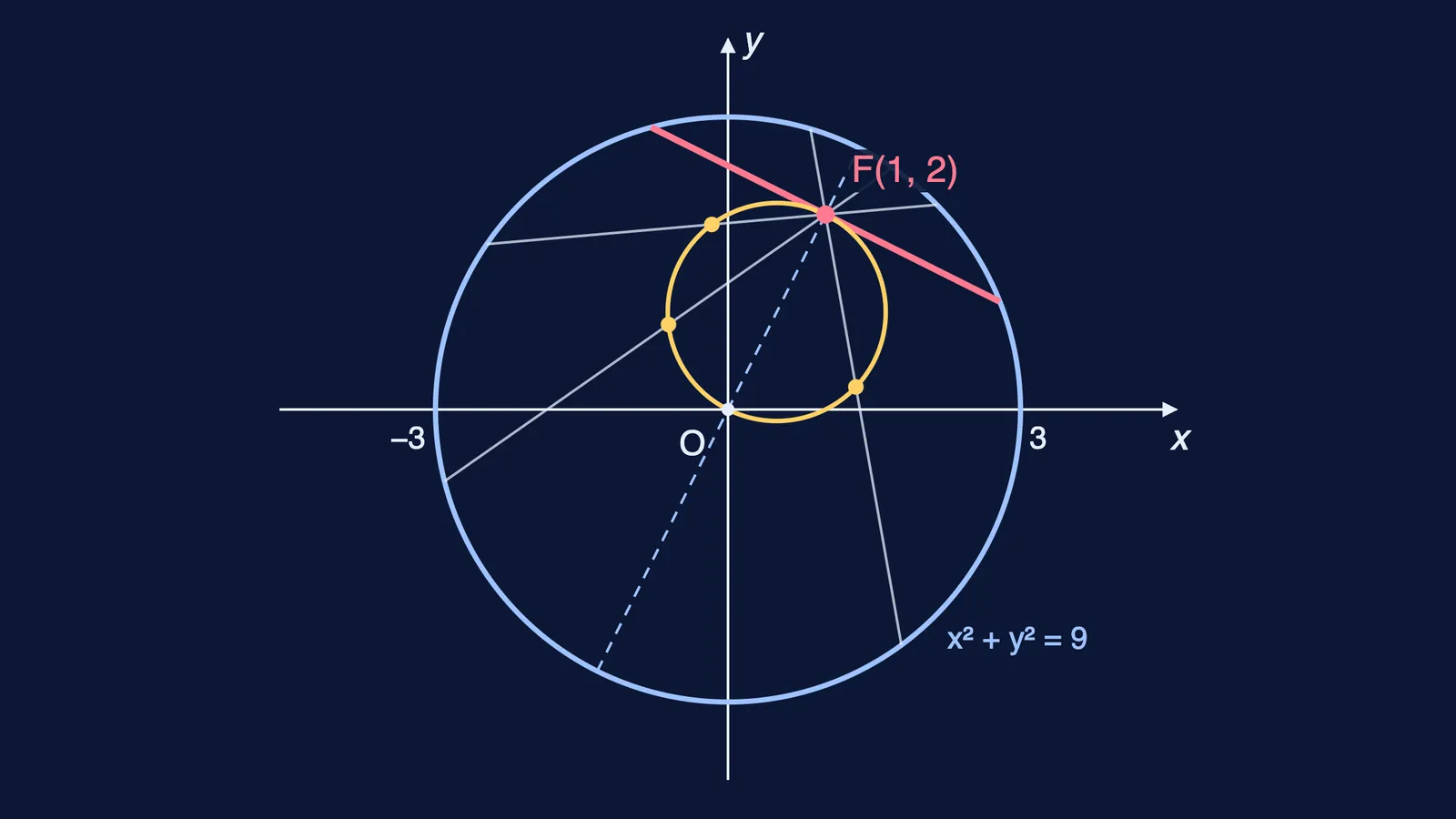
Q7 (hard, one or more options correct). Lines x + 2y − 5 = 0 and 2x − y = 0 meet at F. A line through F cuts x² + y² = 9 at P, Q; M is PQ's midpoint. Which are true?
(A) M lies on x² + y² − x − 2y = 0.
(B) The shortest chord PQ has length 4.
(C) The longest chord lies on x + 2y − 5 = 0.
(D) The locus of M has radius √5.
Answer: (A), (B). F = (1, 2). OM is perpendicular to the chord, so M lies on the circle with diameter OF: centre (1/2, 1), radius √5/2. The shortest chord, perpendicular to OF, is 2√(9 − 5) = 4; the longest is the diameter on 2x − y = 0. Trap: (C) is the shortest chord's line; (D) uses OF as radius.
Q8 (hard, list match). C₁: x² + y² − 2x − 2y − 14 = 0 and C₂: x² + y² − 8x − 10y + 32 = 0. Match the lists.
List-I: (P) number of common tangents, (Q) common chord length, (R) length of a common tangent, (S) distance of C₁'s centre from the common chord
List-II: (1) 2, (2) 12/5, (3) 24/5, (4) 2√6, (5) 16/5
(A) P→1, Q→3, R→4, S→5
(B) P→1, Q→2, R→4, S→5
(C) P→1, Q→5, R→4, S→3
(D) P→1, Q→3, R→5, S→2
Answer: (A). Centres (1, 1), (4, 5) are 5 apart; radii 4, 3. As 1 < 5 < 7 they cut: 2 common tangents, each √(25 − 1) = 2√6. C₁ − C₂ gives 3x + 4y − 23 = 0, 16/5 from (1, 1), so the half-chord is 12/5 and the chord 24/5. Trap: (B) stops at the half-chord.
How did you do?
Score a multiple-correct question only if you picked exactly the true options.
7 or 8: move to timed mixed sets.
4 to 6: redo misses after three days.
3 or fewer: revise the bisector sign test, T = S₁ and S + λL.
For more practice, the Fermi Problem Library has worked problems with a step-by-step solver that explains the reasoning rather than printing an answer.