On this page
What JEE (Advanced) asks in straight lines and circles beyond JEE (Main), with two original worked problems and a four-week plan.
What does the JEE Advanced syllabus say about straight lines and circles?
The official JEE (Advanced) 2026 syllabus lists line forms, angles and distances, then "Lines through the point of intersection of two given lines, equation of the bisector of the angle between two lines, concurrency of lines" and four triangle centres, including the incentre. For circles it adds "equations of tangent, normal and chord", parametric equations, intersections, and "equation of a circle through the points of intersection of two circles and those of a circle and a straight line". The PDF notes that it is unchanged from 2025. The 2027 syllabus is not yet published (as of 19 November 2026); recheck it later.
JEE (Advanced) 2027 will be held on 23 May 2027 (Sunday), organised by IIT Delhi, according to the official JEE (Advanced) website. One eligibility criterion is being among the top 2,50,000 successful candidates in the B.E./B.Tech. paper of JEE (Main) 2027. JEE (Advanced) 2026 had two compulsory papers of three hours each, according to the 2026 Information Brochure.
What is beyond JEE Main in straight lines and circles?
Set against NTA's JEE (Main) 2027 syllabus, these items appear only in the Advanced list:
shift of origin
lines through the point of intersection of two given lines (the family L₁ + λL₂ = 0)
the bisector of the angle between two lines, and the incentre
tangent, normal and chord of a circle, and its parametric equations
intersection of two circles, and circles through the intersection points of two circles or of a circle and a line (the family S + λS′ = 0)
Neither syllabus names a "pair of straight lines". For the basics, see our guides to straight lines for JEE Main and circles for JEE Main.
How do Advanced problems combine these ideas?
Example 1: a family of lines. Lines L₁: x + 2y − 4 = 0 and L₂: 3x − y − 5 = 0 meet at Q. Which line through Q is farthest from P(−2, 4), and how far?
Q = (2, 1). Every line through Q except L₂ is (x + 2y − 4) + λ(3x − y − 5) = 0.
No line through Q is farther from P than PQ = 5; the perpendicular to PQ reaches it.
PQ has direction (4, −3), so the line is 4x − 3y − 5 = 0, which is λ = −11/5. Maximum distance: 5.
Check: P is 2/√5 from L₁ and 3√10/2 ≈ 4.74 from L₂, both under 5. Trap: L₁ + λL₂ never gives L₂ itself, so test it separately.
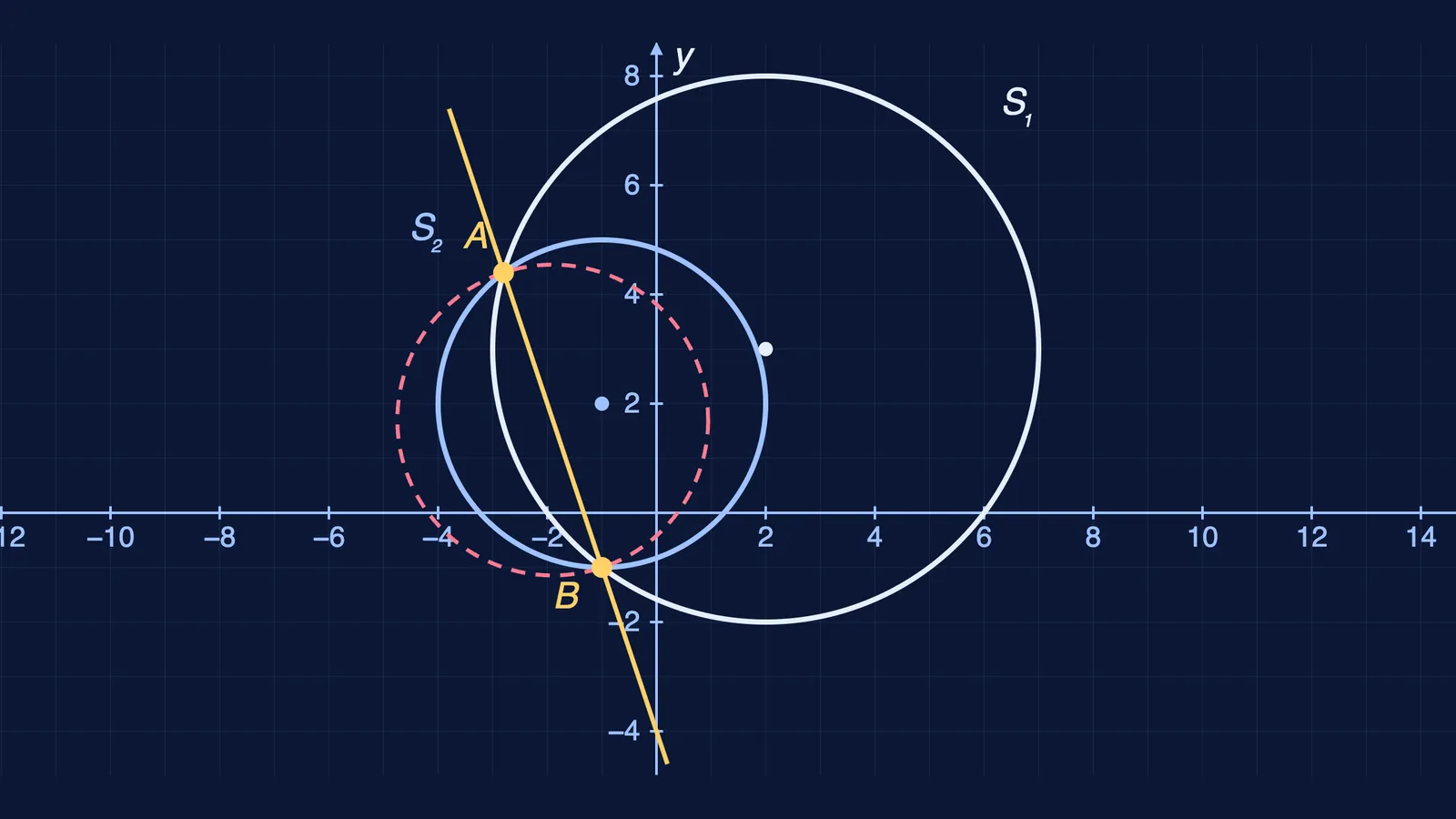
Example 2: two circles, multiple correct. S₁: x² + y² − 4x − 6y − 12 = 0 (centre (2, 3), radius 5); S₂: x² + y² + 2x − 4y − 4 = 0 (centre (−1, 2), radius 3). Which are true? (A) Their common chord is 3x + y + 4 = 0. (B) It has length 9√10/5. (C) The smallest circle through their intersection points has radius² 81/10. (D) They cut orthogonally.
The centres are √10 apart, between 5 − 3 and 5 + 3, so the circles meet twice. S₁ − S₂ = 0 gives 3x + y + 4 = 0: (A) is true.
They meet at A(−14/5, 22/5) and B(−1, −1), so AB = 9√10/5: (B) is true.
The smallest circle has AB as diameter, radius² = 81/10 (μ = 13/5 in S₁ + μ(3x + y + 4) = 0): (C) is true.
Orthogonal needs d² = r₁² + r₂², but 10 ≠ 34: (D) is false.
Answer: A, B and C. Mark only what you have checked; see how partial marking in multiple-correct questions works.
How should you practise straight lines and circles for JEE Advanced?
A four-week plan alongside other subjects:
Week 1: angle bisectors (which one contains a point), incentre, shift of origin, concurrency.
Week 2: families L₁ + λL₂, S + λL and S + λS′: extreme distances, smallest circles.
Week 3: tangent, normal, chord with given midpoint, chord of contact, two-circle positions.
Week 4: timed mixed sets; label each error as formula, algebra or missed case.
Stuck at the same step every time? The Fermi Problem Library has worked problems with a step-by-step solver that explains the reasoning rather than printing an answer.
Can you solve these practice questions?
Find the chord of S₁ whose midpoint is (3, 1). Answer: x − 2y − 1 = 0.
From (7, −2), find the tangent length to S₁ and the chord of contact. Answer: 5, and x − y − 4 = 0.
Find the bisector of the angle between 8x + 15y − 5 = 0 and 20x − 21y + 7 = 0 that contains the origin. Answer: 22x + 3y − 1 = 0.