On this page
Eight original questions, easy to hard, each with the value to type, a check and the usual slip.
How do numerical-answer questions work in JEE Advanced?
In JEE (Advanced) 2025 Paper 1, Mathematics Section 3 had six numerical-value questions, typed on an on-screen keypad and truncated or rounded to two decimal places. A correct value earned +4, anything else 0. The JEE (Advanced) 2026 syllabus covers distance from a line, triangle centres, tangents and chords, and circles through intersection points. Every value below is the same whether you truncate or round.
Easy for Advanced: distances and triangle centres
Q1. Find the distance between the lines 3x + 4y − 7 = 0 and 6x + 8y + 11 = 0.
Divide the second by 2: 3x + 4y + 5.5 = 0. The distance is |−7 − 5.5|/5 = 2.5. Enter 2.50. Check: (1, 1) lies on the first line, and its distance to the second is |6 + 8 + 11|/10 = 2.5. Lost mark: skipping the division gives 18/5 = 3.60.
Q2. A triangle has vertices (0, 0), (12, 0) and (0, 5). Find the distance between its incentre and circumcentre.
The inradius is (12 + 5 − 13)/2 = 2, so the incentre is (2, 2); the circumcentre is the hypotenuse's midpoint, (6, 2.5). The distance is √16.25 = 4.031… Enter 4.03. Check: Euler's OI² = R² − 2Rr = 42.25 − 26. Lost mark: using the centroid instead of the incentre gives about 2.17.
Q3. P moves on the x-axis. Find the least value of PA + PB for A(1, 2) and B(5, 4).
Reflect A to A′(1, −2); the shortest path is A′B = √52 = 7.211… Enter 7.21. Check: A′B meets the axis at P(7/3, 0), where PA + PB = 2.404 + 4.807. Lost mark: entering AB = √20 ≈ 4.47.
Medium: common chords and lattice points
Q4. Find the length of the common chord of x² + y² = 16 and x² + y² − 6x − 8y + 16 = 0.
Subtracting gives the chord 3x + 4y = 16, 3.2 from the origin. Half the chord is √(16 − 10.24) = 2.4. Enter 4.80. Check: from the second centre (3, 4), radius 3, √(9 − 1.8²) = 2.4 again. Lost mark: entering the half-chord, 2.40.
Q5. How many points with integer coordinates lie strictly inside the triangle with vertices (0, 0), (8, 0) and (0, 6)?
The hypotenuse is 3x + 4y = 24, so for x = 1 to 7 count y ≥ 1 with 3x + 4y < 24: 5, 4, 3, 2, 2, 1, 0. Enter 17. Check: Pick's theorem gives 24 − 16/2 + 1 = 17. Lost mark: counting (4, 3), which lies on the hypotenuse, gives 18.
Hard: two ideas in one question
Q6. Of all circles through the points where 3x + 4y = 20 meets x² + y² = 25, find the least area.
The smallest member of S + λL = 0 has the common chord as diameter. The line is 4 from the origin, so the radius is √(25 − 16) = 3 and the area 9π = 28.274… Enter 28.27. Check: λ = −1.6 gives centre (2.4, 3.2), the foot of the perpendicular. Lost mark: entering the radius, or 25π.
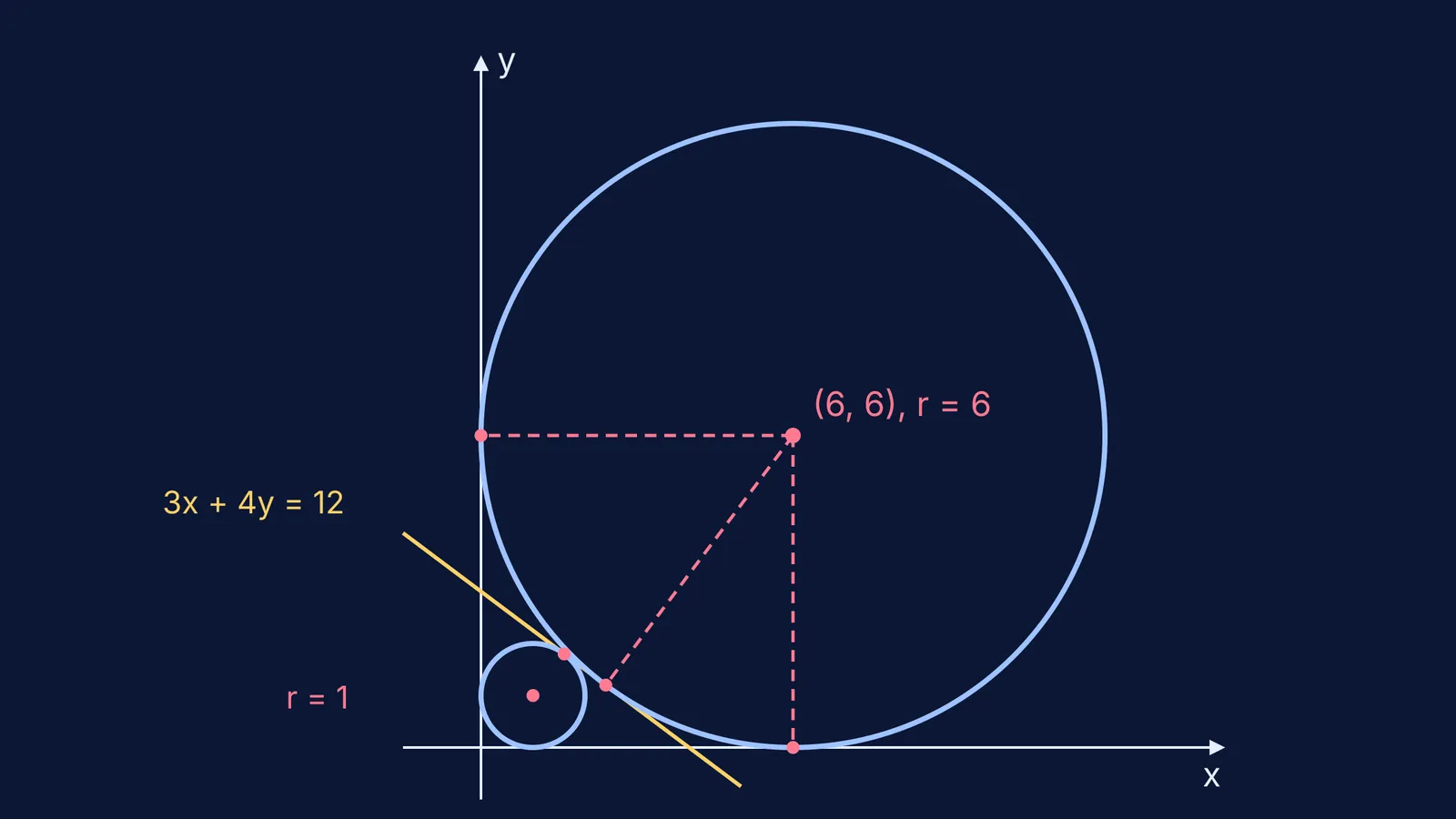
Q7. Find the sum of the radii of all circles in the first quadrant that touch both axes and the line 3x + 4y = 12.
The centre is (r, r), and tangency needs |7r − 12|/5 = r, so r = 6 or r = 1. Enter 7. Check: these are the incircle and an excircle of the 3-4-5 triangle, as the diagram shows. Lost mark: dropping the absolute value and finding only r = 6.
Q8. P is the point of 5x + 12y = 198 nearest the circle x² + y² − 2x − 4y − 20 = 0. Find the area of the triangle formed by the tangents from P and their chord of contact.
The centre C(1, 2) is 13 from the line, so P is the foot (6, 14). With r = 5 the tangent length is 12. The chord of contact is 25/13 from C, so P is 144/13 from it, and the half-chord is rL/CP = 60/13. The area is 8640/169 = 51.124… Enter 51.12. Check: rL³/(r² + L²) gives the same. Lost mark: the quadrilateral CAPB, area rL = 60.
How do you avoid losing the mark on a decimal answer?
Keep the exact form (√52, 9π) until the last line.
Carry four decimals and cut to two at the end.
Reread what was asked: chord or half-chord, one radius or the sum.
For option-based questions, try our straight lines and circles JEE Advanced practice questions with solutions, or warm up with straight lines JEE Main numerical value questions and circles JEE Main numerical value questions.
If one step keeps tripping you, the Fermi Problem Library has a step-by-step solver that explains the reasoning. For the rest of your JEE Main and Advanced preparation, start at Fermi Test Prep.