On this page
What does a JEE Advanced paragraph question look like?
The official JEE Advanced 2026 syllabus covers "arithmetic and geometric progressions, arithmetic and geometric means, sums of finite arithmetic and geometric progressions, infinite geometric series, sum of the first n natural numbers, sums of squares and cubes of the first n natural numbers".
A paragraph question tests this through one setup. The official JEE Advanced 2021 Paper 2 file, which holds that paper's physics questions, shows two formats. Section 2: three question stems, two numerical-value questions each, +2 for the correct value and 0 otherwise. Section 3: two paragraphs, two single-correct questions each, +3 if correct and −1 if wrong. Patterns change yearly. The paragraphs below are original and inside the syllabus; Paragraph 2 adds a third question for practice.
Paragraph 1: what is the AP behind a given sum?
Paragraph. For a sequence a₁, a₂, a₃, …, the sum of the first n terms is Sₙ = 3n² + 5n for every n ≥ 1.
Q1. Find a₁₀.
aₙ = Sₙ − Sₙ₋₁ = (3n² + 5n) − (3(n − 1)² + 5(n − 1)) = 6n + 2. Check: a₁ = S₁ = 8. So this is an AP with first term 8 and common difference 6, and a₁₀ = 62.
Tempting wrong answer: 35, from treating Sₙ/n = 3n + 5 as the nth term. Sₙ/n is the average of the first n terms, not the last one.
Q2. Find a₁ + a₃ + a₅ + … + a₁₉.
Using aₙ = 6n + 2 from Q1, the odd-numbered terms are 8, 20, 32, …, 116: an AP with difference 12 and ten terms. Their sum is 10/2 × (8 + 116) = 620.
Tempting wrong answer: 650, half of S₂₀ = 1300. Each odd-numbered term is 6 less than the term after it, so the odd terms add to less than half.
Paragraph 2: how do you find a GP from its sum and product?
Paragraph. Three positive numbers form an increasing GP. Their sum is 21 and their product is 216.
Q1. The middle term is (A) 7 (B) 6 (C) 4 (D) 9.
Write the terms as a/r, a, ar. Their product is a³ = 216, so a = 6: option (B). The tempting option is (A): 7 = 21/3 is the arithmetic mean of the three numbers. In a GP the middle term is the geometric mean of its neighbours, not their average.
Q2. The common ratio is (A) 1/2 (B) 3 (C) 2 (D) 4.
With a = 6 from Q1, 6/r + 6 + 6r = 21 gives 2r² − 5r + 2 = 0, so r = 2 or r = 1/2. The paragraph says increasing, so r = 2: option (C), and the numbers are 3, 6, 12. Option (A) is the right algebra with the word "increasing" ignored.
Q3. The sum 1/3 + 1/6 + 1/12 + … to infinity is (A) −1/3 (B) 2/3 (C) 1 (D) does not exist.
The reciprocals of a GP with ratio 2 form a GP with ratio 1/2. Sum = (1/3) ÷ (1 − 1/2) = 2/3: option (B). The tempting option is (A), from putting r = 2 into a/(1 − r). That formula needs |r| < 1.
Paragraph 3: what happens when you add up sums?
Paragraph. For each positive integer k, let Tₖ = 1 + 2 + … + k, so T₁ = 1, T₂ = 3, T₃ = 6.
Q1. Find T₁ + T₂ + … + T₁₀.
Tₖ = k(k + 1)/2 = (k² + k)/2. Adding for k = 1 to 10 gives ½(385 + 55) = 220, using 1² + … + 10² = 10 × 11 × 21/6 = 385 and 1 + … + 10 = 55. In general the sum is n(n + 1)(n + 2)/6.
Tempting wrong answers: 440, from forgetting the ½, or 385, from adding only the squares.
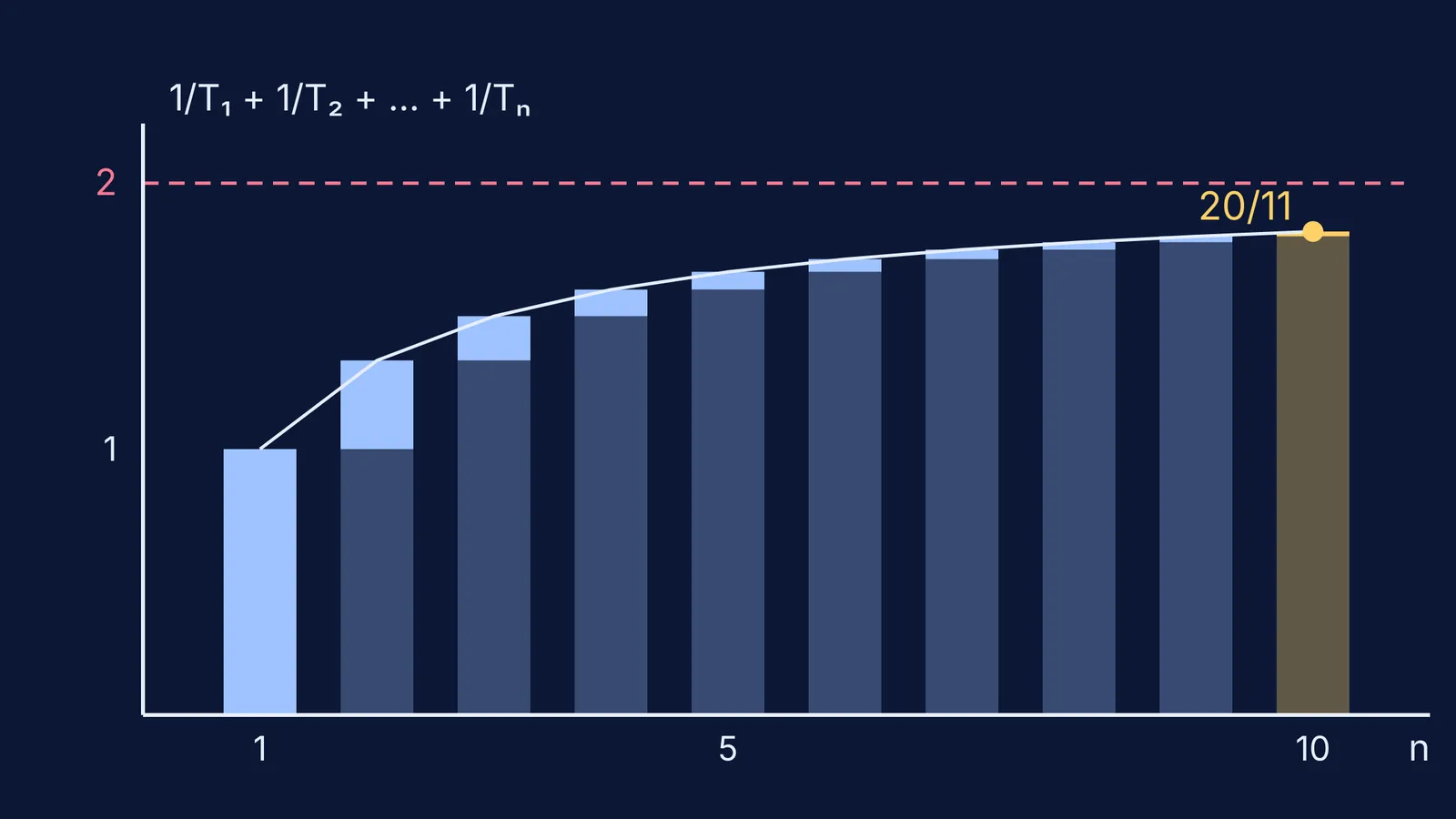
Q2. Find 1/T₁ + 1/T₂ + … + 1/T₁₀.
From the formula in Q1, 1/Tₖ = 2/(k(k + 1)) = 2(1/k − 1/(k + 1)). The middle terms cancel, leaving 2(1 − 1/11) = 20/11, about 1.82. As n grows, this sum approaches 2 but never reaches it.
Tempting wrong answer: 1/220, the reciprocal of Q1's number. What carries over from Q1 is the formula for Tₖ, not 220.
How do you read a sequences and series paragraph quickly?
Read every question in the set first. The last one tells you whether to keep a formula or just a number.
Turn each definition into algebra at once: Sₙ gives aₙ = Sₙ − Sₙ₋₁; three GP terms become a/r, a, ar.
Keep the general formula from Q1, not only its value.
Check with n = 1 or n = 2. It takes seconds and protects two answers.
Next, try the JEE Advanced sequences and series practice set with solutions and the chapter's numerical answer questions.
If a step loses you, the Fermi Problem Library has a step-by-step solver that explains the reasoning. To plan the rest of your preparation, start at Fermi Test Prep for JEE Main and Advanced.