On this page
A paragraph (comprehension) question gives you one short passage and then two or three questions that all draw on it. A typical passage defines something, and the later questions often lean on the earlier answers. One slip early can cost the whole set; one clean setup can earn all of it.
What is a paragraph question in JEE Advanced?
It is a linked set: the passage is the shared input, and each question often builds on the one before. The paper format can change from year to year, so check it on real papers. The official JEE Advanced past papers archive has Paper 1 and Paper 2 for every year from 2007 to 2025. The official JEE Advanced home page says JEE (Advanced) 2027 will be held on May 23, 2027.
The three sets below are original. Try each question before reading its solution.
Paragraph 1: how does rotation find the corners of a square?
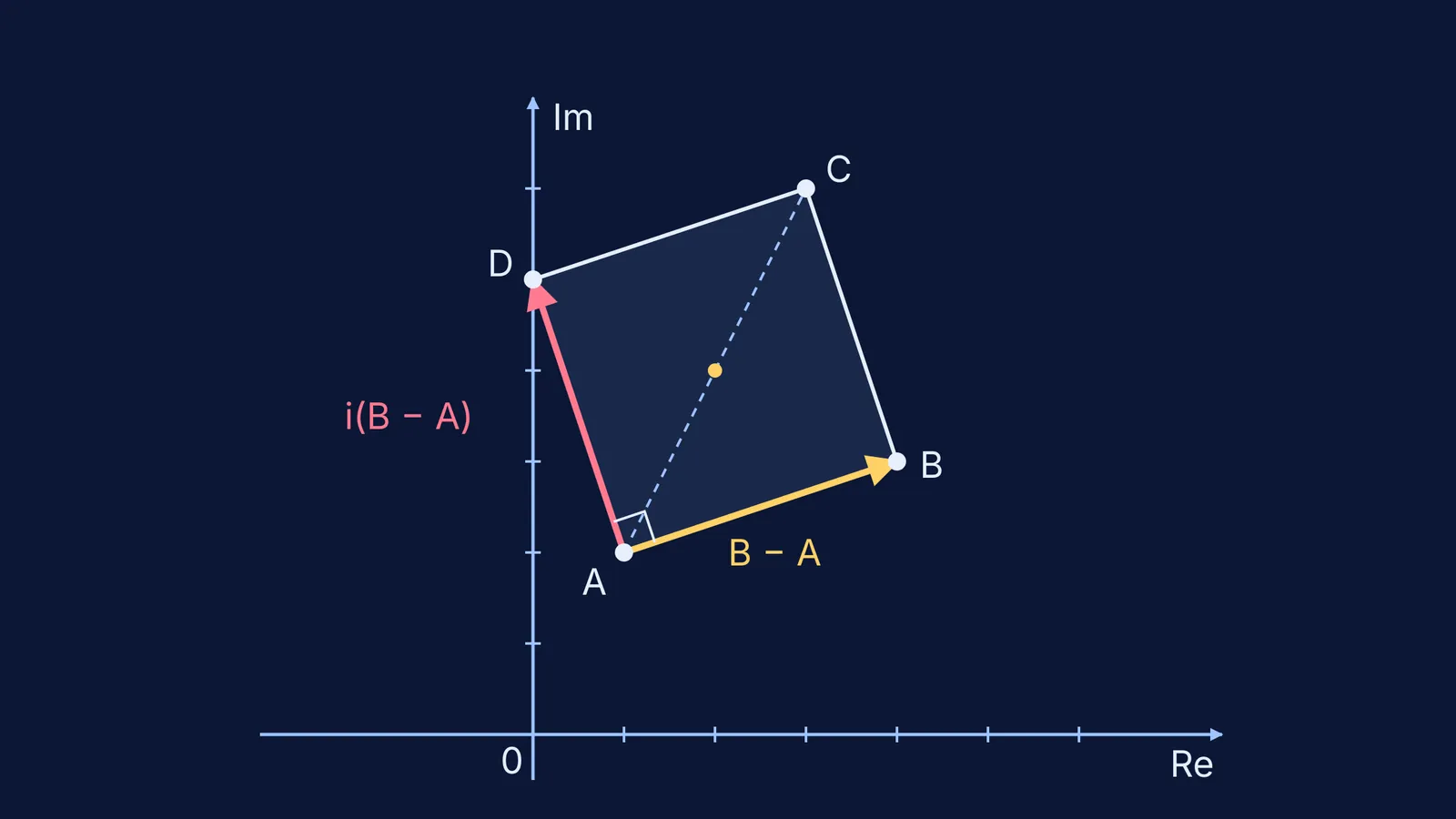
Passage. ABCD is a square in the Argand plane, labelled anticlockwise, with A = 1 + 2i and B = 4 + 3i. Multiplying a complex number by i rotates it 90° anticlockwise about the origin.
Q1. Find C. The side AB is the vector B − A = 3 + i. Turning it 90° anticlockwise gives i(3 + i) = −1 + 3i, which is the side BC. So C = B + (−1 + 3i) = 3 + 6i.
Q2. Find D and the centre. Reuse the vector from Q1: D = A + (−1 + 3i) = 5i. The centre is the midpoint of AC, (A + C)/2 = 2 + 4i. Check it with the other diagonal: (B + D)/2 = 2 + 4i.
Tempting wrong option: C = 5. That comes from multiplying by −i, a clockwise turn, which builds the square on the other side of AB. The word "anticlockwise" decides the sign.
Paragraph 2: what locus does |z − 1| = 2|z + 1| describe?
Passage. Call a complex number z balanced if |z − 1| = 2|z + 1|.
Q1. Describe the balanced points. Put z = x + iy and square both sides: (x − 1)² + y² = 4[(x + 1)² + y²]. This simplifies to x² + y² + (10/3)x + 1 = 0, a circle with centre −5/3 and radius √(25/9 − 1) = 4/3.
Q2. Find the largest |z| for a balanced z. The origin lies outside the circle from Q1, so the farthest point is on the real axis, at distance 5/3 + 4/3 = 3: z = −3. Check it against the passage: |−3 − 1| = 4 and 2|−3 + 1| = 4.
Tempting wrong option: the line x = 0. The perpendicular bisector of 1 and −1 is the locus only when the ratio is 1. Any other ratio gives a circle. The second trap is answering 4/3, the radius, for Q2.
Paragraph 3: how do cube roots of unity link three questions?
Passage. Let ω = cos(2π/3) + i sin(2π/3), so ω³ = 1, and define f(n) = 1 + ωⁿ + ω²ⁿ for whole numbers n.
Q1. Find f(n). If 3 divides n, every term is 1, so f(n) = 3. Otherwise ωⁿ is ω or ω², the three terms are 1, ω and ω² in some order, and they add to 0 because ω is a root of x² + x + 1.
Q2. Find f(1) + f(2) + … + f(30). By Q1, only multiples of 3 count. There are 10 of them, each giving 3, so the sum is 30.
Q3. Simplify (1 + ω)²⁰²⁷. Q1 with n = 1 gives 1 + ω = −ω². So (1 + ω)²⁰²⁷ = −ω⁴⁰⁵⁴, and since 4054 = 3 × 1351 + 1, the answer is −ω.
Tempting wrong option: 0 for Q2. It comes from treating 1 + ω + ω² = 0 as true for every n. Q1 is there to make you split the cases.
How do you read a complex numbers paragraph quickly?
Read the questions first, so you know what you need from the passage.
Rewrite each definition in symbols on one line, such as "balanced: |z − 1| = 2|z + 1|".
Underline the words that fix a sign or a case: anticlockwise, distinct, principal argument, whole number.
Solve Q1 fully and check it, because Q2 and Q3 inherit any error.
Ask what Q1 hands on: a vector, a circle or a case split.
If Q1 stalls, still read Q2; sometimes the passage alone is enough.
For more of the chapter, work through the complex numbers JEE Advanced practice set with full solutions, then the multiple-correct questions on complex numbers and the complex numbers numerical answer set. If your working goes wrong and you can't see where, the Fermi Problem Library has a step-by-step solver that explains the reasoning. To plan the rest of your preparation, start at Fermi Test Prep, our JEE Main and Advanced preparation.