

On this page
Multiple-correct questions reward a habit more than a formula: judge each option as its own true-or-false statement, then tick only what you have proved. Here are eight original questions on complex numbers in that format.
How does partial marking work in JEE Advanced multiple-correct questions?
In the official JEE Advanced 2025 Paper 1 mathematics answer key, Section 2 has questions where one or more of four options is correct, marked like this:
+4 if you choose all the correct options and nothing else.
+3 if all four options are correct and you choose exactly three.
+2 if three or more options are correct and you choose two, both correct.
+1 if two or more options are correct and you choose one correct option.
0 if you leave it blank; −2 in all other cases.
The scheme is printed in each paper's instructions and can change between years, so read it again on exam day.
Eight complex numbers questions, option by option
Here z̄ is the conjugate of z, ω = e^(2πi/3), and arg is the principal argument in (−π, π].
Q1. |z| = 1 and z ≠ ±1. Which are true?
(A) (z − 1)/(z + 1) is purely imaginary. True: using z̄ = 1/z, its conjugate is its negative.
(B) z + 1/z is real. True: it equals 2 Re z.
(C) |z − 1| = |z + 1|. False: only for z = ±i.
(D) z² is real. False: try z = e^(iπ/3).
Answer: A, B. Students often miss A; the conjugate test takes one line.
Q2. Which are true?
(A) 1 + ω^2025 + ω^4050 = 0. False: 2025 is a multiple of 3, so the sum is 3.
(B) (1 + ω − ω²)³ = −8. True: the bracket is −2ω².
(C) ω^n + ω^(2n) = −1 whenever 3 does not divide n. True.
(D) (1 − ω)(1 − ω²) = 3. True: it expands to 2 − (ω + ω²).
Answer: B, C, D. A is the classic wrong tick, recalled without checking the powers.
Q3. |z − 2i| = 2|z + i|. Which are true?
(A) The locus is a circle with centre −2i. True: squaring gives x² + y² + 4y = 0.
(B) Its radius is 2. True.
(C) It passes through the origin. True.
(D) The greatest |z| on it is 4. True, at z = −4i.
Answer: A, B, C, D. Doubting that all four can be right and dropping one earns +3, not +4.
Q4. z₁ = 1 + i√3, z₂ = −1 + i. Which are true?
(A) arg(z₁z₂) = 13π/12. False: that lies outside (−π, π]; the principal argument is −11π/12.
(B) arg(z₁/z₂) = −5π/12. True.
(C) |z₁z₂| = 2√2. True.
(D) arg(z̄₁) = −π/3. True.
Answer: B, C, D. Ticking A, adding arguments without reducing, is the costly slip.
Q5. α = e^(2πi/5); the fifth roots of unity are 1, α, α², α³, α⁴. Which are true?
(A) Their sum is 0. True.
(B) (1 − α)(1 − α²)(1 − α³)(1 − α⁴) = 5. True: put z = 1 in 1 + z + z² + z³ + z⁴.
(C) α + α⁴ = 2cos(2π/5). True: α⁴ is the conjugate of α.
(D) The product of all five roots is −1. False: it is 1.
Answer: A, B, C. Students skip B, which looks like heavy multiplication, and tick D after a sign slip.
Q6. S is the set of z with z² = z̄. Which are true?
(A) S has exactly 4 elements. True: |z|² = |z| gives z = 0 or |z| = 1, and then z³ = 1.
(B) The elements of S add to 1. False: 0 + 1 + ω + ω² = 0.
(C) Every element of S has modulus 1. False: 0 is in S.
(D) i is in S. False: i² = −1, but the conjugate of i is −i.
Answer: A only. A multiple-correct question can have one correct option. Forgetting z = 0 leads students to C.
Q7. A = 1 + i and B = 3 + 2i are adjacent vertices of square ABCD, labelled anticlockwise. Which are true?
(A) C = 2 + 4i. True: C = B + i(B − A).
(B) D = 2 − i. False: that belongs to the clockwise square; here D = 3i.
(C) The centre is (3 + 5i)/2. True: the midpoint of AC.
(D) The area is 5. True: |B − A|² = 5.
Answer: A, C, D. Rotating by −i instead of i makes B look right.
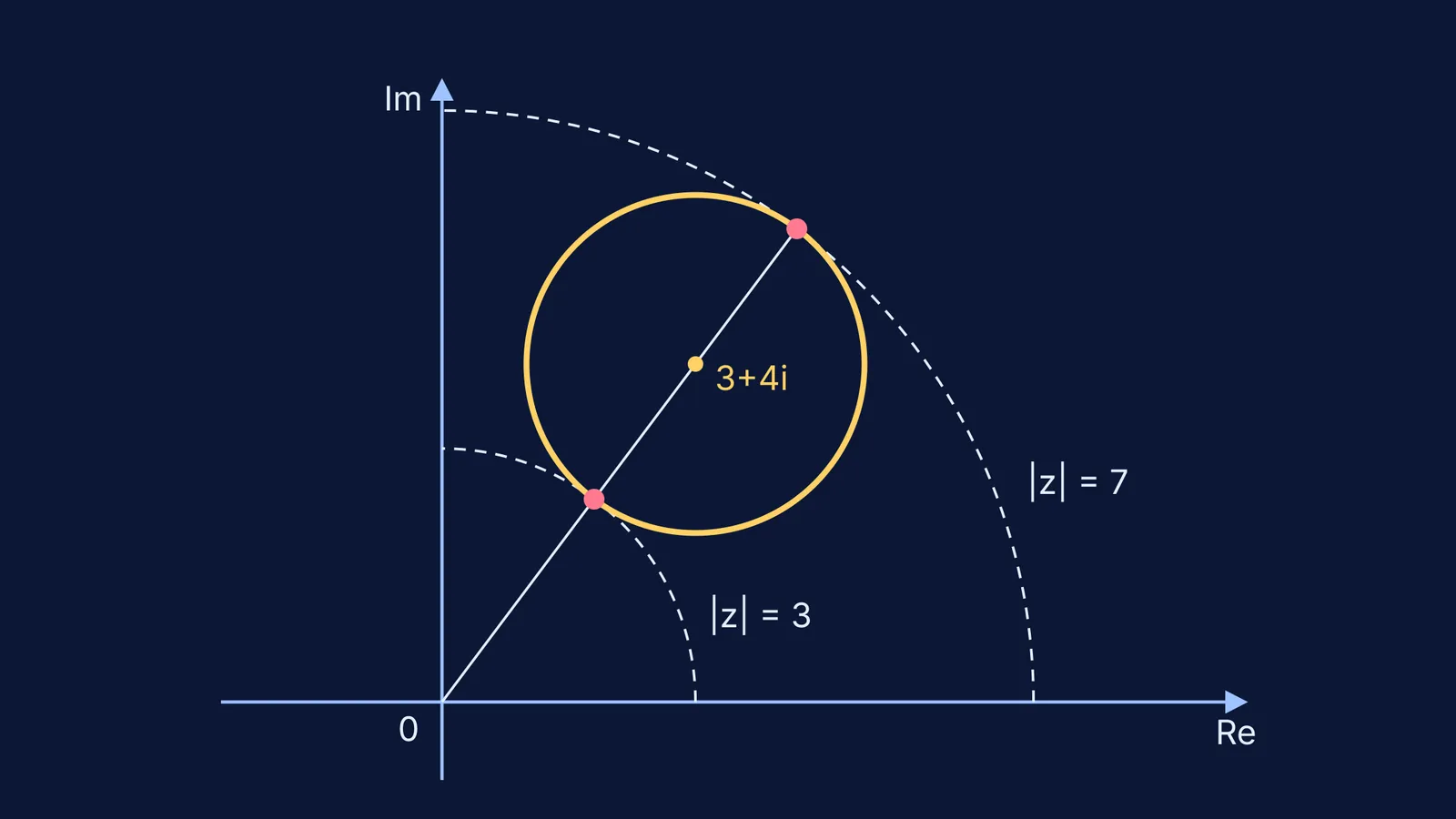
Q8. |z − 3 − 4i| = 2. Which are true?
(A) The greatest |z| is 7. True: 5 + 2.
(B) The least |z| is 3, at z = (9 + 12i)/5. True: three-fifths of the way from 0 to 3 + 4i.
(C) z can be real. False: the centre is 4 above the real axis, more than the radius.
(D) |z + 3 + 4i| ≥ 8. True: the centre is 10 from −3 − 4i, minus the radius.
Answer: A, B, D. Students skip D, though it is the same distance idea as A.
What should you do with options you cannot settle?
Mark each option T, F or ? before ticking anything.
Tick every T. Never tick a ?.
With one sure T and the rest unsure, tick it alone: it earns +1, or +4 if it is the only correct option.
Leave the question blank if you have no sure T; a guess risks −2.
For fully worked solutions, try the complex numbers JEE Advanced practice questions, then the JEE Advanced numerical answer questions on complex numbers and our guide on how to prepare complex numbers and quadratics for JEE Advanced. If one wrong option keeps fooling you, the Fermi Problem Library has a step-by-step solver that explains the reasoning. For the rest of your JEE Main and Advanced preparation, start at Fermi Test Prep.


