

On this page
Eight original questions, easy to hard, each with the exact value, the number to type, a check and the step where the mark usually goes.
How do numerical-answer questions work in JEE Advanced?
In JEE (Advanced) 2025 Paper 1, Mathematics Section 3 had six numerical-value questions, typed on an on-screen numeric keypad and truncated or rounded to two decimal places. A correct value earned +4 and anything else 0. Patterns change yearly, so read the instructions on the day. All questions below fit the JEE (Advanced) 2026 syllabus.
Easy for Advanced: argument and cube roots
Q1. z = (1 + i√3)⁵ / (1 − i)³. The principal argument of z is kπ/12. Find k.
arg z = 5(π/3) − 3(−π/4) = 29π/12; subtract 2π to get 5π/12. Enter 5. Check: 5π/12 lies in (−π, π]. Lost mark: taking arg(1 − i) as +π/4 gives 11; not reducing gives 29.
Q2. ω is a non-real cube root of unity. Find |1 + 2ω + 3ω²|.
For real a, b, c, |a + bω + cω²|² = a² + b² + c² − ab − bc − ca, since ω̄ = ω² and ω + ω² = −1. That is 14 − 11 = 3, so the value is √3 = 1.7320… Enter 1.73. Check: directly, the number is −3/2 − i√3/2. Lost mark: entering 3, the squared modulus.
Medium: loci, powers and rotation
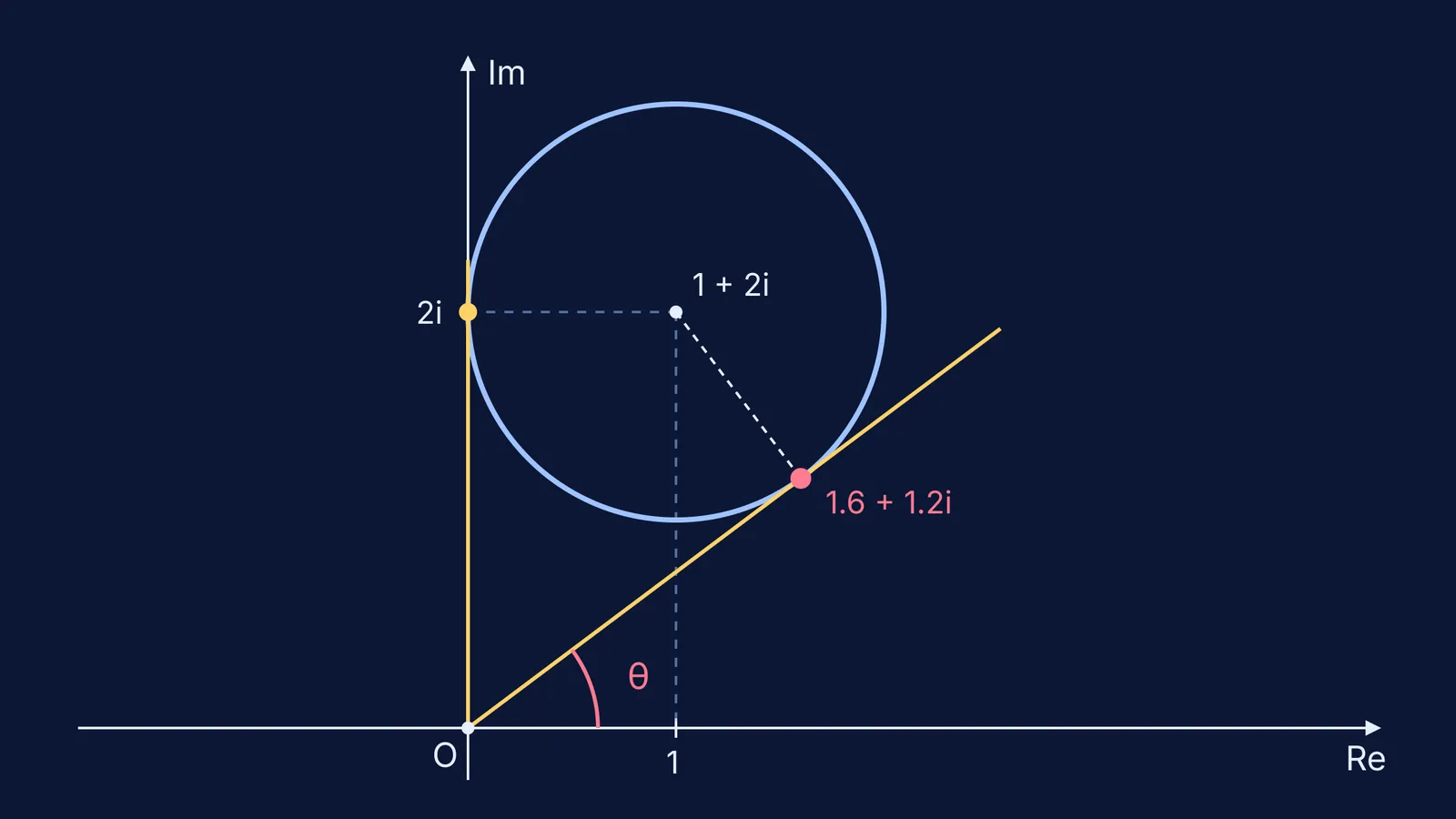
Q3. z moves on |z − 1 − 2i| = 1. Find the least value of arg z, in radians.
The centre 1 + 2i is √5 from O and the radius is 1, so the tangent from O makes angle α with the centre line, where tan α = 1/2. Least argument = tan⁻¹2 − tan⁻¹(1/2) = tan⁻¹(3/4) = 0.6435… Enter 0.64. Check: the tangent point 1.6 + 1.2i is exactly 1 from the centre (see the diagram). Lost mark: entering degrees, 36.87.
Q4. α and β are the roots of x² − x + 1 = 0. How many n in {1, 2, …, 100} satisfy αⁿ + βⁿ = 2?
The roots are cos(π/3) ± i sin(π/3), so by De Moivre αⁿ + βⁿ = 2cos(nπ/3), which is 2 only when 6 divides n. Enter 16. Check: n = 3 gives −2. Lost mark: treating α as a cube root of unity and counting multiples of 3 (33); in fact α = −ω², so α³ = −1.
Q5. z₁ = 1 + i, z₂ = 4 + 2i, and z₁, z₂, z₃ form an equilateral triangle in anticlockwise order. Find |z₃|.
Rotate 3 + i by +60° about z₁: z₃ = z₁ + (3 + i)(1/2 + i√3/2) = (5 − √3)/2 + i(3 + 3√3)/2. So |z₃|² = 16 + 2√3 and |z₃| = 4.4118… Enter 4.41. Check: |z₃ − z₁| = √10, the side. Lost mark: rotating by −60° (clockwise) gives 3.54.
Hard: two ideas in one question
Q6. How many complex numbers z satisfy z³ = z̄ and |z − 1| ≤ 1?
Moduli give |z|³ = |z|, so |z| = 0 or 1. If |z| = 1, z̄ = 1/z and z⁴ = 1: ±1, ±i. Of these five solutions, only 0 and 1 lie within 1 of the point 1. Enter 2. Check: |i − 1| = √2. Lost mark: dividing by z and losing z = 0.
Q7. Find the area of the region |z − 1| + |z + 1| ≤ 4.
It is an ellipse with foci ±1 and 2a = 4, so a = 2, c = 1, b = √3 and area πab = 2√3π = 10.882… Enter 10.88. Check: z = 2 gives 1 + 3 = 4, on the boundary. Lost mark: taking b = 1 and entering 6.28.
Q8. For non-zero z with |z − 1/z| = 3, find the greatest value of |z|.
With r = |z|, the triangle inequality gives 3 ≥ r − 1/r, so r² − 3r − 1 ≤ 0 and r ≤ (3 + √13)/2 = 3.3027… The real z = (3 + √13)/2 attains it. Enter 3.30. Check: 3.3028 − 0.3028 = 3. Lost mark: using r + 1/r ≥ 3, which only gives r ≥ 2.62.
How should you enter a decimal answer?
Write the exact form first (√3, tan⁻¹(3/4)); it is your check.
Carry four decimals and cut to two only at the end.
Reread what was asked: radians or degrees, modulus or its square.
For single-correct, multiple-correct and list-match questions on the same chapter, try our complex numbers JEE Advanced practice questions with solutions, and for the easier version, complex numbers JEE Main numerical value questions.
If one step keeps tripping you, the Fermi Problem Library has a step-by-step solver that explains the reasoning. For the rest of your JEE Main and Advanced preparation, start at Fermi Test Prep.


