On this page
A paragraph question gives you one short passage and two or three questions about it, each usually building on the last. Here are three original matrices and determinants paragraphs, solved, with the trap in each. Check recent papers in the official JEE Advanced past question papers archive, which lists Paper 1 and Paper 2 for every year from 2007 to 2025.
Paragraph 1: what can the trace and determinant alone tell you?
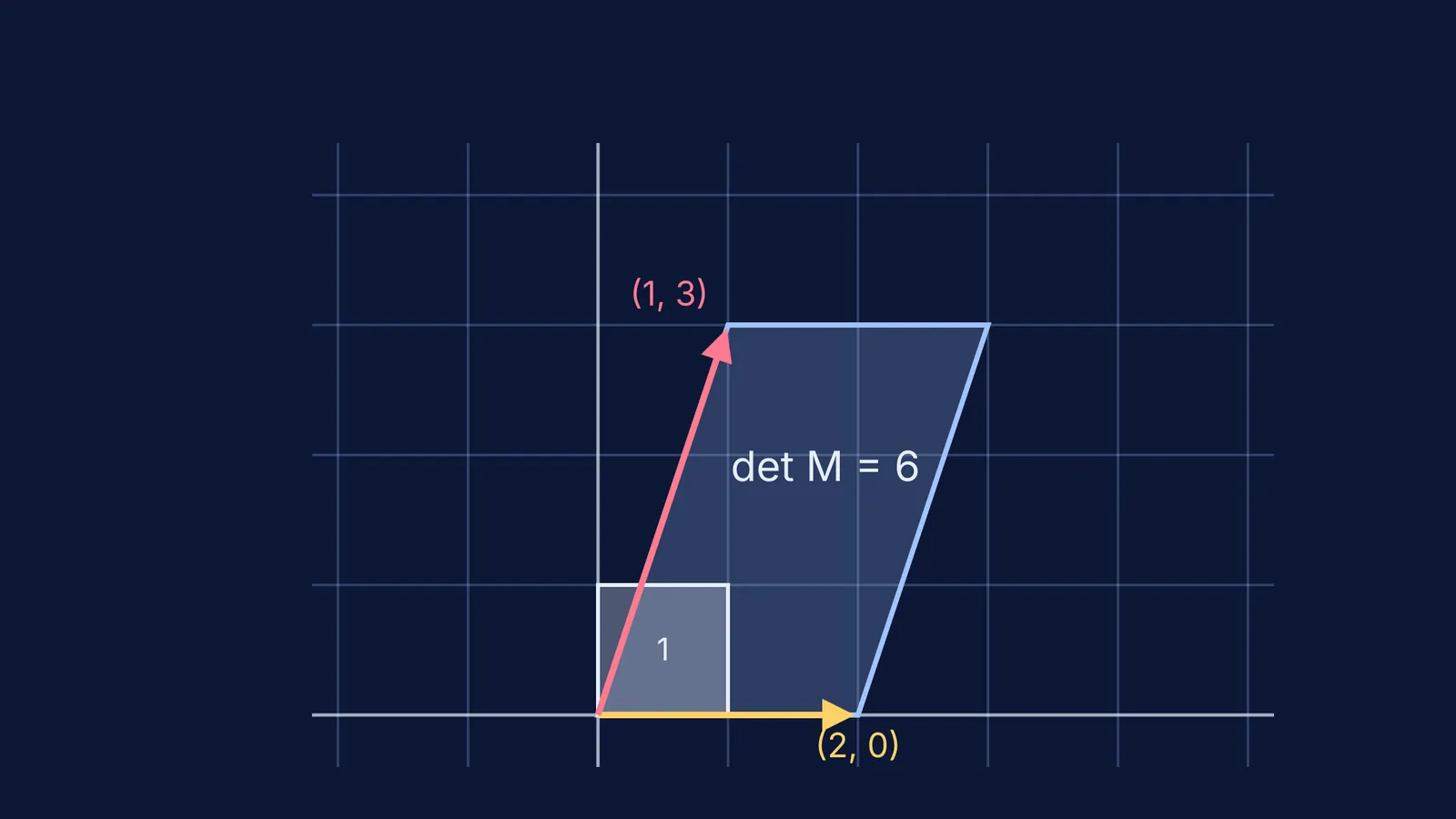
Paragraph. M is a real 2×2 matrix with trace 5 and determinant 6. One example has rows (2, 1) and (0, 3).
Q1. M² − 5M + 6I equals (A) I (B) O (C) M (D) 6I.
Every 2×2 matrix satisfies M² − (trace M)M + (det M)I = O, so the answer is (B); the example confirms it entry by entry.
Q2. If M⁻¹ = αM + βI, then (α, β) is (A) (1/6, −5/6) (B) (−1/6, 5/6) (C) (−1, 5) (D) (1/5, −6/5).
Rearrange Q1's identity: M(5I − M) = 6I, so M⁻¹ = (5I − M)/6, giving α = −1/6 and β = 5/6, (B). Option (C) forgets to divide by det M.
Q3. det(M² + M) equals (A) 42 (B) 72 (C) 36 (D) 48.
Factor first: M² + M = M(M + I). For a 2×2 matrix, det(M + I) = det M + trace M + 1 = 12, so the answer is 6 × 12 = 72, (B). The trap, (A), adds det(M²) = 36 and det M = 6; a determinant does not split over a sum.
Paragraph 2: when does a linear system have infinitely many solutions?
Paragraph. Consider x + y + z = 6, x + 2y + 3z = 14 and x + 3y + λz = μ, with λ and μ real.
Q1. The system has a unique solution exactly when (A) λ ≠ 5 (B) λ ≠ 3 (C) μ ≠ 22 (D) λ ≠ 5 and μ ≠ 22.
The coefficient determinant is 1(2λ − 9) − 1(λ − 3) + 1(3 − 2) = λ − 5. A unique solution needs only this to be non-zero, so (A). Option (D) adds a needless condition on μ.
Q2. If λ = 5, there are infinitely many solutions when μ equals (A) 14 (B) 18 (C) 22 (D) any value.
The second minus the first gives y + 2z = 8. The third minus the second gives y + 2z = μ − 14. They agree only when μ = 22, (C). The trap is (D): for any other μ there is no solution at all.
Q3. For λ = 5 and μ = 22, the solution with y = 0 has z equal to (A) 2 (B) 4 (C) 6 (D) 8.
With z = t, y = 8 − 2t and x = 6 − y − z = t − 2. Setting y = 0 gives (2, 0, 4), (B), and the third equation checks: 2 + 20 = 22. Option (A) is x, not z.
Paragraph 3: how are adj A and adj(adj A) linked to det A?
Paragraph. A is the 3×3 matrix with rows (1, 2, 0), (0, 1, 2) and (k, 0, 1), and det A = 9. For an invertible n×n matrix, det(adj A) = (det A)ⁿ⁻¹ and adj(adj A) = (det A)ⁿ⁻² A.
Q1. k equals (A) 1 (B) 2 (C) 3 (D) −2.
Along the first row, det A = 1(1 − 0) − 2(0 − 2k) + 0 = 1 + 4k = 9, so k = 2, (B). Option (D) comes from dropping the minus sign on the middle cofactor.
Q2. det(adj A) equals (A) 9 (B) 81 (C) 729 (D) 27.
With n = 3, det(adj A) = 9² = 81, (B). Option (C) uses the power n instead of n − 1.
Q3. The entry in row 1, column 2 of adj(adj A) is (A) 2 (B) 18 (C) 162 (D) 81.
Here adj(adj A) = 9A, so the entry is 9 × 2 = 18, (B). The trap, (C), carries Q2's power n − 1 into this formula: 81 × 2 = 162.
How do you read a paragraph question quickly?
Mark what the passage defines: the matrix, the condition, the parameters.
Read every question in the set first; their order shows the chain.
Given only properties, such as a trace and determinant, test the options on a small example.
Watch the usual traps: the determinant of a sum, det(kA) = kⁿ det A, the powers n − 1 and n − 2, and a zero determinant read as infinitely many solutions.
Where can you practise more JEE Advanced matrices questions?
Start with the eight solved JEE Advanced matrices and determinants questions, then try the multiple-correct questions on the same chapter and the JEE Advanced matrices numerical answer set.
When your working and an answer disagree, the Fermi Problem Library has a step-by-step solver that explains the reasoning rather than printing an answer. For the rest of your JEE Main and Advanced preparation, start at Fermi Test Prep.