On this page
What is a JEE Advanced paragraph question in integral calculus?
The official JEE Advanced 2026 syllabus lists integral calculus as "integration as the inverse process of differentiation, indefinite integrals of standard functions, definite integrals as the limit of sums, definite integral and their properties, fundamental theorem of integral calculus", plus integration by parts, substitution, partial fractions and areas bounded by simple curves.
A paragraph question tests this through one shared setup. In JEE Advanced 2021 Paper 2, mathematics Section 3 had two paragraphs with two single-correct questions each, marked +3 for the correct option, 0 if unanswered and −1 otherwise. The second paragraph defined two of its four functions as definite integrals, such as g(x) = ∫₀^(x²) √t e^(−t) dt. Formats change yearly. The paragraphs below are original, written to that pattern; Paragraph 2 adds a third question to show a longer chain.
Paragraph 1: how do you study a function defined by an integral?
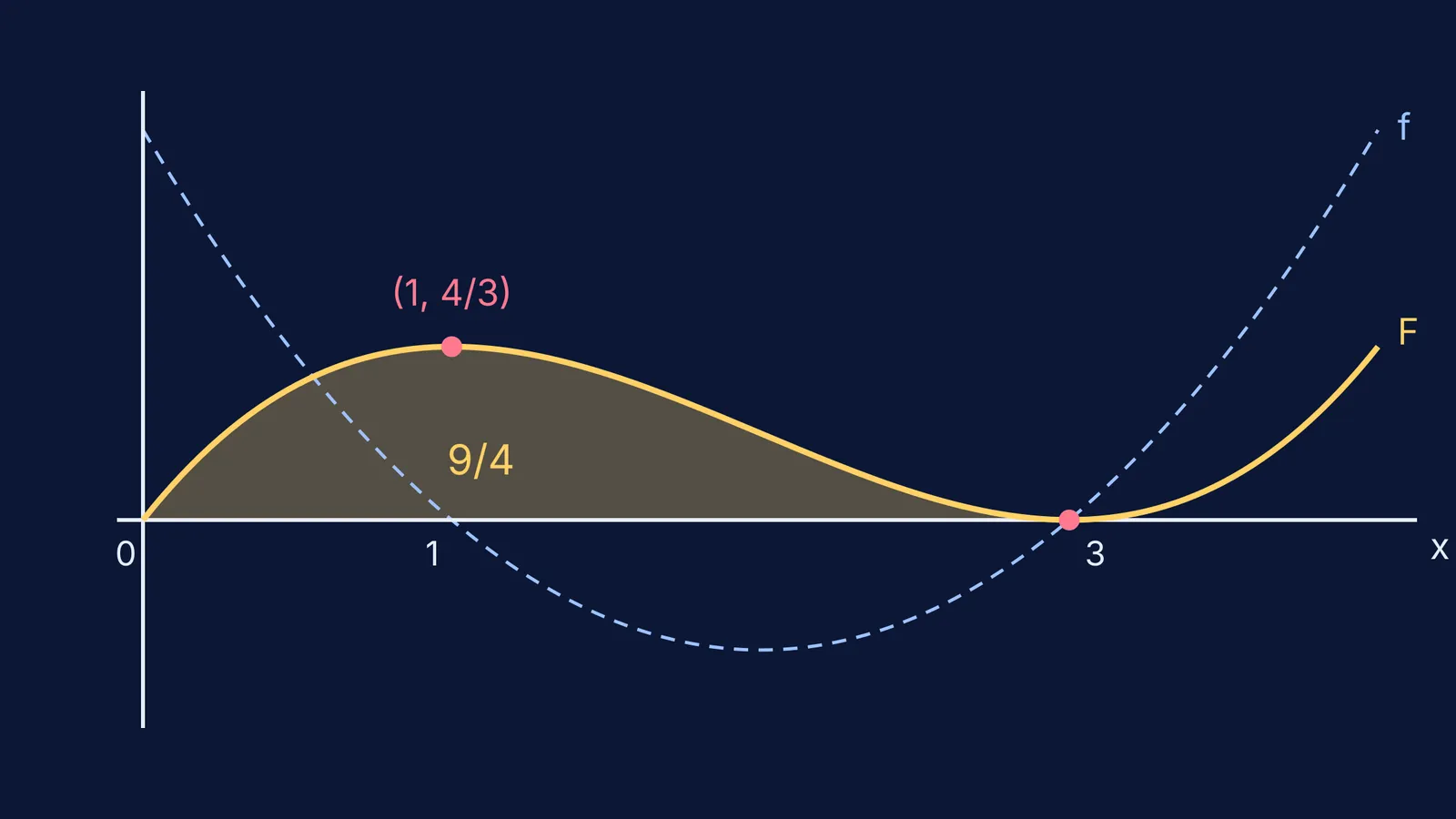
Paragraph. Let F(x) = ∫₀ˣ (t − 1)(t − 3) dt for x ≥ 0.
Q1. The local maximum value of F is (A) 0 (B) 4/3 (C) 1 (D) 3.
By the fundamental theorem, F′(x) = (x − 1)(x − 3). F′ changes from positive to negative at x = 1, so the maximum is F(1) = ∫₀¹ (t² − 4t + 3) dt = 1/3 − 2 + 3 = 4/3: option (B). Option (A) is the integrand's value at t = 1, and (C) is where the maximum happens, not its value.
Q2. The area between y = F(x) and the x-axis from x = 0 to x = 3 is (A) 0 (B) 27/4 (C) 9/4 (D) 4/3.
Keep the antiderivative from Q1: F(x) = x³/3 − 2x² + 3x = (x/3)(x − 3)². So F ≥ 0 on [0, 3] and touches zero at x = 3, where F′ is also zero. Area = (1/3)∫₀³ (x³ − 6x² + 9x) dx = (1/3)(81/4 − 54 + 81/2) = 9/4: option (C).
The tempting option is (A): integrating the integrand (t − 1)(t − 3) from 0 to 3 gives 9 − 18 + 9 = 0, the signed area of the wrong curve. Option (B) forgets the 1/3.
Paragraph 2: how does a reduction formula link three questions?
Paragraph. For n = 0, 1, 2, …, let Iₙ = ∫₀¹ xⁿ eˣ dx.
Q1. For n ≥ 1, (A) Iₙ = e − nIₙ₋₁ (B) Iₙ = e + nIₙ₋₁ (C) Iₙ = nIₙ₋₁ − e (D) Iₙ = e − Iₙ₋₁.
Integrate by parts with u = xⁿ and dv = eˣ dx: Iₙ = [xⁿeˣ]₀¹ − n∫₀¹ xⁿ⁻¹eˣ dx = e − nIₙ₋₁: option (A). The boundary term is e − 0 because 0ⁿ = 0 for n ≥ 1. Option (B) is the sign slip from dropping the minus in integration by parts.
Q2. I₃ equals (A) 6 − 2e (B) −2e (C) 2e − 5 (D) e − 2.
Start from I₀ = e − 1 and apply Q1's relation: I₁ = e − (e − 1) = 1, I₂ = e − 2, I₃ = e − 3(e − 2) = 6 − 2e, about 0.563: option (A). Option (D) is I₂, one step short.
The tempting slip is I₀ = e, forgetting e⁰ = 1. That chain gives option (B), −2e, negative for a positive integrand.
Q3. As n → ∞, nIₙ tends to (A) 0 (B) 1 (C) e (D) e − 1.
Since eˣ ≤ e on [0, 1], 0 < Iₙ ≤ e/(n + 1), so Iₙ → 0. Q1's relation for n + 1 gives (n + 1)Iₙ = e − Iₙ₊₁, which tends to e. Then nIₙ = (n + 1)Iₙ − Iₙ → e, about 2.718: option (C).
The tempting answer is (A), because Iₙ → 0. But n grows as fast as Iₙ shrinks.
Paragraph 3: how does a given property set up the next answer?
Paragraph. For f continuous on [a, b], ∫ₐᵇ f(x) dx = ∫ₐᵇ f(a + b − x) dx. Let K = ∫₀^π sin x/(1 + cos²x) dx and J = ∫₀^π x sin x/(1 + cos²x) dx.
Q1. K equals (A) 0 (B) π/4 (C) π/2 (D) π.
Put u = cos x, so du = −sin x dx and the limits run from 1 to −1. The minus sign flips them back: K = ∫₋₁¹ du/(1 + u²) = tan⁻¹1 − tan⁻¹(−1) = π/2: option (C). Option (B) is tan⁻¹1 alone, from losing the lower limit.
Q2. J equals (A) π²/4 (B) π²/2 (C) π/2 (D) π²/8.
Use the property the paragraph hands you. Replacing x by π − x leaves sin x and cos²x unchanged, so J = ∫₀^π (π − x) sin x/(1 + cos²x) dx = πK − J. Then 2J = πK and, with K from Q1, J = π²/4: option (A).
Option (B) is πK, forgetting that J appears on both sides. Option (D) is Q1's trap value π/4 carried forward: one slip, two wrong answers.
How do you read an integral calculus paragraph quickly?
Read every question first. The last one tells you whether to keep a function, a formula or a number.
Mark what the paragraph defines, and keep the integrand and the integral apart.
Turn each definition into a tool at once: F′ by the fundamental theorem, a recurrence by parts.
A property stated in the paragraph will be used later.
Check signs and sizes: a positive integrand gives a positive integral.
Next, try the integral calculus JEE Advanced practice set with solutions, then the chapter's multiple-correct questions and numerical answer questions.
If a step loses you, the Fermi Problem Library has a step-by-step solver that explains the reasoning. To plan the rest of your preparation, start at Fermi Test Prep for JEE Main and Advanced.