

On this page
Each question has one numerical answer and no options. Work it on paper before reading the solution. All eight are original.
How does the JEE Advanced numerical answer format work?
In the official JEE (Advanced) 2025 Paper 1, mathematics Section 3 had six numerical-value questions, typed on an on-screen keypad. Values with more than two decimal places were to be truncated or rounded to two. A correct value earned 4 marks and anything else 0.
The JEE (Advanced) 2026 syllabus lists definite integrals as the limit of sums, their properties, substitution, integration by parts and areas bounded by simple curves under Integral Calculus. Every question here stays inside that list, and truncating or rounding each answer gives the same two decimals.
Questions 1 to 4: easy to medium
Q1 (easy). Find ∫₀² |x² − 1| dx.
Answer: 2 (enter 2). Split at x = 1: ∫₀¹ (1 − x²) dx = 2/3 and ∫₁² (x² − 1) dx = 4/3. Where the mark goes: dropping the modulus, which gives 2/3.
Q2 (easy to medium). A continuous f satisfies f(x) = x² + x∫₀¹ f(t) dt for all real x. Find f(3).
Answer: 11 (enter 11). Call the constant integral A, so f(x) = x² + Ax. Integrating from 0 to 1 gives A = 1/3 + A/2, so A = 2/3 and f(3) = 9 + 2 = 11. Check: ∫₀¹ (x² + 2x/3) dx = 2/3. Where the mark goes: taking A = 1/3, which gives 10.
Q3 (medium). Find ∫₀² [x²] dx, where [·] is the greatest integer function.
Answer: 5 − √2 − √3, about 1.8537 (enter 1.85). [x²] jumps at x = 1, √2 and √3, so the integral is 1(√2 − 1) + 2(√3 − √2) + 3(2 − √3) = 5 − √2 − √3. Check: it is below ∫₀² x² dx = 8/3. Where the mark goes: rounding √2 and √3 to 1.41 and 1.73 first, which gives 1.86.
Q4 (medium). Find the limit as n → ∞ of the sum of k/(n² + k²) for k = 1 to 2n.
Answer: ½ ln 5, about 0.8047 (enter 0.80). Each term is (1/n) × (k/n)/(1 + (k/n)²), and k/n runs from 0 to 2, so the limit is ∫₀² x/(1 + x²) dx = ½ ln 5. Check: the integrand never exceeds ½, so the answer is below 1. Where the mark goes: using upper limit 1 from habit, which gives about 0.35.
Questions 5 to 8: medium to hard
Q5 (medium). Find the limit as x → 0 of (1/x⁴) times the integral of ln(1 + t) from 0 to x².
Answer: 1/2 (enter 0.5). It is 0/0. By L'Hôpital and the Leibniz rule, the ratio becomes 2x ln(1 + x²)/4x³, which tends to 2x³/4x³ = 1/2. Check: ln(1 + t) ≈ t for small t, so the integral is about x⁴/2. Where the mark goes: dropping the 2x from the upper limit.
Q6 (medium to hard). Let f(x) = 1/(1 + e^(sin x)). Find the integral of f from 0 to 2π.
Answer: π, about 3.1416 (enter 3.14). By the integral from 0 to 2a property, it equals the integral from 0 to π of f(x) + f(2π − x). Since sin(2π − x) = −sin x and 1/(1 + e^s) + 1/(1 + e^(−s)) = 1, that sum is 1, giving π. Check: the integrand is ½ wherever sin x = 0. Where the mark goes: assuming f(2π − x) = f(x) and doubling.
Q7 (hard). Find ∫₀¹ ln(1 + x)/(1 + x²) dx.
Answer: (π/8) ln 2, about 0.2722 (enter 0.27). Put x = tan θ to get I as the integral of ln(1 + tan θ) from 0 to π/4. Replace θ by π/4 − θ: 1 + tan(π/4 − θ) = 2/(1 + tan θ), so 2I = (π/4) ln 2. Check: Simpson's rule at 0, 0.5 and 1 gives about 0.274. Where the mark goes: stopping at 2I and entering 0.54.
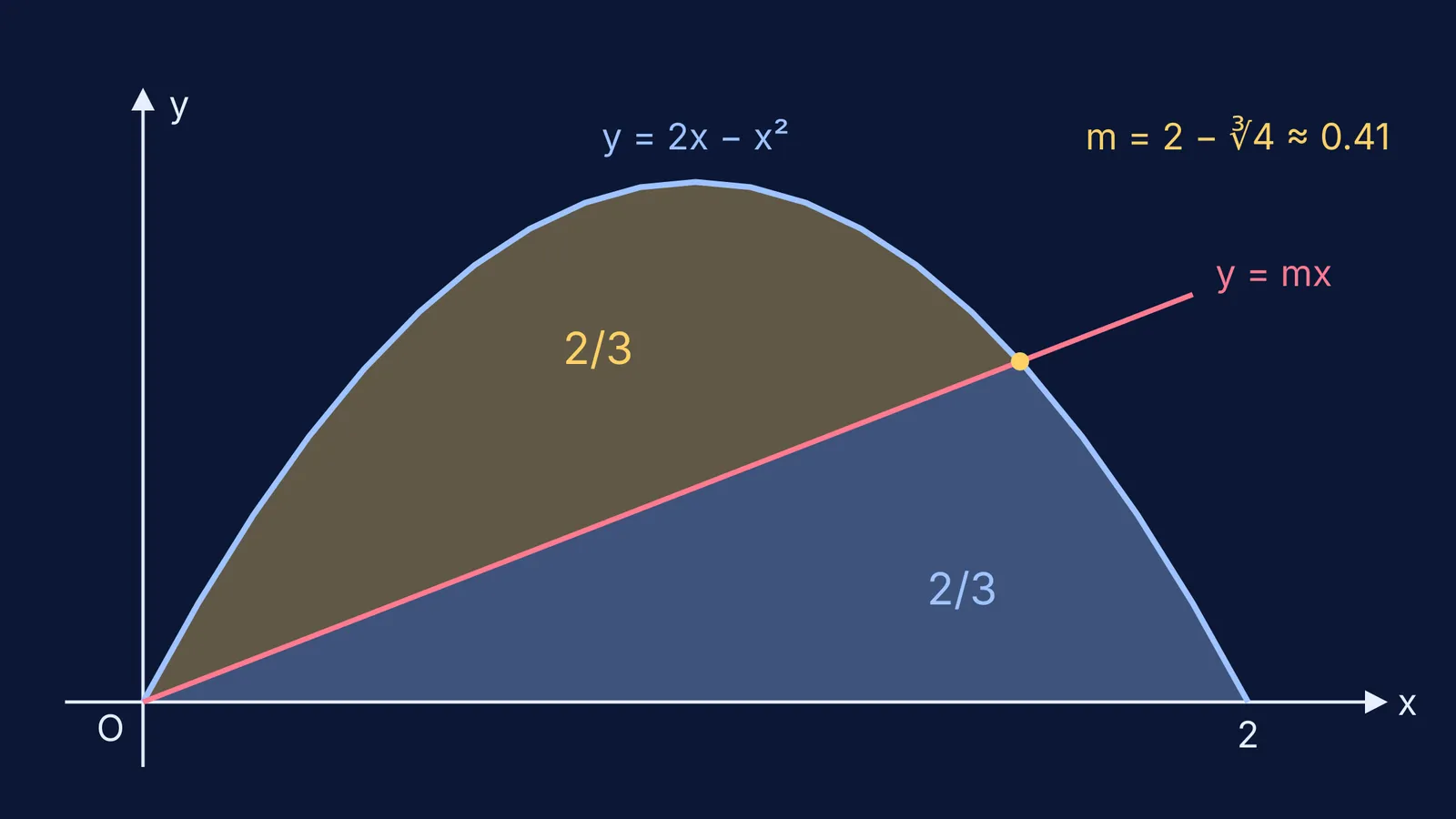
Q8 (hard). The line y = mx (m > 0) cuts the region between y = 2x − x² and the x-axis into two equal areas. Find m.
Answer: 2 − ∛4, about 0.4126 (enter 0.41). The region's area is ∫₀² (2x − x²) dx = 4/3. The line meets the parabola at x = 2 − m, and the area between them is (2 − m)³/6. Setting this to 2/3 gives (2 − m)³ = 4. Check: 1.5874³ ≈ 4.000. Where the mark goes: equating (2 − m)³/6 to the whole area, which gives m = 0.
How should you review integral calculus mistakes?
Next to every miss, write the step where the mark went.
Redo the misses later in the week with the solutions covered.
Move on to the mixed-format JEE Advanced integral calculus practice set with solutions.
If a topic feels shaky, revisit how to prepare integral calculus for JEE Advanced.
If the method went wrong rather than the arithmetic, the Fermi Problem Library has a step-by-step solver that explains the reasoning rather than printing an answer. For JEE Main and Advanced preparation, start at Fermi Test Prep.


