On this page
These eight original questions run from easy to hard, each labelled with its type and followed by a worked solution and the trap: the tempting wrong option.
The JEE (Advanced) 2026 syllabus lists limits of sums, properties of definite integrals, the fundamental theorem, parts, substitution, partial fractions and areas bounded by simple curves. All eight sit inside it. New to the chapter? Start with our guide on how to prepare integral calculus for JEE Advanced.
How should you use this JEE Advanced integral calculus set?
For "one or more options correct", test every statement on its own. Our explainer on JEE Advanced question types covers each.
Take 30 minutes, solutions covered.
Write one line of reasoning per answer.
Easy: can you convert, substitute and use symmetry?
Q1 (easy, single-correct). lim (n → ∞) of the sum over k = n + 1 to 3n of n/(k² + n²) equals
(A) tan⁻¹ 2 (B) tan⁻¹ 3 (C) tan⁻¹(1/2) (D) (1/2) ln 5
Answer: (C). Each term is (1/n) × 1/(1 + (k/n)²) and x = k/n runs from 1 to 3, so the limit is ∫ from 1 to 3 of dx/(1 + x²) = tan⁻¹ 3 − tan⁻¹ 1 = tan⁻¹(1/2). Trap: (B) starts the integral at 0 out of habit.
Q2 (easy, numerical-value). f is continuous on [0, 4], f(x) = f(4 − x) for all x, and ∫ from 0 to 4 of f(x) dx = 10. Find ∫ from 0 to 4 of x f(x) dx.
Answer: 20. Replacing x by 4 − x gives I = ∫ from 0 to 4 of (4 − x) f(x) dx. Adding, 2I = 4 × 10, so I = 20. Trap: stopping at 2I and writing 40.
Q3 (easy, single-correct). ∫ from 0 to 1 of x sin⁻¹(x²) dx equals
(A) π/4 − 1/2 (B) π/2 − 1 (C) π/4 (D) π/4 + 1/2
Answer: (A). Put t = x², so x dx = dt/2 and the integral is (1/2) ∫ from 0 to 1 of sin⁻¹ t dt. By parts, ∫ from 0 to 1 of sin⁻¹ t dt = π/2 − 1; half is π/4 − 1/2. Trap: (B) drops the 1/2 from dt = 2x dx.
Medium: which property or theorem is hiding here?
Q4 (medium, one or more options correct). For n ≥ 0, let Kₙ = ∫ from 0 to 1 of xⁿ/(1 + x²) dx. Which statements are true?
(A) Kₙ + Kₙ₊₂ = 1/(n + 1) (B) K₄ = π/4 − 2/3 (C) K₃ = 1/2 − ln 2 (D) 2Kₙ₊₂ < 1/(n + 1)
Answer: (A), (B), (D). The integrands add to xⁿ, so (A) holds. K₂ = 1 − π/4 and K₄ = 1/3 − K₂ = π/4 − 2/3, so (B) holds. K₁ = (1/2) ln 2 gives K₃ = 1/2 − (1/2) ln 2, so (C) is false. On (0, 1), xⁿ⁺² < xⁿ, so Kₙ₊₂ < Kₙ and 2Kₙ₊₂ < Kₙ + Kₙ₊₂ = 1/(n + 1); (D) holds. Trap: (C) drops the 1/2 in K₁.
Q5 (medium, one or more options correct). Let F(x) = ∫ from 0 to x of (t − 1)(t − 2)e^(−t) dt for x > 0. Which statements are true?
(A) F has a local maximum at x = 1 (B) F(2) < 0 (C) F(x) < 1 for every x > 0 (D) F(2) = 1 − 3/e²
Answer: (A), (C), (D). F′(x) = (x − 1)(x − 2)e^(−x) changes from positive to negative at x = 1, so (A) holds. By parts, F(x) = 1 − (x² − x + 1)e^(−x). As x² − x + 1 > 0, F(x) < 1, so (C) holds; F(2) = 1 − 3/e² ≈ 0.59, so (D) holds and (B) fails. Trap: (B) sees the integrand negative on (1, 2) and ignores the larger positive area from 0 to 1.
Q6 (medium, numerical-value). f is continuous and f(x) = x + ∫ from 0 to 1 of (x + t) f(t) dt for all real x. Find f(−2).
Answer: 8. Let A = ∫ from 0 to 1 of f(t) dt and B = ∫ from 0 to 1 of t f(t) dt, both constants. Then f(x) = (1 + A)x + B, and A = (1 + A)/2 + B and B = (1 + A)/3 + B/2, so A = −7 and B = −4. So f(x) = −6x − 4 and f(−2) = 8. Trap: losing the x inside the integral.
Hard: can you set up the area before you integrate?
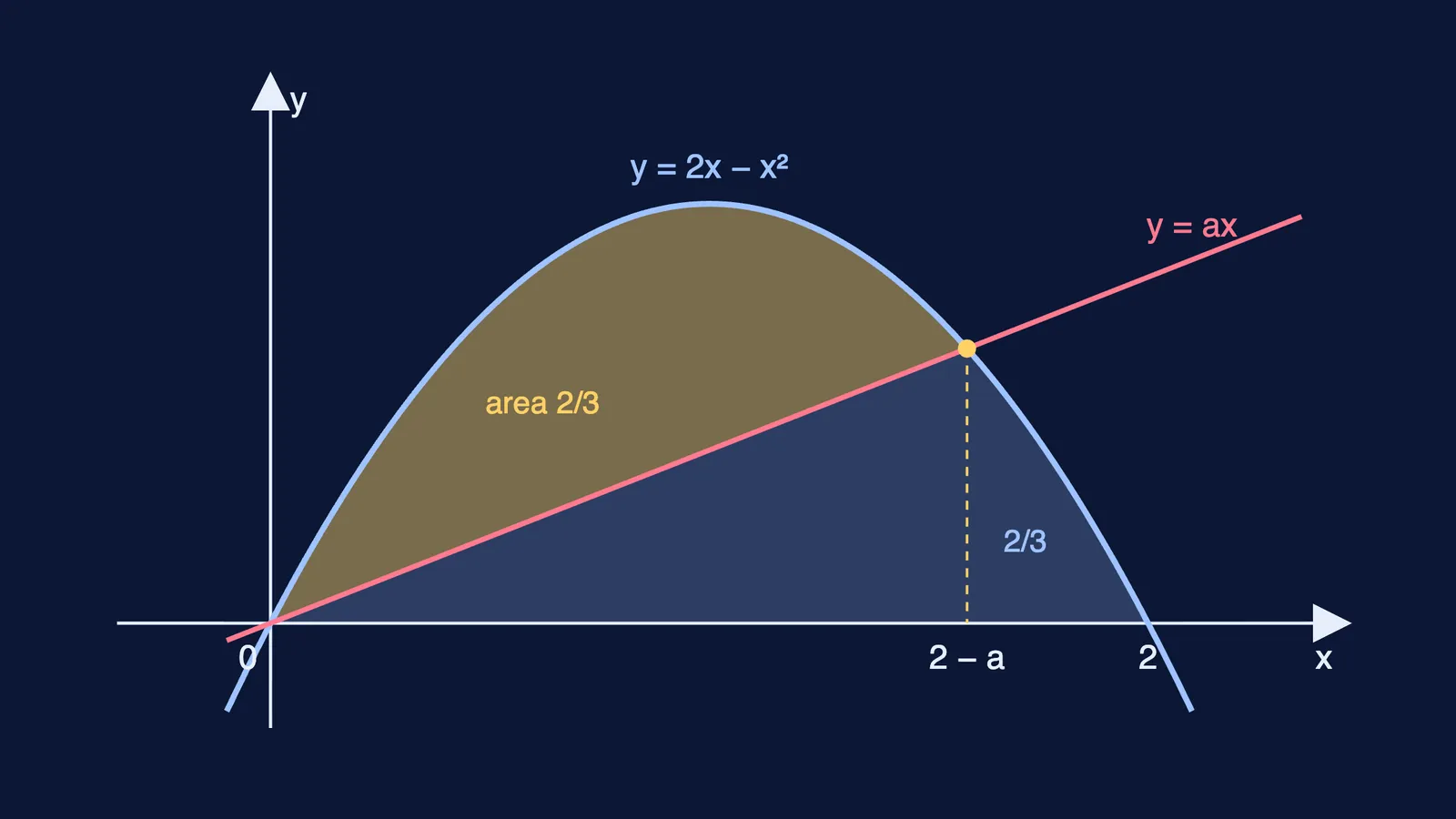
Q7 (hard, single-correct). For 0 < a < 2, the line y = ax divides the region between y = 2x − x² and the x-axis into two parts of equal area. Then a equals
(A) 1/3 (B) 2 − ∛4 (C) 2 − ∛2 (D) 1
Answer: (B). The full area is ∫ from 0 to 2 of (2x − x²) dx = 4/3. The line meets the parabola at x = 2 − a, and the part above the line has area ∫ from 0 to 2 − a of ((2 − a)x − x²) dx = (2 − a)³/6. Setting this to 2/3 gives (2 − a)³ = 4, so a = 2 − ∛4. Trap: (A) integrates 2x − x² − ax from 0 to 2, past the intersection.
Q8 (hard, numerical-value). Let f(x) = x³ + x + 1. Find ∫ from 1 to 11 of f⁻¹(y) dy.
Answer: 14. f′(x) = 3x² + 1 > 0, so f is invertible, with f(0) = 1 and f(2) = 11. Then ∫ from 1 to 11 of f⁻¹(y) dy = 2 × 11 − 0 × 1 − ∫ from 0 to 2 of f(x) dx = 22 − 8 = 14. Trap: reporting 8, the area under f itself. The picture is in the integral of an inverse function using area.
What should you revise after this set?
Sort misses by idea: limits of sums (Q1), properties of definite integrals (Q2, Q4), parts and substitution (Q3), the fundamental theorem (Q5, Q6) and areas (Q7, Q8). For each miss, write down the line you skipped.
For more practice, the Fermi Problem Library has worked problems with a step-by-step solver that explains the reasoning rather than printing an answer. Retry these eight in a week.