

On this page
Some JEE questions hand you a function like f(x) = x³ + x and ask for the integral of its inverse. Writing f⁻¹ means solving a cubic. You don't need f⁻¹ at all: one picture turns the question into an integral of f.
What is the formula for the integral of an inverse function?
If f is continuous and strictly monotonic on [a, b], then ∫ from a to b of f(x) dx + ∫ from f(a) to f(b) of f⁻¹(y) dy = b·f(b) − a·f(a), as stated in the Wikipedia article on integrals of inverse functions. The same article notes that Charles-Ange Laisant published the formula in 1905, and that one of his proofs was geometric.
Rearranged for exams: ∫ from f(a) to f(b) of f⁻¹(y) dy = b·f(b) − a·f(a) − ∫ from a to b of f(x) dx. The right-hand side contains only f. That is the whole trick.
Why does the area picture work?
Take an increasing f with a ≥ 0 and f(a) ≥ 0, and draw it from x = a to x = b. Two regions sit next to the curve.
The area between the curve and the x-axis, from x = a to x = b, is ∫f(x) dx.
The area between the curve and the y-axis, from y = f(a) to y = f(b), is ∫f⁻¹(y) dy. The graph of f⁻¹ is the same curve read sideways, so its width at height y is exactly f⁻¹(y).
Together, the two regions fill the big rectangle with corners (0, 0) and (b, f(b)), except for the small rectangle with corners (0, 0) and (a, f(a)), which neither of them covers. So their sum is b·f(b) − a·f(a). If you want a refresher on why an integral measures area in the first place, read why integration gives area under a curve.
If the function you are given is not one-one, see how to make a function one-one by restricting its domain before using the formula.
How do you use it on a JEE-style question?
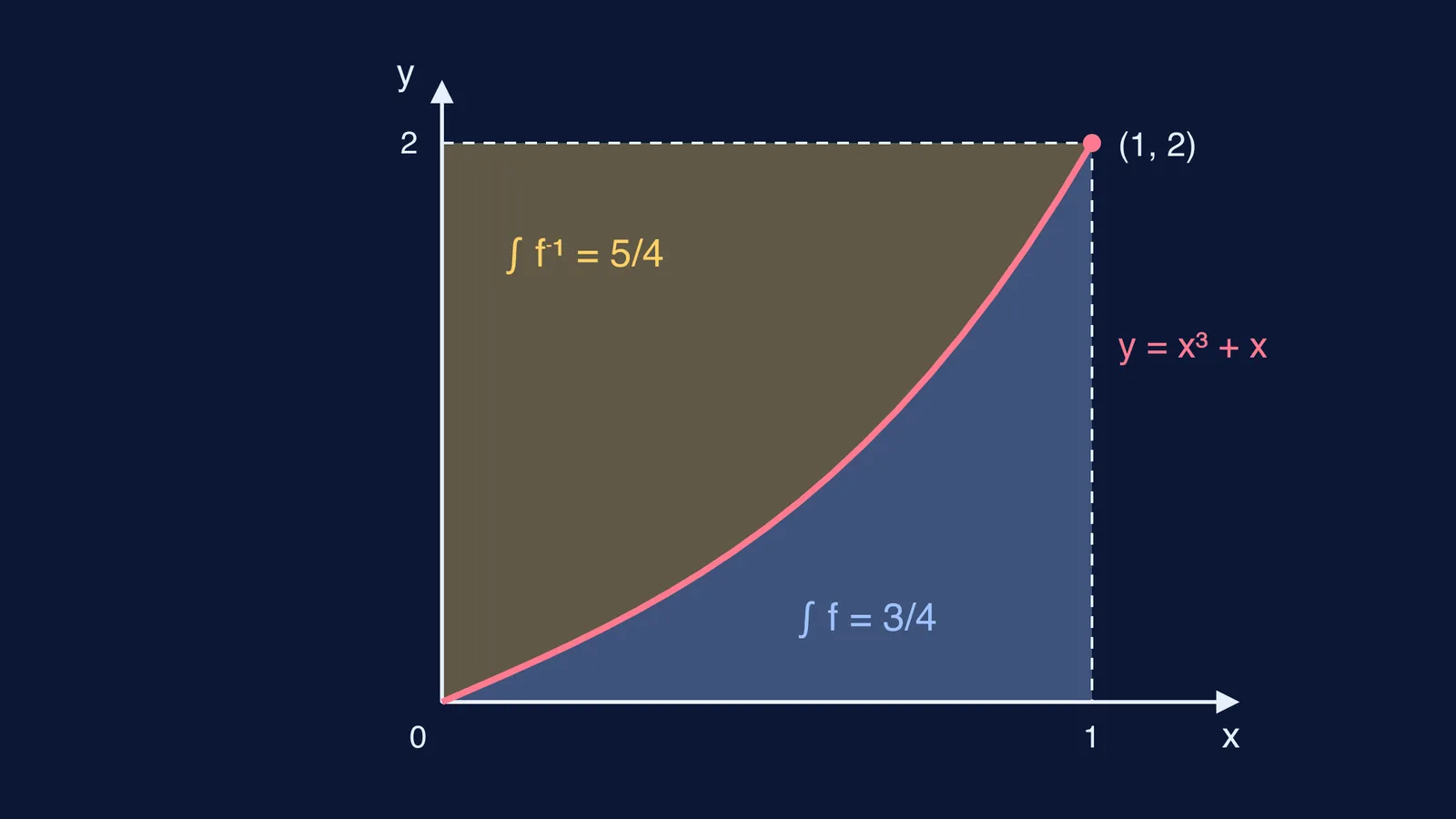
Question. Let f(x) = x³ + x. Find the integral of f⁻¹(y) from y = 0 to y = 2.
Check that f is one-one. f′(x) = 3x² + 1, which is always positive, so f is strictly increasing and f⁻¹ exists.
Turn the y-limits into x-limits. f(0) = 0 and f(1) = 1 + 1 = 2, so a = 0 and b = 1.
Integrate f, not f⁻¹. ∫ from 0 to 1 of (x³ + x) dx = 1/4 + 1/2 = 3/4.
Apply the formula. Answer = b·f(b) − a·f(a) − 3/4 = 1·2 − 0 − 3/4 = 5/4.
The top diagram shows it: the 1 by 2 rectangle split into 3/4 below the curve and 5/4 to its left.
In step 2, remember that the limits in the question belong to y, so find the x values that produce them. Try 0, 1 and −1 first.
Can you check the formula on functions you already know?
Yes. Do it once so you trust it.
Logarithm. ln is the inverse of eˣ. With f(x) = eˣ, a = 0 and b = 1, the formula gives ∫ from 1 to e of ln y dy = 1·e − 0·1 − ∫ from 0 to 1 of eˣ dx = e − (e − 1) = 1. Integrating ln y by parts gives [y ln y − y] from 1 to e = 0 − (−1) = 1. They match.
Inverse sine. With f(x) = sin x, a = 0 and b = π/6, the formula gives ∫ from 0 to 1/2 of sin⁻¹y dy = (π/6)(1/2) − (1 − √3/2) = π/12 + √3/2 − 1. By parts gives the same value, with more work. For a by-parts example where the inverse function cannot be avoided, see the integral of x tan⁻¹x.
A five-step checklist for the exam
Do you see f⁻¹ inside an integral, with f given as a formula? Use the area method.
Is f one-one on the interval? Check the sign of f′.
Solve f(a) = lower limit and f(b) = upper limit for a and b.
Write b·f(b) − a·f(a) − ∫ from a to b of f(x) dx.
Sketch it to check the answer is sensible.
If you get stuck on step 3, or your answer comes out negative when the sketch says it should be positive, the Fermi Problem Library has worked problems with a step-by-step solver that explains the reasoning rather than printing an answer. If the gap is in inverse functions themselves, the Fermi Concept Library gives each mathematics concept its own lesson.
Next time you see f⁻¹ in an integral, draw the rectangle before you write anything else.


