On this page
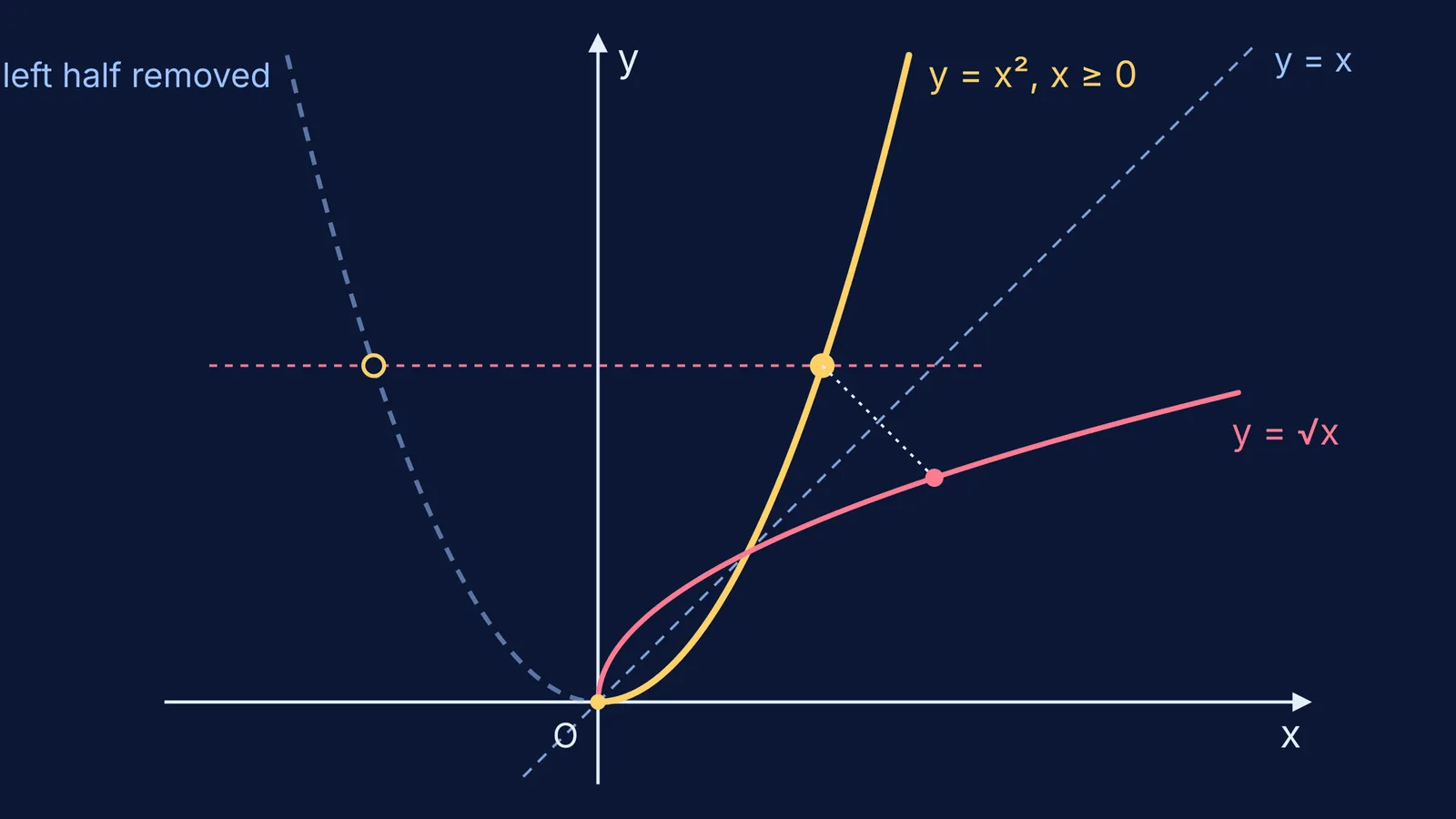
Ask for the inverse of f(x) = x² and you hit a wall: f(2) = 4 and f(−2) = 4, so an inverse would have to send 4 back to two different places. The fix is not a new formula. It is a smaller domain, and principal branches of inverse trigonometric functions are the same trick.
Why doesn't x² have an inverse on all real numbers?
The Class 12 NCERT textbook states the rule in its chapter on inverse trigonometric functions: the inverse of a function f exists if f is one-one and onto.
One-one means no two inputs share an output. On a graph, no horizontal line may cut it twice, and y = 4 cuts y = x² at x = 2 and x = −2. For a refresher, see checking one-one functions with the horizontal line test.
How do you restrict the domain to make a function one-one?
You throw away part of the domain so that every horizontal line meets what is left at most once. The OpenStax Precalculus 2e section on inverse functions does exactly this: x² with its domain limited to [0, ∞) is one-to-one and has the square-root function as its inverse.
Why x ≥ 0 and not x ≤ 0? Both halves pass the test; on (−∞, 0] the inverse would be −√x. Textbooks pick [0, ∞) because √ already means the non-negative root.
How do you find the largest interval where a function is one-one?
For a continuous function on an interval, being one-one is the same as being strictly increasing or strictly decreasing throughout. So the largest usable intervals run from one turning point to the next.
Find the turning points: where f′(x) changes sign, or x = −b/2a for a quadratic.
Mark the intervals between them, with a sign chart for increasing and decreasing.
Pick the interval containing the point the question cares about, turning point included.
Shrink the codomain to the range on that interval, so f is onto.
Solve y = f(x) for x, choosing the sign that fits your interval, then swap x and y.
Worked example: f(x) = x² − 4x + 3
Complete the square: f(x) = (x − 2)² − 1. The only turning point is the vertex at x = 2, so the two largest intervals are (−∞, 2] and [2, ∞).
Take [2, ∞). The smallest value is f(2) = −1, so the range is [−1, ∞). Now solve y = (x − 2)² − 1, which gives x − 2 = ±√(y + 1). Because x ≥ 2, x − 2 is never negative, so keep the plus sign: x = 2 + √(y + 1). Swapping letters, f⁻¹(x) = 2 + √(x + 1), with domain [−1, ∞).
Check it: f(5) = 8, and f⁻¹(8) = 2 + √9 = 5. On (−∞, 2] the same steps give 2 − √(x + 1).
Notice what fails. [1, ∞) is not allowed, because f(1) = f(3) = 0. [3, ∞) works but is not the largest, because it extends down to 2 without breaking anything.
How is this the same idea as principal value branches?
Sine repeats forever, so it fails the horizontal line test badly. NCERT's inverse trigonometric functions chapter says that if you restrict sine's domain to [−π/2, π/2], it becomes one-one and onto with range [−1, 1].
The same chapter notes that intervals such as [−3π/2, −π/2] and [π/2, 3π/2] work too; each gives a branch of sin⁻¹, and the branch with range [−π/2, π/2] is called the principal value branch. For cosine, NCERT restricts the domain to [0, π], which gives cos⁻¹ the range [0, π].
Run the five steps on sine and you land in the same place: sine turns at ±π/2, so [−π/2, π/2] is the largest interval containing 0 on which it only rises. A principal branch is a one-one piece textbooks agree to use, like 0, ∞) for x². Our explainer on [inverse trigonometric functions and their principal values goes further.
This explains a classic trap. NCERT gives sin⁻¹(sin x) = x for −π/2 ≤ x ≤ π/2; outside that interval it fails, for the same reason √(x²) is |x|, not x.
What should you write in an exam answer?
The turning point, and why f is strictly increasing or decreasing on your interval.
The restricted domain and the matching range.
The sign choice at the square root, with the reason.
The domain of f⁻¹, which is the range of f.
One value checked through f and then f⁻¹.
If one-one, onto and inverse still feel shaky, the Fermi Concept Library gives each mathematics concept its own lesson and its place in the map. To practise, the Fermi Problem Library has worked problems with a step-by-step solver that explains the reasoning rather than printing an answer.