On this page
Each option is its own true-or-false statement: four small proofs, not one guess. Here are eight original questions in the JEE Advanced style.
How does partial marking work in JEE Advanced multiple-correct questions?
In the JEE Advanced 2024 Paper 1 mathematics section with one or more correct options, choosing exactly the correct options earned +4 marks. Choosing only some correct options and no wrong one earned +3, +2 or +1; a blank earned 0; any wrong option earned −2. Recheck each year's paper.
Which options are true in differential equations questions 1 to 4?
Q1. [1 + (dy/dx)²]^(3/2) = k·d²y/dx², with k a non-zero constant.
(A) Order 2. True: the highest derivative is y″.
(B) Degree 2. True: squaring gives (1 + y′²)³ = k²(y″)².
(C) Degree 3/2. False: a degree is a positive integer.
(D) Linear. False: y′ sits inside a power.
Answer: A, B. Read the degree before squaring and you miss B.
Q2. Eliminate A and B from y = Ae^(2x) + Be^(−x).
(A) Order 2. True: two constants, two differentiations.
(B) y″ − y′ − 2y = 0. True: 2 and −1 are the roots of r² − r − 2 = 0.
(C) y″ + y′ − 2y = 0. False: its roots are 1 and −2.
(D) y = 3e^(2x) also satisfies it. True: A = 3, B = 0.
Answer: A, B, D. D is easy to miss.
Q3. dy/dx = (1 + y²)/(1 + x²), y(0) = 1.
(A) y = (1 + x)/(1 − x). True: tan⁻¹y = tan⁻¹x + π/4.
(B) y(1/2) = 3. True.
(C) The solution exists for every real x. False: it blows up at x = 1.
(D) xy + x − y + 1 = 0. True: A rearranged.
Answer: A, B, D. C is the wrong tick; D is easy to miss.
Q4. dy/dx = (x² + y²)/(2xy) for x, y > 0, through (2, √2).
(A) The equation is homogeneous. True: x → tx, y → ty leaves the right side unchanged.
(B) The curve is x² − y² = x. True: y = vx gives 2v dv/(1 − v²) = dx/x, so x² − y² = Cx, C = 1.
(C) It passes through (3, √6). True: 9 − 6 = 3.
(D) It is a circle. False: a hyperbola.
Answer: A, B, C. D is the wrong tick: one sign slip gives dy/dx = (y² − x²)/(2xy), whose solutions are circles.
Which options are true in differential equations questions 5 to 8?
Q5. dy/dx + y tan x = sec x on (−π/2, π/2), y(0) = 1.
(A) Integrating factor sec x. True: e^(∫tan x dx) = e^(ln sec x).
(B) Integrating factor cos x. False: ∫tan x dx = −ln cos x.
(C) y = sin x + cos x. True: y sec x = tan x + 1.
(D) The largest value of y is √2. True: y = √2 sin(x + π/4).
Answer: A, C, D. B is the wrong tick; D is easy to miss if you stop at y.
Q6. dy/dx + y/x = xy² for x > 0, y(1) = 1.
(A) z = 1/y gives z′ + z/x = −x. False: z′ = −y′/y², so z′ − z/x = −x.
(B) y = 1/(2x − x²). True: z/x = −x + C with C = 2.
(C) y(1/2) = 3/4. False: it is 4/3.
(D) Defined for every x > 0. False: it blows up at x = 2.
Answer: B only. A is the tempting wrong tick: it drops the minus sign in z′.
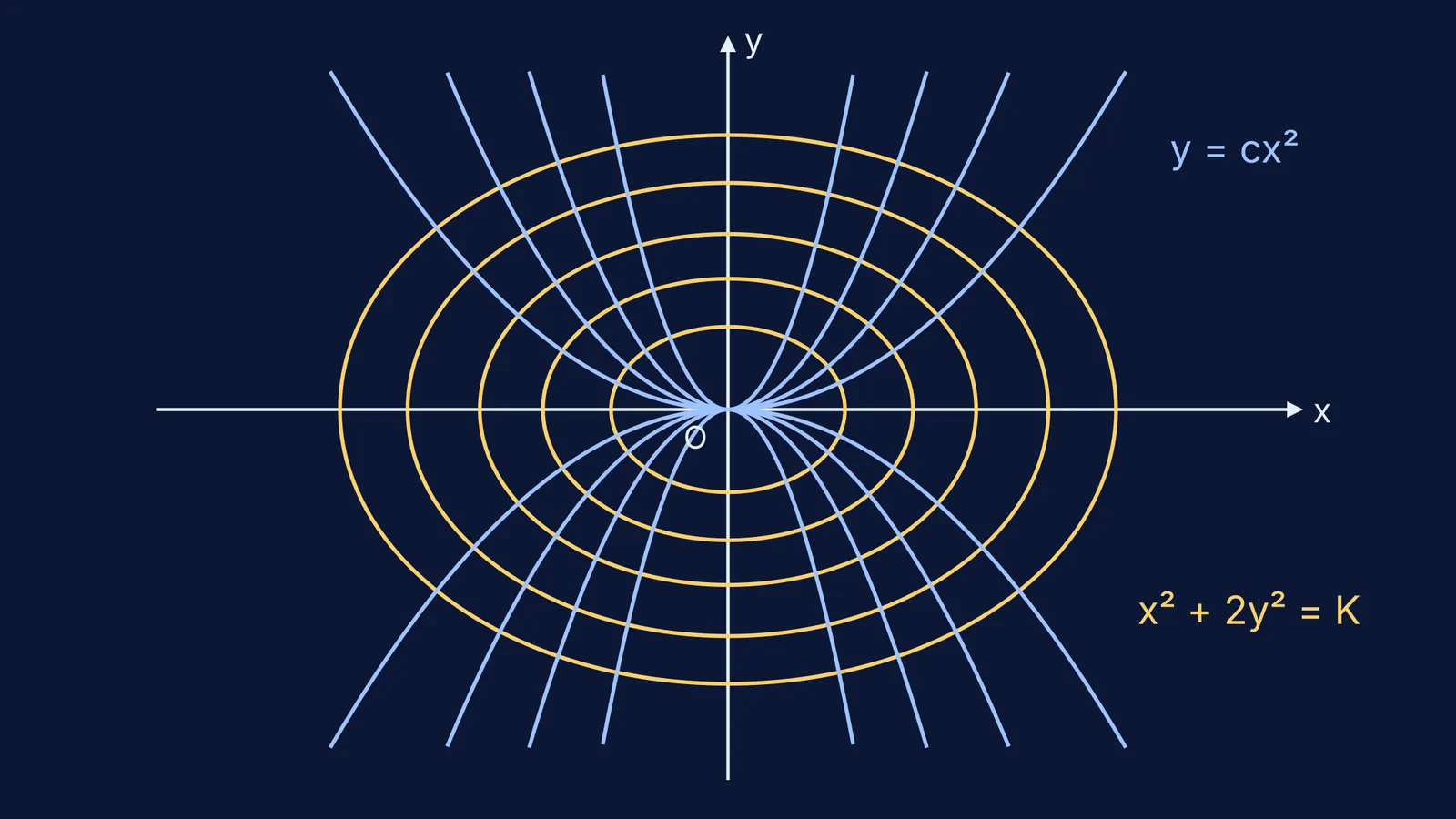
Q7. The parabolas y = cx² and their orthogonal trajectories.
(A) The family satisfies xy′ = 2y. True: y′ = 2cx = 2y/x.
(B) The trajectories are x² + 2y² = K. True: y′ → −1/y′ gives 2y dy = −x dx.
(C) They are 2x² + y² = K. False: coefficients swapped.
(D) They are ellipses of eccentricity 1/√2. True: a² = K, b² = K/2.
Answer: A, B, D. C is the wrong tick; D is easy to miss.
Q8. dy/dx = y(1 − y), y(0) = 1/2.
(A) y increases for every x. True: y = eˣ/(1 + eˣ) stays in (0, 1), so y′ > 0.
(B) y → 1 as x → ∞. True.
(C) Inflection point at x = 0. True: y″ = y′(1 − 2y) changes sign where y = 1/2.
(D) y(ln 3) = 3/4. True.
Answer: all four. If you expect a trap, you may leave out C.
How should you practise multiple-correct differential equation questions?
Write T or F with a one-line reason beside each option.
Score yourself with the real scheme, negative mark included.
Name each slip and redo only those options later in the week.
For full solutions, work through the differential equations JEE Advanced practice set, then try the differential equations numerical-answer questions and how to prepare differential equations for JEE Advanced.
The Fermi Problem Library has a step-by-step solver that explains the reasoning. For JEE Main and Advanced preparation, see Fermi Test Prep.