On this page
Each question has one numerical answer and no options. All eight are original.
How does the JEE Advanced numerical answer format work?
In the official JEE (Advanced) 2025 Paper 1, mathematics Section 3 had six numerical-value questions, answered on an on-screen virtual numeric keypad. Values with more than two decimal places were to be truncated or rounded to two. A correct value earned 4 marks and anything else 0.
The JEE (Advanced) 2026 syllabus lists formation of ordinary differential equations, homogeneous first-order first-degree equations, separation of variables and linear first-order equations. Every question here stays inside that list, and truncating or rounding gives the same two decimals.
Questions 1 to 4: easy to medium
Q1 (easy). y = y(x) satisfies dy/dx = e^(x − y) with y(0) = ln 2. Find y(1).
Answer: ln(e + 1), about 1.3133 (enter 1.31). Separate: e^y dy = e^x dx, so e^y = e^x + C. At x = 0, 2 = 1 + C, so C = 1 and y = ln(e^x + 1). Check: differentiating gives e^x/(e^x + 1), which equals e^(x − y). Where the mark goes: dropping the constant, which gives y = x and the answer 1.
Q2 (easy to medium). For x > 0, dy/dx + y/x = x² and y(1) = 1. Find y(3).
Answer: 7 (enter 7). The integrating factor is e^(∫dx/x) = x, so (xy)′ = x³ and xy = x⁴/4 + C. From y(1) = 1, C = 3/4. At x = 3, 3y = 81/4 + 3/4 = 21, so y = 7. Check: y = x³/4 + 3/(4x) satisfies the equation. Where the mark goes: stopping at xy = 21 and entering 21.
Q3 (medium). For x > 0, xy dy/dx = x² + y² and y(1) = 2. Find [y(e)]².
Answer: 6e², about 44.3343 (enter 44.33). Put y = vx: v + x dv/dx = v + 1/v, so v dv = dx/x and v²/2 = ln x + C. At x = 1, v = 2, so C = 2 and y² = x²(2 ln x + 4). At x = e this is 6e². Check: at x = 1 the formula gives y² = 4. Where the mark goes: losing the ½ in v²/2, which gives 5e², about 36.95.
Q4 (medium). On [0, π/2), dy/dx + y tan x = sec x with y(0) = 1. Find the maximum value of y.
Answer: √2, about 1.4142 (enter 1.41). The integrating factor is e^(∫tan x dx) = sec x, so (y sec x)′ = sec² x and y sec x = tan x + 1. Hence y = sin x + cos x, largest at x = π/4. Check: y(0) = 1, and y tends to 1 as x approaches π/2. Where the mark goes: using cos x as the integrating factor.
Questions 5 to 8: medium to hard
Q5 (medium). A curve in the first quadrant passes through (2, 3), and the part of every tangent between the axes is bisected at the point of contact. Find the area between the curve, the x-axis, x = 2 and x = 6.
Answer: 6 ln 3, about 6.5917 (enter 6.59). The tangent at (x, y) meets the x-axis at x − y/y′. Bisection makes this 2x, so dy/dx = −y/x, giving xy = 6. The area is ∫₂⁶ 6/x dx = 6 ln 3. Check: it lies between the rectangles 4 × 1 and 4 × 3. Where the mark goes: a sign slip giving dy/dx = y/x and the area 24.
Q6 (medium to hard). A continuous f satisfies f(x) = 3x + 2∫₀ˣ f(t) dt for all real x. Find f(ln 2).
Answer: 9/2 (enter 4.5). Putting x = 0 gives f(0) = 0. Differentiating gives f′ = 3 + 2f, so ln(3 + 2f) = 2x + C, and f(0) = 0 makes 3 + 2f = 3e^(2x). Then f(x) = (3/2)(e^(2x) − 1) and f(ln 2) = (3/2)(4 − 1). Check: f′(0) = 3, matching 3 + 2f(0). Where the mark goes: missing the hidden condition f(0) = 0.
Q7 (hard). Tea at 100 °C in a 25 °C room cools at a rate proportional to its excess temperature. It is at 70 °C after 5 minutes. After how many minutes is it at 40 °C?
Answer: 5 ln 5/ln(5/3), about 15.7533 (enter 15.75). dT/dt = −k(T − 25) gives T − 25 = 75e^(−kt). From 45 = 75e^(−5k), e^(−5k) = 3/5. Setting 15 = 75(3/5)^(t/5) gives (3/5)^(t/5) = 1/5, so t = 5 ln 5/ln(5/3). Check: (3/5)³ = 0.216, just above 0.2, so t is just over 15. Where the mark goes: assuming a steady drop of 30 degrees every 5 minutes, which gives 10.
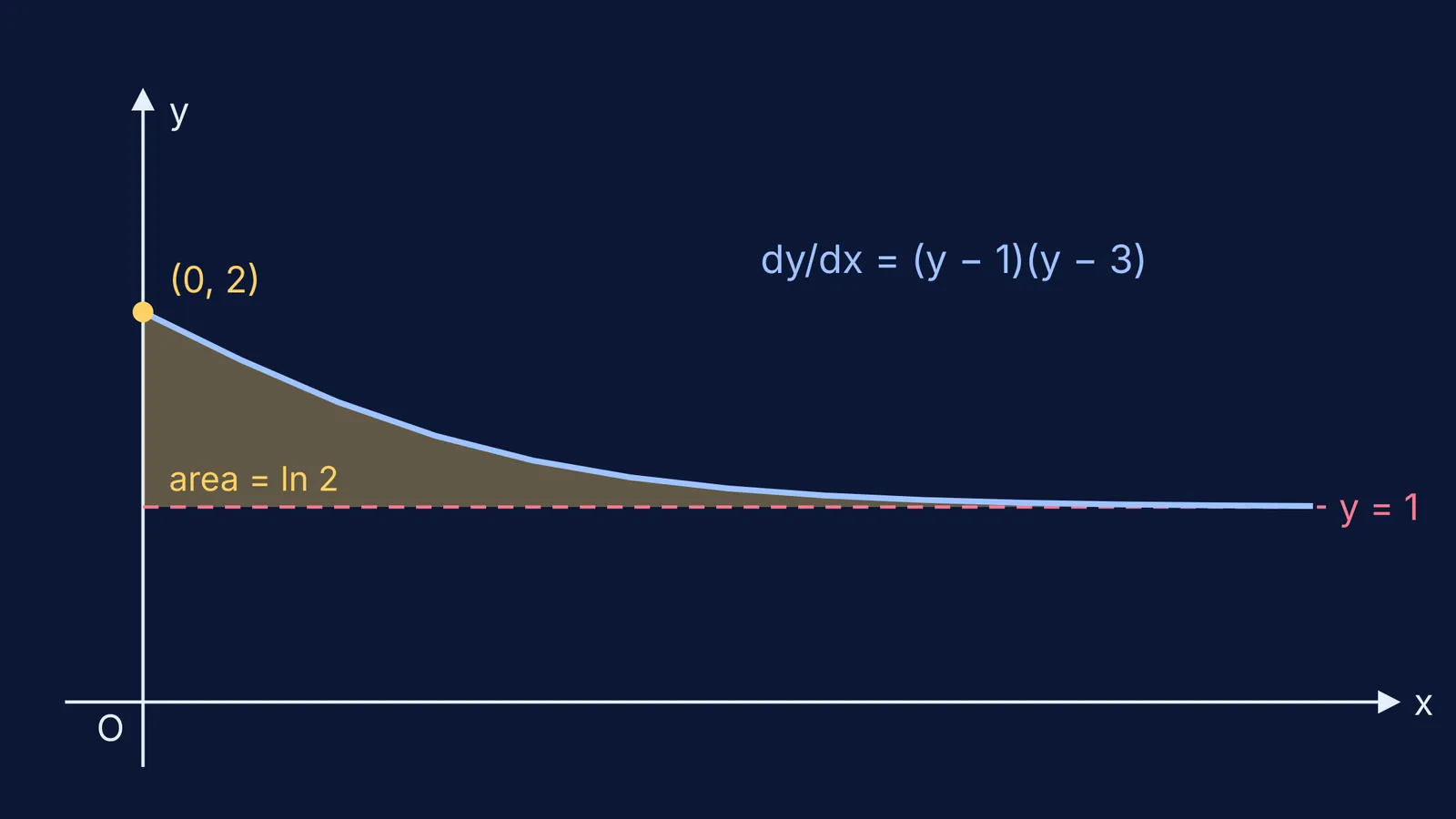
Q8 (hard). dy/dx = (y − 1)(y − 3) with y(0) = 2. Find the area between the curve, the y-axis and the line y = 1 for x ≥ 0.
Answer: ln 2, about 0.6931 (enter 0.69). Partial fractions give 1/((y − 1)(y − 3)) = ½[1/(y − 3) − 1/(y − 1)], so ½ ln|(y − 3)/(y − 1)| = x + C, and y(0) = 2 gives C = 0. Since 1 < y < 3, y = (3 + e^(2x))/(1 + e^(2x)), so y − 1 = 2/(1 + e^(2x)). The area is ∫₀^∞ 2e^(−2x)/(1 + e^(−2x)) dx = ln 2. Check: the slope at x = 0 is −1, so the curve falls towards 1. Where the mark goes: flipping the partial-fraction signs, which sends the curve towards y = 3.
What should you do after this set?
Next to every miss, write the step where the mark went.
Redo the misses later in the week with the solutions covered.
Move on to the mixed-format JEE Advanced differential equations practice set with solutions.
If the methods feel shaky, read how to prepare differential equations for JEE Advanced or warm up on JEE Main numerical questions on differential equations.
If the method went wrong rather than the arithmetic, the Fermi Problem Library has a step-by-step solver that explains the reasoning rather than printing an answer. For JEE Main and Advanced preparation, start at Fermi Test Prep.