On this page
JEE (Advanced) 2027 will be held on 23 May 2027, according to the official JEE (Advanced) website. Check the paper pattern there once it is published. Paragraph questions reward a skill that single-question practice rarely trains: setting up one situation and reusing it. Here are three original passages, solved as you would in rough work.
How do paragraph-based questions in vectors and 3D geometry work?
A passage defines a situation (points, lines, a plane), then two or three linked questions follow: a foot of perpendicular leads to an image, a volume leads to a distance. A wrong first answer tends to carry into the rest, so a careful first step beats speed.
Paragraph 1: where does a reflected ray meet the plane?
Passage. A ray of light starts at P(1, 3, 4), strikes the mirror plane 2x − y + z + 3 = 0 and, after reflection, passes through B(3, 5, 2).
Q1. Foot of the perpendicular from P. Put P + t(2, −1, 1) into the plane: 2(1 + 2t) − (3 − t) + (4 + t) + 3 = 0 gives 6 + 6t = 0, so t = −1. The foot is F(−1, 4, 3).
Q2. Image of P. The image lies twice as far along the same normal, so t = −2 gives P′(−3, 5, 2). You reuse t from Q1 instead of starting again.
Q3. Point where the ray strikes the mirror. A reflected ray looks as if it came from the image, so the strike point lies on line P′B. That line is (−3 + 6s, 5, 2). In the plane: −6 + 12s − 5 + 2 + 3 = 0 gives s = 1/2, so the ray strikes at R(0, 5, 2). Check: reflecting R − P = (−1, 2, −2) in the normal gives (3, 0, 0), exactly the direction from R to B.
The trap: an option built from line PB. P and B both give +6 in 2x − y + z + 3, so they sit on the same side and PB never touches the mirror. Using the foot F instead of the image P′ is the other trap.
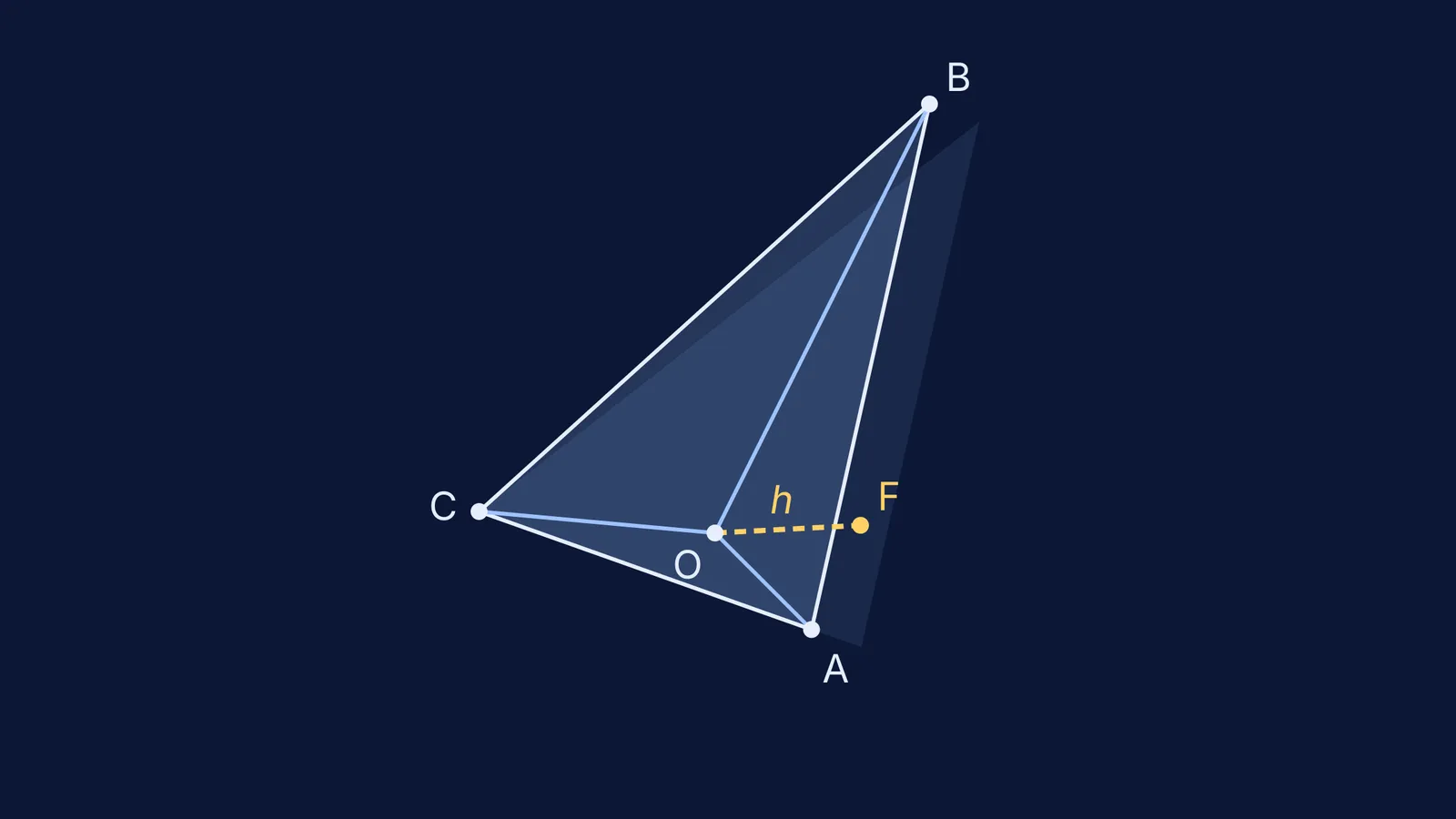
Paragraph 2: how far is a tetrahedron's vertex from the opposite face?
Passage. O is the origin; A, B, C have position vectors a = i + j, b = j + 2k, c = 2i + k.
Q1. Volume of OABC. V = (1/6)[a b c]. The determinant of rows (1, 1, 0), (0, 1, 2), (2, 0, 1) is 1(1) − 1(0 − 4) + 0 = 5, so V = 5/6.
Q2. Area of face ABC. AB = (−1, 0, 2), AC = (1, −1, 1), and AB × AC = (2, 3, 1), of magnitude √14. The area is √14/2.
Q3. Distance of O from plane ABC. Since V = (1/3)(base area)(height), h = 3V ÷ area = (5/2) ÷ (√14/2) = 5/√14. Independent check: the normal from Q2 gives the plane 2x + 3y + z = 5 (A, B and C all satisfy it), and its distance from O is 5/√14.
The trap: 5/(2√14), which comes from taking |AB × AC| = √14 as the triangle's area instead of half of it.
Paragraph 3: how close do two skew lines come?
Passage. L1: r = i + s(i + j) and L2: r = 3k + t(j + k).
Q1. A vector perpendicular to both lines. (1, 1, 0) × (0, 1, 1) = (1, −1, 1).
Q2. Shortest distance. Join a point of each line: (0, 0, 3) − (1, 0, 0) = (−1, 0, 3). Project it on Q1's vector: |−1 + 0 + 3| ÷ √3 = 2/√3. It is not zero, so the lines are skew, not intersecting.
Q3. Plane containing L1 and parallel to L2. Its normal is Q1's vector and it passes through (1, 0, 0), so x − y + z = 1. The distance of (0, 0, 3) from it is |3 − 1| ÷ √3 = 2/√3, matching Q2: a free check.
The trap: 1, from dividing by |d1||d2| = 2 instead of |d1 × d2| = √3.
For eight more solved problems, work through our JEE Advanced practice set on 3D geometry and vectors. The multiple-correct questions on vectors and 3D geometry and the numerical-answer problems drill the same tools.
How do you read a paragraph question quickly?
Before the questions, list what the passage defines: points, direction vectors, normals, each as a triple.
Read every question next. They show what to compute once and reuse: the parameter t, the cross product, the normal.
Test sides of a plane by substituting both points: same sign means same side.
Look for a built-in check in the last question, like the plane distance matching the shortest distance.
If the same step fails twice, the Fermi Problem Library has a step-by-step solver that explains the reasoning rather than printing an answer. For the rest of your JEE Main and Advanced preparation, start at Fermi Test Prep.