

On this page
Numerical questions give you no options to eliminate, so every digit you type must be right. The eight questions below are original and stay inside the official JEE Advanced 2026 syllabus, which lists skew lines, shortest distance, planes, the angle between a line and a plane, and triple products.
How do JEE Advanced numerical-answer questions work?
In JEE Advanced 2025 Paper 1, the maths numerical section had six questions marked +4 if correct and 0 in all other cases. Values with more than two decimal places were to be truncated or rounded off to two places, and the paper's answer key listed decimal answers as ranges such as 1.15 to 1.25. So carry the exact value to the end, then convert once.
Eight vectors and 3D geometry numerical questions
1. Coplanar lines
The lines (x−1)/2 = (y−k)/3 = (z−3)/4 and (x−2)/1 = (y−3)/2 = (z−4)/3 are coplanar. Find k.
Non-parallel lines are coplanar exactly when AB·(d₁×d₂) = 0. Here d₁×d₂ = (1,−2,1) and AB = (1,3−k,1), so 2−2(3−k) = 0 and k = 2. Enter 2. Check: AB = (1,1,1) gives 1−2+1 = 0. Where the mark goes: a sign slip in the cross product's middle component.
2. Angle between a line and a plane
θ is the angle between the line x/1 = y/2 = z/2 and the plane 2x−y+2z = 5. Find 81sin²θ.
For a line and a plane, sinθ = |d·n|/(|d||n|). Here d·n = 4 and |d| = |n| = 3, so sinθ = 4/9 and 81sin²θ = 16. Enter 16. Check: θ ≈ 26.4°, a sensible tilt. Where the mark goes: using cos, which gives the angle with the normal.
3. Image of a point in a plane
Q(a,b,c) is the image of P(1,2,3) in the plane x+y+z = 12. Find a+b+c.
Move along the normal: Q = P + t(1,1,1) with t = 2(12−6)/3 = 4, so Q = (5,6,7). Enter 18. Check: the midpoint (3,4,5) lies on the plane. Where the mark goes: dropping the 2 and finding the foot, which gives 12.
4. Shortest distance between skew lines
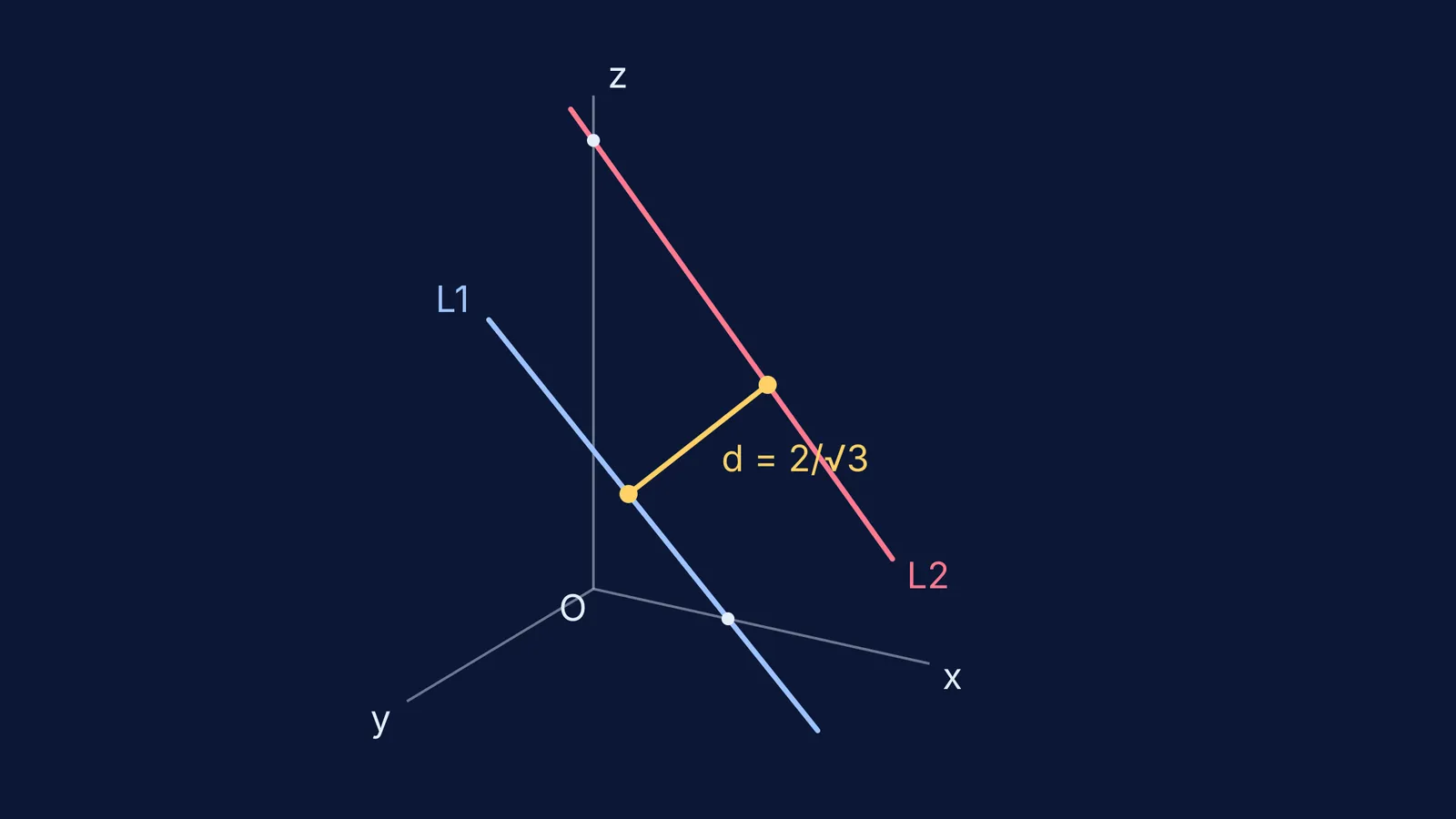
L₁ passes through (1,0,0) along (1,1,0); L₂ passes through (0,0,3) along (0,1,1). Find the shortest distance between them.
Use d = |AB·(u×v)|/|u×v|. With u×v = (1,−1,1) and AB = (−1,0,3), d = 2/√3 ≈ 1.1547. Enter 1.15. Check: the closest points (−2/3,−5/3,0) and (0,−7/3,2/3) are 2/√3 apart. Where the mark goes: dividing by |AB| instead of |u×v|.
5. A vector triple product
a and b are unit vectors with a·b = 1/2, and c = a×(a×b). Find |c|.
Expand: c = (a·b)a − (a·a)b = a/2 − b, so |c|² = 1/4 − 1/2 + 1 = 3/4 and |c| = √3/2 ≈ 0.866. Enter 0.87 (0.86 if you truncate). Check: a is perpendicular to a×b, so |c| = |a×b| = sin60°. Where the mark goes: reversing the expansion to (a·b)b − (a·a)a.
6. Box product of sums
[a b c] = 4. Find the volume of the tetrahedron with edges a+b, b+c and c+a from one vertex.
[a+b, b+c, c+a] = 2[a b c] = 8, and a tetrahedron is one-sixth of its parallelepiped, so the volume is 4/3 ≈ 1.333. Enter 1.33. Check: a = i, b = j, c = 4k gives a determinant of 8. Where the mark goes: forgetting the 2 or the 1/6.
7. Line meets plane, then distance
The line through (1,1,1) along (1,2,2) meets the plane x+2y+2z = 23 at R. Find OR, where O is the origin.
Substituting (1+t, 1+2t, 1+2t) gives 5+9t = 23, so t = 2 and R = (3,5,5). OR = √59 ≈ 7.681. Enter 7.68. Check: 3+10+10 = 23. Where the mark goes: entering t = 2 and stopping.
8. Plane from its perpendicular foot
The foot of the perpendicular from the origin to a plane is P(1,2,3). Find the volume of the tetrahedron the plane cuts off with the coordinate planes.
OP is the normal, so the plane is x+2y+3z = 14, with intercepts 14, 7 and 14/3. Volume = (1/6)(14)(7)(14/3) = 686/9 ≈ 76.222. Enter 76.22. Check: P satisfies 1+4+9 = 14. Where the mark goes: writing x+2y+3z = 0, the plane through O.
Where do students lose marks on 3D numericals?
Before you type a value, run four checks:
Formula: sin for a line and a plane, cos for two lines or two planes.
Factors: 2 for an image, 2 for a box product of sums, 1/6 for a tetrahedron.
Exact first: keep surds and fractions until the last line.
Plug back: put your point into the line or plane it must satisfy.
What should you practise next?
For mixed formats, try the JEE Advanced practice set on vectors and 3D geometry. If the formulas feel shaky, start with how to prepare 3D geometry and vectors for JEE Advanced or the gentler JEE Main numerical questions on vectors and 3D geometry.
When a method goes wrong and you cannot see where, the Fermi Problem Library has a step-by-step solver that explains the reasoning. For the rest of the syllabus, Fermi Test Prep is our JEE Main and Advanced preparation.


