On this page
Try each question before reading the reasoning. For more, see the chapter's JEE Advanced practice set on 3D geometry and vectors and these vectors and 3D geometry numerical-answer problems.
How does partial marking work in JEE Advanced multiple-correct questions?
In JEE Advanced 2026 Paper 2, the one-or-more-correct section gave +4 only if all the correct options were chosen; +3 for choosing three when all four were correct; +2 for two correct choices when three or more were correct; +1 for one correct choice when two or more were correct; 0 for a blank; and −1 in all other cases.
The JEE Advanced 2025 Paper 2 used the same partial marks but −2 in all other cases, so read the instructions on your own paper. One wrong tick makes the answer negative, however many right ones sit beside it. If you are unsure whether to attempt at all, read when to guess with negative marking.
Can you find every correct option in questions 1 to 4?
Question 1: a = i + j, b = j + k
(A) a × b = i − j + k. True: expand the determinant.
(B) The angle between a and b is π/3. True: a · b = 1 and |a||b| = 2.
(C) The parallelogram on a and b has area √3. True: |a × b| = √3.
(D) a × b is parallel to a + b. False: (1, −1, 1) · (1, 2, 1) = 0, so they are perpendicular.
Answer: A, B, C. Trap: D. A cross product is perpendicular to both vectors, so to their sum too.
Question 2: u = i + j + k, v = i + λj + k, w = i + j + λk
Here [u v w] = (λ − 1)².
(A) They are coplanar for exactly one real λ. True: only λ = 1.
(B) For λ = 3 the parallelepiped has volume 2. False: (3 − 1)² = 4.
(C) For λ = 0 the tetrahedron has volume 1/3. False: it is one-sixth of |[u v w]| = 1, so 1/6.
(D) [u v w] is negative for some λ. False: a square never is.
Answer: A only. Trap: B, from forgetting to square. A single correct option is allowed in this format.
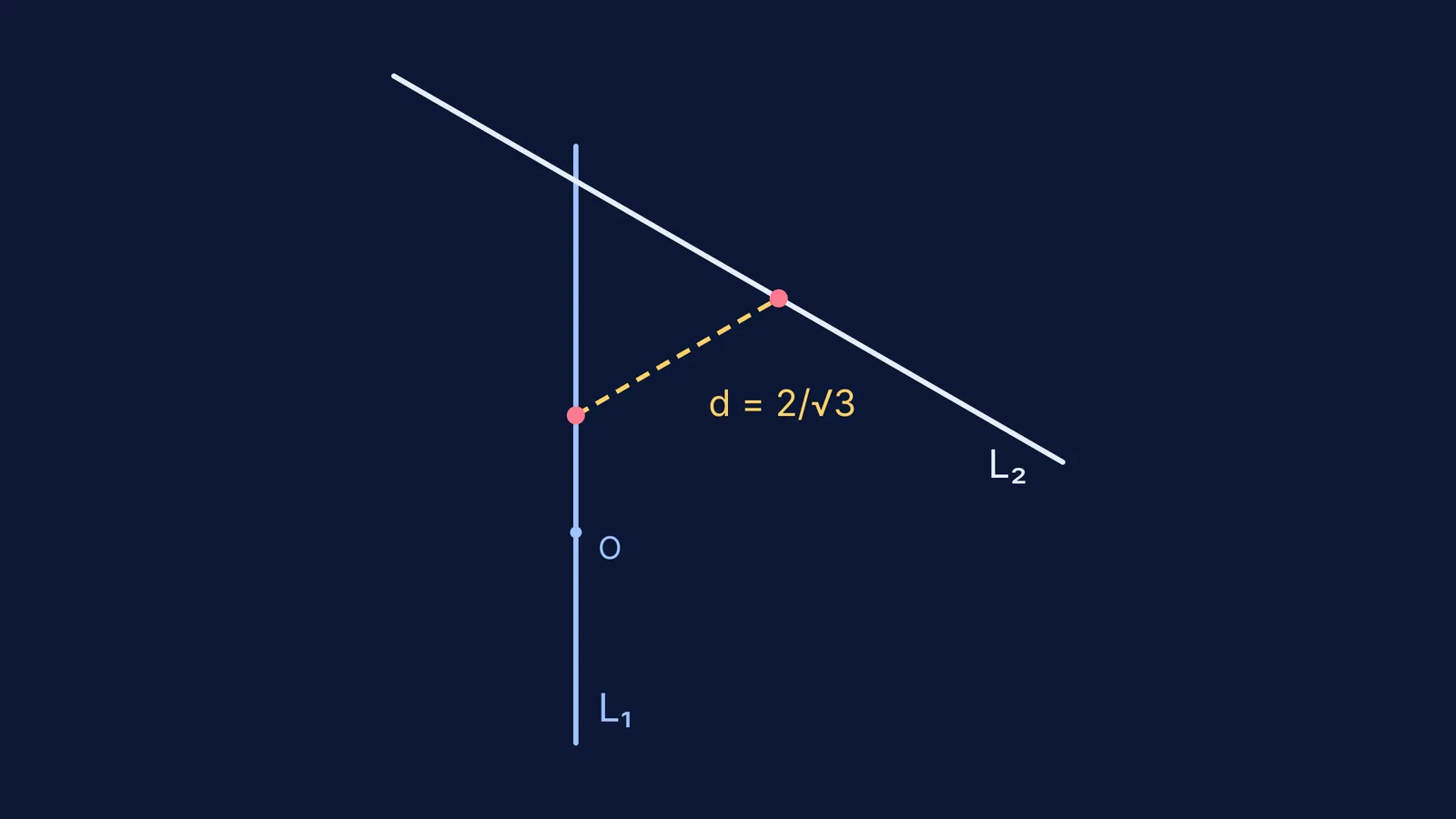
Question 3: L1 through the origin along i + j; L2 through (0, 0, 2) along j + k
Let n = (1, 1, 0) × (0, 1, 1) = (1, −1, 1).
(A) The lines intersect. False: they are not parallel and the distance below is not zero, so they are skew.
(B) The shortest distance is 2/√3. True: |(0, 0, 2) · n| / |n|.
(C) The angle between them is π/3. True: the directions have dot product 1 and lengths √2 each.
(D) The plane containing L1 and parallel to L2 is x − y + z = 0. True: normal n, through the origin.
Answer: B, C, D. Trap: missing D because it looks like a separate problem. It uses the same n.
Question 4: P(1, 2, 3) and the plane x + y + z = 3
(A) The foot of the perpendicular is (0, 1, 2). True: t = (1 + 2 + 3 − 3)/3 = 1, and P − t(1, 1, 1).
(B) The image of P is (−1, 0, 1). True: P − 2t(1, 1, 1).
(C) The distance from P to the plane is 3. False: 3/√3 = √3.
(D) The line from P to its image is parallel to the plane. False: it runs along the normal.
Answer: A, B. Trap: C, forgetting to divide by |n|.
Can you find every correct option in questions 5 to 8?
Question 5: line (x − 1)/2 = (y + 1)/1 = z/2 and plane 2x − 2y + z = 5
(A) The angle θ between line and plane has sin θ = 4/9. True: |d · n| / (|d||n|) = 4/(3 × 3).
(B) cos θ = 4/9. False: that formula gives the angle with the normal, so here it is the sine.
(C) The line meets the plane at (3/2, −3/4, 1/2). True: put (1 + 2t, −1 + t, 2t) in the plane to get t = 1/4.
(D) The line is parallel to the plane x − 2y = 0. True: (2, 1, 2) · (1, −2, 0) = 0, and (1, −1, 0) is not on that plane.
Answer: A, C, D. Trap: B.
Question 6: a and b are unit vectors at π/3, and c = a × b
(A) |c| = √3/2. True: sin(π/3).
(B) c · (a + b) = 0. True: c is perpendicular to both.
(C) (a × b) × a = b − a/2. True: (a · a)b − (b · a)a.
(D) |a + b| = √2. False: 1 + 1 + 2(1/2) = 3, so √3.
Answer: A, B, C. Trap: missing C over a sign doubt; use (u × v) × w = (u · w)v − (v · w)u.
Question 7: planes x + y + z = 1 and x − y + 2z = 3
(A) Their line of intersection runs along 3i − j − 2k. True: (1, 1, 1) × (1, −1, 2).
(B) (2, −1, 0) lies on that line. True: it satisfies both equations.
(C) The angle θ between the planes has cos θ = √2/3. True: 2/(√3 × √6).
(D) The plane through that line and the origin is 2x + 4y + z = 0. True: (x + y + z − 1) + λ(x − y + 2z − 3) = 0 passes through the origin when λ = −1/3.
Answer: A, B, C, D. Trap: dropping a proved option because all four feel unlikely; +3 is less than +4.
Question 8: a = i + j + k, b = i − j, r × a = b × a and r · j = 0
From (r − b) × a = 0, r = b + ta; then r · j = −1 + t = 0 gives t = 1.
(A) r = 2i + k. True.
(B) |r| = √5. True.
(C) r is perpendicular to a. False: r · a = 3.
(D) r − b is parallel to a. True: r − b = a.
Answer: A, B, D. Trap: cancelling a and writing r = b.
How should you check options before ticking?
Prove or disprove each option on its own; never infer it from the others.
Re-check the quick slips: dividing by |n|, squaring, sine versus cosine.
After each mock, list the traps that caught you and redo those questions.
If you can't see why an option is false, the Fermi Problem Library has a step-by-step solver that explains the reasoning. For the rest of your JEE Main and Advanced preparation, start at Fermi Test Prep.