On this page
Multiple-correct questions reward a habit more than a formula: judge each option as its own true-or-false statement, then tick only what you have proved. The eight questions below are original practice questions in the JEE Advanced format, not past-paper questions.
How does partial marking work in JEE Advanced multiple-correct questions?
In the official JEE Advanced 2025 Paper 1 answer key, Section 2 has questions where one or more of four options is correct, marked like this:
+4 if you choose all the correct options and nothing else.
+3 if all four options are correct and you choose exactly three.
+2 if three or more options are correct and you choose two, both correct.
+1 if two or more options are correct and you choose one correct option.
0 if you leave it blank; −2 in all other cases.
The scheme can change between years, so read it again on exam day.
Eight sets, relations and functions questions, option by option
Q1. A, B, C are subsets of a universal set. Which are true?
(A) A ∪ (B − C) = (A ∪ B) − (A ∪ C). False: take A = {1}, B = C = ∅; the left side is {1}, the right side is empty.
(B) A − (B ∪ C) = (A − B) ∩ (A − C). True: De Morgan's law inside A.
(C) A ∩ (B − C) = (A ∩ B) − (A ∩ C). True: both are the elements of A and B that are not in C.
(D) (A − B) ∪ (B − A) = (A ∪ B) − (A ∩ B). True: both describe the symmetric difference.
Answer: B, C, D. Students tick A by analogy with C; one small counterexample settles it.
Q2. n(A) = 3 and n(B) = 4. Which are true?
(A) There are 2¹² relations from A to B. True: A × B has 12 elements, and a relation is any subset.
(B) There are 81 functions from A to B. False: each of 3 elements has 4 images, so 4³ = 64.
(C) There are 24 one-one functions from A to B. True: 4 × 3 × 2.
(D) There are 36 onto functions from B to A. True: 3⁴ − 3·2⁴ + 3 = 36.
Answer: A, C, D. B swaps base and exponent; D is often skipped because it reverses the direction.
Q3. On the non-zero integers, a R b means a divides b. Which are true?
(A) R is symmetric. False: 2 divides 4, but 4 does not divide 2.
(B) R is reflexive. True.
(C) R is antisymmetric. False: 2 R −2 and −2 R 2, but 2 ≠ −2.
(D) R is transitive. True.
Answer: B, D. C is the wrong tick: divisibility is antisymmetric on the natural numbers, not once negatives are allowed.
Q4. On the real numbers, x R y means x − y + √2 is irrational. Which are true?
(A) R is symmetric. False: √2 R 0, since 2√2 is irrational, but 0 − √2 + √2 = 0.
(B) R is transitive. False: 0 R √3 and √3 R √2, yet 0 − √2 + √2 = 0, so 0 is not related to √2.
(C) R is reflexive. True: x − x + √2 = √2.
(D) R is neither symmetric nor transitive. True.
Answer: C, D. Students tick B without hunting for a counterexample, and miss D, which restates A and B.
Q5. f: ℝ → ℝ, f(x) = x|x|. Which are true?
(A) f is odd. True: f(−x) = −x|x|.
(B) f is one-one. True: it is strictly increasing.
(C) f is onto. True: it is continuous and unbounded both ways.
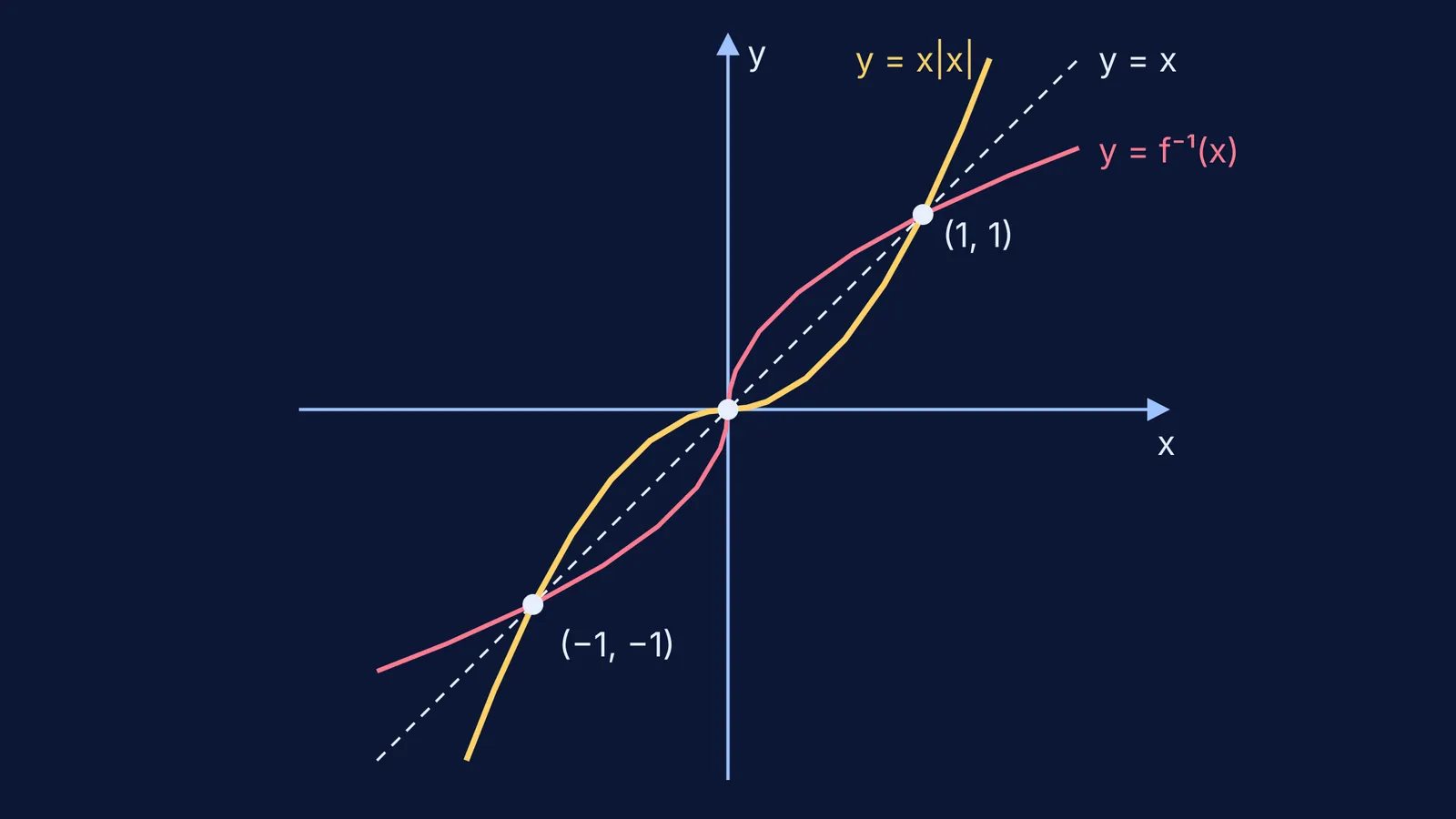
(D) f(x) = f⁻¹(x) has exactly two real solutions. False: for an increasing f, the solutions lie on y = x, giving −1, 0 and 1.
Answer: A, B, C. Reading x|x| as x² makes students miss B and C.
Q6. f: ℝ → ℝ, f(x) = (x² − 1)/(x² + 1). Which are true?
(A) f(x) = 0 only at x = ±1. True.
(B) f is one-one. False: f is even.
(C) The range of f is [−1, 1). True: f = 1 − 2/(x² + 1), and 2/(x² + 1) takes every value in (0, 2].
(D) f is onto when the codomain is [−1, 1]. False: 1 is never reached.
Answer: A, C. D is the classic wrong tick: a value only approached is not in the range.
Q7. f(x) = 1/(1 − x) on ℝ − {0, 1}. Which are true?
(A) Composing f with itself 2025 times gives f. False: f∘f∘f is the identity and 3 divides 2025.
(B) f(f(x)) = (x − 1)/x. True.
(C) f(f(f(x))) = x. True.
(D) f⁻¹ = f∘f. True: it follows from C.
Answer: B, C, D. A comes from miscounting the cycle of three.
Q8. f(x) = x − [x], where [x] is the greatest integer function. Which are true?
(A) f is periodic with period 1. True.
(B) The range of f is [0, 1]. False: f never equals 1.
(C) f(x + y) = f(x) + f(y) for all real x, y. False: f(0.5 + 0.5) = 0.
(D) f(−x) = 1 − f(x) for all real x. False at integers: f(−2) = 0, not 1.
Answer: A only. One correct option is allowed. D holds for every non-integer, which is why students tick it.
What should you do with options you cannot settle?
Mark each option T, F or ? before ticking anything.
Test every "for all" statement with a small counterexample.
Tick every T. Never tick a ?.
Leave the question blank if you have no sure T; a guess risks −2.
For fully worked solutions, try the sets, relations and functions JEE Advanced practice questions, then the chapter's JEE Advanced numerical answer questions. If one wrong option keeps fooling you, the Fermi Problem Library has a step-by-step solver that explains the reasoning. For the rest of your JEE Main and Advanced preparation, start at Fermi Test Prep.