

On this page
Eight original questions, easy to hard, each with the exact value, the number to type, a check and the step where the mark usually goes.
How do numerical-answer questions work in JEE Advanced?
In the JEE (Advanced) 2025 Paper 1 answer key, Mathematics Section 3 had six numerical-value questions, typed on an on-screen numeric keypad and truncated or rounded to two decimal places. A correct value earned +4 and anything else 0. Its first question asked how many reflexive, symmetric relations on a six-element set have exactly 10 elements (the key gives 105), so this chapter does appear in this format. Patterns change yearly, so read the instructions on the day. Every question below fits the JEE (Advanced) 2026 syllabus.
Easy for Advanced: counting with sets
Q1. n(U) = 50, n(A) = 32 and n(B) = 28 for subsets A, B of U. If m and M are the least and greatest possible values of n(A ∩ B), find M − m.
M = 28, when B ⊆ A. Since n(A ∪ B) ≤ 50, n(A ∩ B) ≥ 32 + 28 − 50 = 10, so m = 10. Enter 18. Check: with overlap 10, the union is exactly 50. Lost mark: taking m = 0 and entering 28.
Q2. How many ordered pairs (A, B) of subsets of {1, 2, 3, 4, 5} have exactly one element in A ∩ B?
Choose the common element (5 ways). Each of the other four goes in A only, B only or neither: 3⁴ = 81. Enter 405. Check: summing over all overlap sizes gives 4⁵ = 1024. Lost mark: entering 3⁵ = 243, the count for disjoint pairs.
Medium: relations and onto functions
Q3. How many equivalence relations on {1, 2, 3, 4, 5} relate 1 and 2?
An equivalence relation is a partition into classes. If 1 and 2 share a class, glue them into one element; you are now partitioning four objects, which can be done in 1 + 7 + 6 + 1 = 15 ways (one, two, three or four classes). Enter 15. Check: all partitions of five elements number 52. Lost mark: entering 52.
Q4. How many onto functions f: {1, 2, 3, 4, 5} → {1, 2, 3} satisfy f(1) = 1?
The other four inputs must hit both 2 and 3. By inclusion-exclusion: 3⁴ − 2·2⁴ + 1 = 50. Enter 50. Check: there are 3⁵ − 3·2⁵ + 3 = 150 onto functions, and by symmetry a third have f(1) = 1. Lost mark: forgetting the +1 for the function that misses both, entering 49.
Medium: domain and range
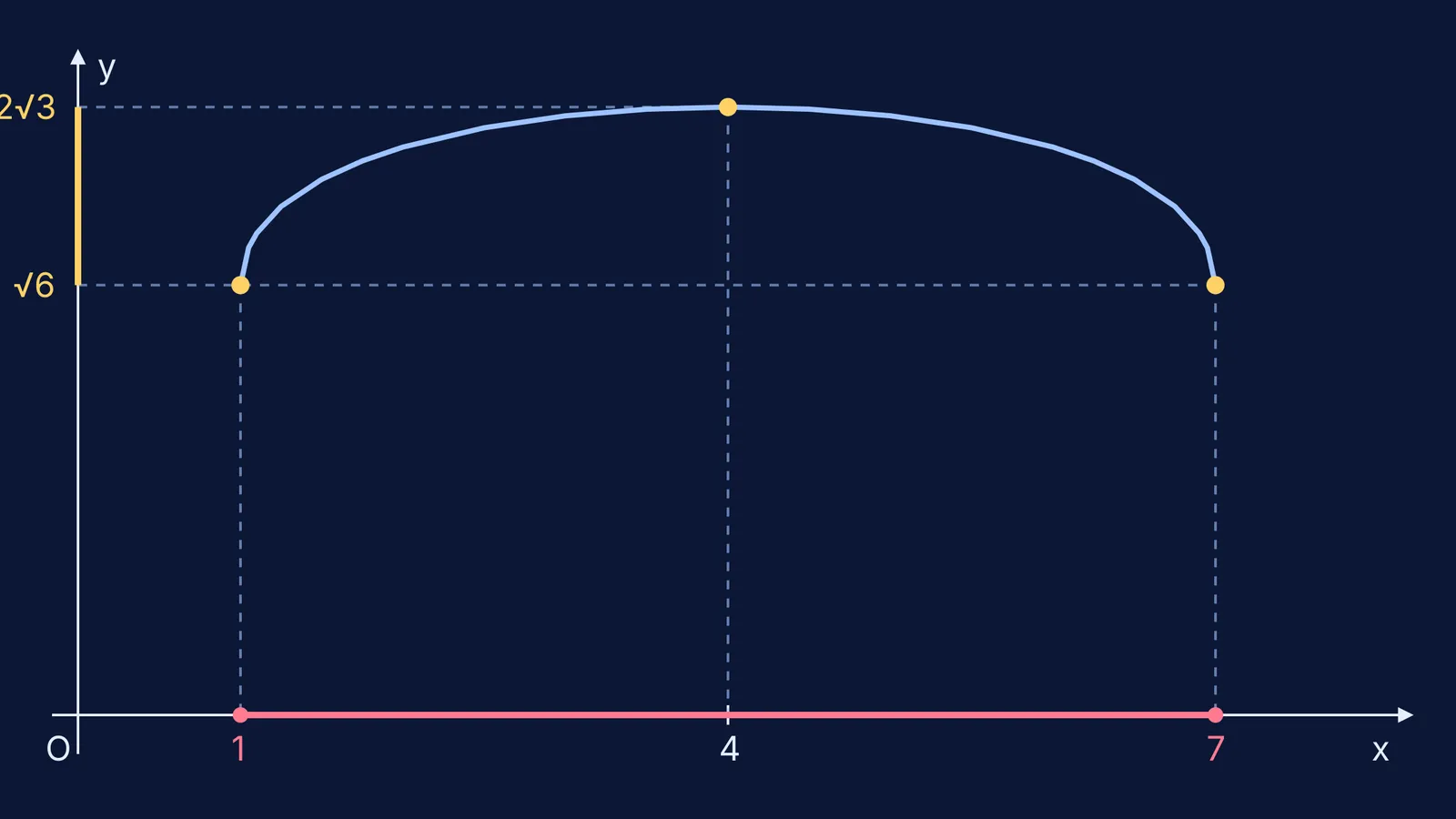
Q5. f(x) = √(x − 1) + √(7 − x). Find (greatest value) − (least value) of f.
The domain is [1, 7]. Squaring, f² = 6 + 2√((x − 1)(7 − x)), and the product runs from 0 (at the ends) to 9 (at x = 4). So the range is [√6, 2√3], and 2√3 − √6 = 1.0146… Enter 1.01. Check: f(4) = 2√3 = 3.464. Lost mark: taking the least value as 0.
Q6. Find (greatest value) − (least value) of f(x) = x/(x² + x + 4) on the real line.
Set y = f(x): yx² + (y − 1)x + 4y = 0 must have a real root, so (y − 1)² ≥ 16y², giving (3y + 1)(5y − 1) ≤ 0 and y in [−1/3, 1/5]. The gap is 8/15 = 0.5333… Enter 0.53. Check: f(2) = 1/5 and f(−2) = −1/3. Lost mark: dividing by y without checking y = 0, which is in the range at x = 0.
Hard: two ideas in one question
Q7. How many bijections f of {1, 2, 3, 4, 5} satisfy f∘f = identity and f(1) ≠ 1?
f∘f = identity means f swaps some pairs and fixes the rest. 1 is swapped with one of 4 elements, and the remaining three form 1 + 3 = 4 such maps. Enter 16. Check: of all 26 such maps, the 10 with f(1) = 1 match those on four elements. Lost mark: entering 26.
Q8. [x] is the greatest integer ≤ x. Find the sum of the squares of all real solutions of x² − 4[x] + 3 = 0.
Let [x] = n, so x² = 4n − 3, which needs n ≥ 1 and so x > 0. Then n ≤ √(4n − 3) < n + 1 forces n² − 4n + 3 ≤ 0, so n = 1, 2, 3, and x = 1, √5, 3. Enter 15. Check: [√5] = 2 and 5 − 8 + 3 = 0. Lost mark: dropping the endpoint n = 3 and entering 6.
How should you check a counting answer?
Shrink the set (two or three elements) and count by hand.
Check a total: the cases you split into must add up to the whole.
Reread what was asked: least or greatest, ordered or unordered pairs.
For single-correct, multiple-correct and matching questions on this chapter, try our sets, relations and functions JEE Advanced practice questions with solutions. For a plan, read how to prepare sets, relations and functions for JEE Advanced.
If one step keeps tripping you, the Fermi Problem Library has a step-by-step solver that explains the reasoning. For the rest of your JEE Main and Advanced preparation, start at Fermi Test Prep.


