On this page
Here is the official JEE (Advanced) list for this unit, what goes beyond JEE (Main), two original solved problems and a plan.
What does the JEE Advanced syllabus say about sets, relations and functions?
The official JEE (Advanced) 2026 syllabus lists three groups of topics:
Sets: "Sets and their representations, different kinds of sets (empty, finite and infinite), algebra of sets, intersection, complement, difference and symmetric difference of sets and their algebraic properties, De-Morgan's laws on union, intersection, difference (for finite number of sets) and practical problems based on them."
Relations: "Cartesian product of finite sets, ordered pair, relations, domain and codomain of relations, equivalence relation."
Functions: "Function as a special case of relation, functions as mappings, domain, codomain, range of functions, invertible functions, even and odd functions, into, onto and one-to-one functions, special functions (polynomial, trigonometric, exponential, logarithmic, power, absolute value, greatest integer, etc.), sum, difference, product and composition of functions."
It says it is unchanged from 2025. The 2027 syllabus is not yet published (as of 19 November 2026), so recheck later.
JEE (Advanced) 2027 will be held on 23 May 2027 (Sunday), organised by IIT Delhi, says the official JEE (Advanced) website. One eligibility criterion is being among the top 2,50,000 candidates in the B.E./B.Tech. paper of JEE (Main) 2027. JEE (Advanced) 2026 had two compulsory papers of three hours each (2026 Information Brochure). Question types and marking change yearly; see JEE Advanced question types.
What is beyond JEE Main in this unit?
These Advanced items are absent from Unit 1 of NTA's JEE (Main) 2027 syllabus:
difference, symmetric difference and De Morgan's laws for difference
Cartesian products, and the domain and codomain of a relation
range, invertible functions, and even and odd functions
special functions such as absolute value and greatest integer
sum, difference and product of functions
For the basics, start with our Sets, Relations and Functions for JEE Main guide.
How do Advanced problems combine these ideas?
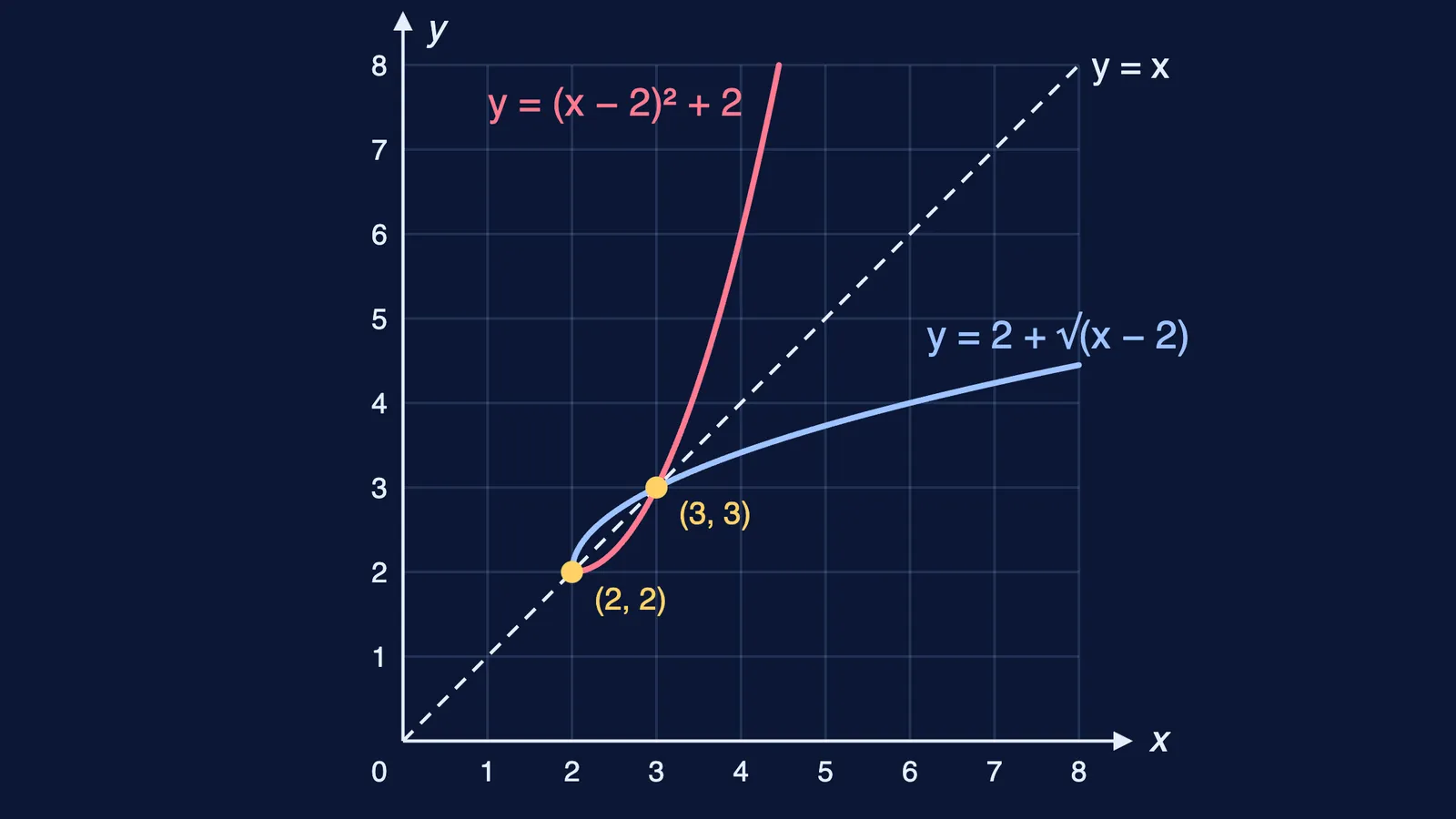
Example 1: inverse and composition, multiple correct. Let f(x) = x² − 4x + 6 with domain [2, ∞). Which are true? (A) f is one-one onto [2, ∞). (B) f⁻¹(x) = 2 + √(x − 2). (C) f(x) = f⁻¹(x) has exactly two solutions. (D) f(f(4)) = 4.
f(x) = (x − 2)² + 2 is strictly increasing on [2, ∞) with range [2, ∞). (A) is true.
Solve y = (x − 2)² + 2 for x, keeping the root x ≥ 2: x = 2 + √(y − 2). (B) is true.
A strictly increasing f meets its inverse only on y = x. So x² − 5x + 6 = 0, giving x = 2 and x = 3. (C) is true.
f(4) = 6 and f(6) = 18, so (D) is false.
Answer: A, B and C.
The shortcut needs an increasing function: f(x) = −x³ meets its inverse at (1, −1), off y = x.
Example 2: greatest integer, numerical answer. Find the sum of all real x with [x² − 2x] = 2x − 3, where [·] is the greatest integer function.
The left side is an integer, so put 2x − 3 = n. Then x = (n + 3)/2 and x² − 2x = (n² + 2n − 3)/4.
So n ≤ (n² + 2n − 3)/4 < n + 1.
The left part gives (n − 3)(n + 1) ≥ 0; the right gives n² − 2n − 7 < 0, so 1 − 2√2 < n < 1 + 2√2.
Only n = −1 and n = 3 survive: x = 1 and x = 3. Check: [−1] = −1 and [3] = 3.
Answer: 4. In multiple-correct questions, mark only options you have checked (how partial marking works).
How should you practise sets, relations and functions for JEE Advanced?
Week 1: sets. Prove De Morgan's laws for difference; count symmetric differences and Cartesian products.
Week 2: relations. Test reflexive, symmetric and transitive on small sets by listing pairs, then on integer rules.
Week 3: functions. Sketch each special function, then find its domain, range, parity and invertibility.
Week 4: composition and inverses. Find the domain of f∘g before simplifying; label every error by its cause.
Repeating the same slip? The Fermi Problem Library has worked problems with a step-by-step solver that explains the reasoning rather than printing an answer.
Can you solve these practice questions?
On A = {1, 2, ..., 10}, a R b means 5 divides a² − b². How many ordered pairs are in R, and how many equivalence classes? Answer: 36 pairs, 3 classes.
n(A) = 7, n(B) = 5 and n(A ∩ B) = 3. Find n(A Δ B) and n((A × B) ∩ (B × A)). Answer: 6 and 9.
For f(x) = x² − 4x + 6 on [2, ∞), find f⁻¹(11). Answer: 5.