On this page
Eight new JEE Advanced-style questions, easy to hard, in four formats. We checked every option in Python; each solution ends with the trap, the wrong option that looks most right.
What does JEE Advanced ask from sets, relations and functions?
The official JEE (Advanced) 2026 syllabus includes symmetric difference, equivalence relations, invertible, even and odd functions, onto and one-to-one functions, the greatest integer function and composition. For the theory, see our guide on how to prepare sets, relations and functions for JEE Advanced.
How should you use this set?
Hide the solutions; allow 3 minutes per easy question, 6 per hard one.
In one-or-more-correct questions, judge each option on its own.
Note the trap behind each miss; redo it in three days.
New to the formats? Read about JEE Advanced question types.
Easy: symmetric difference, domains and odd functions
Q1 (easy, single correct). Of 60 students, 35 attend physics olympiad classes (P) and 28 chemistry ones (C). If n(P Δ C) = 33, how many attend neither?
(A) 12 (B) 27 (C) 15 (D) 30
Answer: (A). n(P Δ C) = n(P) + n(C) − 2n(P ∩ C) gives n(P ∩ C) = 15, so n(P ∪ C) = 48 and 60 − 48 = 12. Trap: (B) treats P Δ C as P ∪ C.
Q2 (easy, single correct). With [x] the greatest integer function, the domain of f(x) = 1/√([x]² − 5[x] + 6) is
(A) (−∞, 2) ∪ (3, ∞) (B) (−∞, 2) ∪ [4, ∞) (C) (−∞, 2] ∪ [3, ∞) (D) (−∞, 1] ∪ [4, ∞)
Answer: (B). You need ([x] − 2)([x] − 3) > 0, so [x] ≤ 1 or [x] ≥ 4, that is x < 2 or x ≥ 4. Trap: (A) solves for x, not [x]; at x = 3.5 the denominator is zero.
Q3 (easy, one or more options correct). Which of these functions from R to R are odd?
(A) f(x) = log(x + √(x² + 1))
(B) f(x) = x(3ˣ − 1)/(3ˣ + 1)
(C) f(x) = |x + 1| − |x − 1|
(D) f(x) = x cos x + 1
Answer: (A), (C). In (A), (−x + √(x² + 1))(x + √(x² + 1)) = 1, so f(−x) = −f(x). In (C), x → −x swaps the moduli. (B) is a product of two odd factors, so even. (D) has f(0) = 1, not 0. Trap: (D), because x cos x is odd; the + 1 spoils it.
Medium: equivalence relations, inverses and mappings
Q4 (medium, numerical value). The number of equivalence relations on {1, 2, 3, 4, 5} that contain (1, 2) but not (1, 3) is ____.
Answer: 10. Count partitions. With 1 and 2 glued, four objects have 15 partitions; 5 of them also put 3 in that block. 15 − 5 = 10. Trap: 15 ignores "not (1, 3)".
Q5 (medium, one or more options correct). f(x) = (2x + 3)/(x − 2), x ≠ 2. Which are true?
(A) f(f(x)) = x for every x ≠ 2.
(B) The range of f is R − {2}.
(C) Applying f 2027 times to 5 gives 5.
(D) f(x) = x has exactly one real solution.
Answer: (A), (B). f(f(x)) simplifies to x, so f is its own inverse, and x = (2y + 3)/(y − 2) exists for every y ≠ 2. An odd number of applications equals f, and f(5) = 13/3, so (C) is false. f(x) = x gives x² − 4x − 3 = 0, with two roots 2 ± √7. Trap: (C) forgets that 2027 is odd.
Q6 (medium, list match). Match List-I with List-II.
List-I: (P) f: R → R, f(x) = x³ − 3x; (Q) f: R → R, f(x) = 2x + cos x; (R) f: Z → Z, f(n) = n² + n; (S) f: R → R, f(x) = x/(1 + |x|)
List-II: (1) one-one but not onto; (2) onto but not one-one; (3) one-one and onto; (4) neither
(A) P→2, Q→3, R→4, S→1 (B) P→3, Q→3, R→2, S→1 (C) P→2, Q→1, R→4, S→3 (D) P→3, Q→2, R→1, S→4
Answer: (A). P is onto, but P(0) = P(√3) = 0. Q′(x) = 2 − sin x ≥ 1, so Q is increasing and onto. R(0) = R(−1) = 0, and n² + n is always even. S increases but stays inside (−1, 1). Trap: (B) assumes every cubic is one-one.
Hard: greatest integer and composition
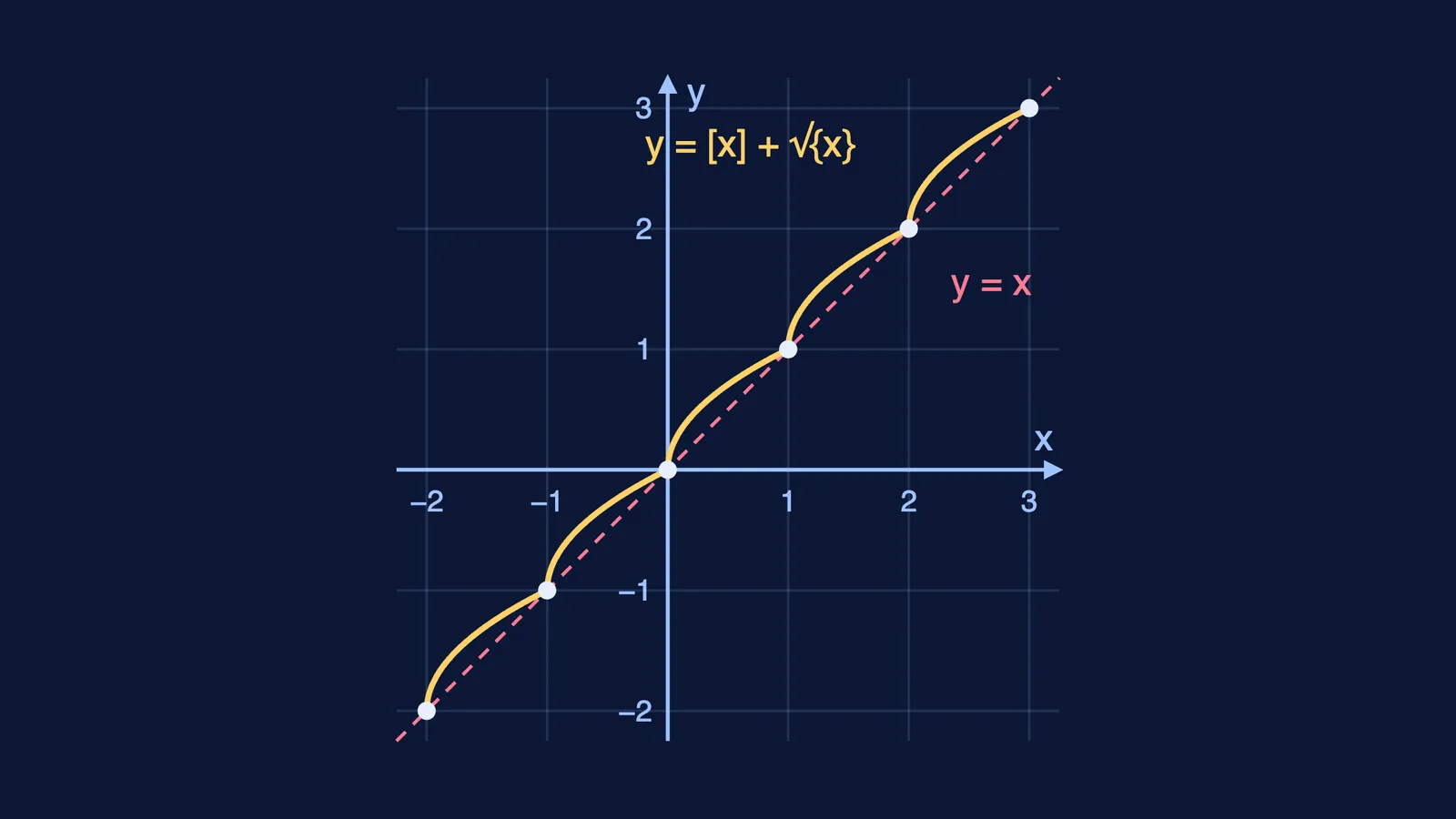
Q7 (hard, one or more options correct). With {x} = x − [x], let f: R → R, f(x) = [x] + √{x}. Which are true?
(A) f is one-one and onto.
(B) f⁻¹(x) = [x]² + {x}.
(C) f(x) ≥ x for every real x.
(D) f is an odd function.
Answer: (A), (C). On [n, n + 1), f(x) = n + √(x − n) rises from n towards n + 1 = f(n + 1), so f increases strictly and covers R (graph above). As 0 ≤ {x} < 1, √{x} ≥ {x}, giving (C). The true inverse is [x] + {x}². f(0.5) ≈ 0.707 but f(−0.5) ≈ −0.293, so f is not odd. Trap: (B) squares the wrong part.
Q8 (hard, single correct). For f: R → R, f(x) = x² + 4x + k, f∘f and f have the same range exactly when
(A) k ≤ 2 (B) k ≥ 2 (C) k ≤ 4 (D) k is any real number
Answer: (A). f has range [k − 4, ∞), its minimum at x = −2. f∘f feeds f only inputs from [k − 4, ∞), so it reaches that least value only if −2 ≥ k − 4, that is k ≤ 2. At k = 3: [−1, ∞) against [0, ∞). Trap: (C) checks whether the range contains 0, not the vertex −2.
What should you do after this set?
7 or 8 right: move to timed mixed papers.
4 to 6 right: redo your misses without notes.
0 to 3 right: revisit domain, range and composite functions, then retry in a week.
For more practice, the Fermi Problem Library has worked problems with a step-by-step solver that explains the reasoning rather than printing an answer.