

On this page
In a multiple-correct question, each option is its own true-or-false statement, so you need four small proofs, not one. Here are eight original integral calculus questions in the JEE Advanced style.
How does partial marking work in JEE Advanced multiple-correct questions?
In the JEE Advanced 2024 Paper 1 mathematics section where one or more options are correct, choosing all the correct options and nothing else earned +4 marks. Choosing only some correct options and no wrong one earned +3, +2 or +1; leaving the question blank earned 0; any choice that included a wrong option earned −2. Recheck the instructions on each year's paper.
Questions 1 to 4: which options are true?
Q1. Let I = ∫₀^(π/2) sin x/(sin x + cos x) dx.
(A) I = π/4. True: replacing x by π/2 − x gives J = ∫₀^(π/2) cos x/(sin x + cos x) dx with I = J, and I + J = π/2.
(B) I = π/2. False: that is I + J.
(C) I = ∫₀^(π/2) dx/(1 + cot x). True: divide top and bottom by sin x.
(D) ∫₀^(π/2) cos x/(sin x + cos x) dx = π/4. True: it is J.
Answer: A, C, D. C is the easy one to miss, because it is the same integrand rewritten.
Q2. Let F(x) = ∫₀ˣ (t − 1)(t − 2) dt.
(A) F has a local maximum at x = 1. True: F′(x) = (x − 1)(x − 2) changes from positive to negative there.
(B) F has a local minimum at x = 2. True: F′ changes from negative to positive.
(C) F(x) = 0 for some x in (0, 3). False: F(x) = x(2x² − 9x + 12)/6, and that quadratic has discriminant 81 − 96 < 0, so F > 0 for x > 0.
(D) F(3) = 3/2. True: 9 − 27/2 + 6.
Answer: A, B, D. The tempting wrong tick is C: F′ is negative on (1, 2), and it is easy to assume the area cancels.
Q3. Let Iₙ = ∫₀^(π/4) tanⁿx dx for n ≥ 0.
(A) Iₙ increases with n. False: 0 ≤ tan x ≤ 1 there, so higher powers are smaller.
(B) Iₙ + Iₙ₊₂ = 1/(n + 1). True: the sum is ∫₀^(π/4) tanⁿx sec²x dx.
(C) I₂ = 1 − π/4. True: put n = 0, with I₀ = π/4.
(D) I₃ = (1 − ln 2)/2. True: I₁ = ln √2 and I₁ + I₃ = 1/2.
Answer: B, C, D. If you never check the size of tan x, A looks plausible.
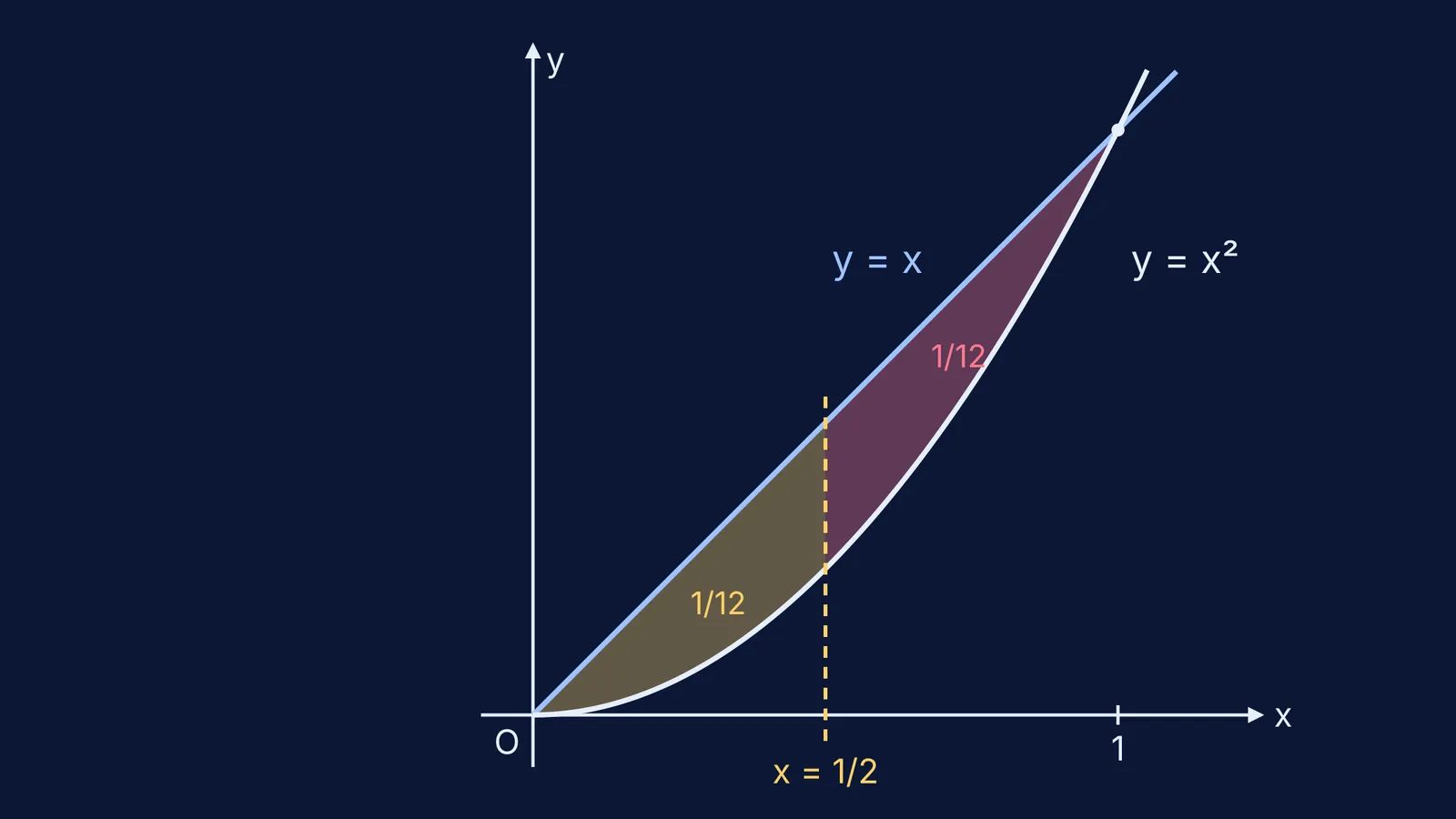
Q4. The vertical line x = a splits the region between y = x and y = x² into two equal areas.
(A) The region's area is 1/6. True: ∫₀¹ (x − x²) dx = 1/2 − 1/3.
(B) a satisfies 4a³ − 6a² + 1 = 0. True: a²/2 − a³/3 = 1/12.
(C) a = 1/2. True: the cubic factors as (2a − 1)(2a² − 2a − 1), whose other roots lie outside (0, 1).
(D) a = 1/√2. False: it does not satisfy the cubic.
Answer: A, B, C. Stop at the cubic and you miss C.
Questions 5 to 8: which options survive a check?
Q5. Let L = lim (n→∞) Σₖ₌₁ⁿ n/(n² + k²).
(A) L = ∫₀¹ dx/(1 + x²). True: each term is (1/n)·1/(1 + (k/n)²).
(B) L = π/4. True.
(C) Summing k from 0 to n − 1 gives the same limit. True: the sums differ by 1/(2n), which tends to 0.
(D) L < 1. True: π/4 is about 0.785.
Answer: all four. C is the easiest to leave out.
Q6. An antiderivative of 1/(x² + 2x + 5) is:
(A) (1/4) ln(x² + 2x + 5). False: its derivative is (x + 1)/(2(x² + 2x + 5)).
(B) (1/2) tan⁻¹((x + 1)/2). True: complete the square, (x + 1)² + 4.
(C) (1/2) tan⁻¹(x + 1). False: the 2 must divide inside too.
(D) −(1/2) cot⁻¹((x + 1)/2). True: it differs from B by the constant π/4.
Answer: B, D. D is easy to miss: antiderivatives may differ by a constant.
Q7. Which statements are true?
(A) ∫₋₁¹ x sin x dx = 0. False: x sin x is even and never negative, giving 2(sin 1 − cos 1).
(B) ∫₋₁¹ x³ cos x dx = 0. True: the integrand is odd.
(C) ∫₋₁¹ x²/(1 + eˣ) dx = 1/3. True: adding the x → −x version gives x², so 2I = 2/3.
(D) ∫₋₁¹ ln(x + √(x² + 1)) dx = 0. True: this function is odd.
Answer: B, C, D. A is the trap: odd times odd is even.
Q8. For x > 1, let g(x) = ∫ₓ^(x²) dt/ln t.
(A) g′(x) = 1/ln(x²) − 1/ln x. False: the chain-rule factor 2x is missing.
(B) g′(x) = (x − 1)/ln x. True: 2x/(2 ln x) − 1/ln x.
(C) g is decreasing on (1, ∞). False: g′ > 0 there.
(D) g′(x) → 0 as x → 1⁺. False: by L'Hôpital the limit is 1.
Answer: B only. Ticking B with anything else scores −2.
How should you practise multiple-correct integral questions?
Write T or F beside each option with a one-line reason before checking the answer.
Score yourself with the real scheme, including the −2, so you feel what a guess costs.
Name every slip: a missing chain-rule factor, a parity error, a forgotten constant.
Redo only the slipped options later in the week.
For full solutions, work through the integral calculus JEE Advanced practice set. For numerical answers, try the integral calculus numerical-answer questions, and to plan the chapter, read how to prepare integral calculus for JEE Advanced.
When the same slip keeps returning, the Fermi Problem Library has a step-by-step solver that explains the reasoning, so you can see where your method turned. For JEE Main and Advanced preparation, see Fermi Test Prep.


