

On this page
Probability numericals reward one habit: get the exact fraction first, then convert once. Here are eight original questions, easier to hard.
How do JEE Advanced numerical-answer questions work?
In JEE Advanced 2025 Paper 1, mathematics Section 3, each answer was a numerical value typed on an on-screen virtual numeric keypad, truncated or rounded off to two decimal places. The marking scheme gave +4 if only the correct value was entered and 0 in all other cases. No options to eliminate, but no negative mark. Truncating or rounding was allowed, so 2/3 could be 0.66 or 0.67; the final key gave some answers as a range, such as 1.15 to 1.25.
Formats change, so check the official JEE Advanced website before your exam.
What do easier JEE Advanced probability numericals look like?
Q1. Conditioning on a product
Two fair dice are thrown. Given that the product of the numbers is even, find the probability that their sum is even.
Solution. The product is odd only when both are odd (9 of 36), so 27 outcomes have an even product. Among these, an even sum needs both even: 9 outcomes. P = 9/27 = 1/3. Enter 0.33. Check: 18 mixed-parity outcomes plus 9 make 27. Trap: dividing by 36 and entering 0.25.
Q2. Bayes with a die and two urns
A die is rolled. On 1 or 2, a ball is drawn from urn I (4 red, 1 white); otherwise from urn II (1 red, 4 white). The ball is red. Find the probability it came from urn I.
Solution. P(red) = (1/3)(4/5) + (2/3)(1/5) = 2/5. P(I given red) = (4/15)/(2/5) = 2/3. Enter 0.67. Check: P(II given red) = 1/3; they add to 1. Trap: entering 0.80, urn I's red fraction, ignoring the die.
Q3. Real roots from two dice
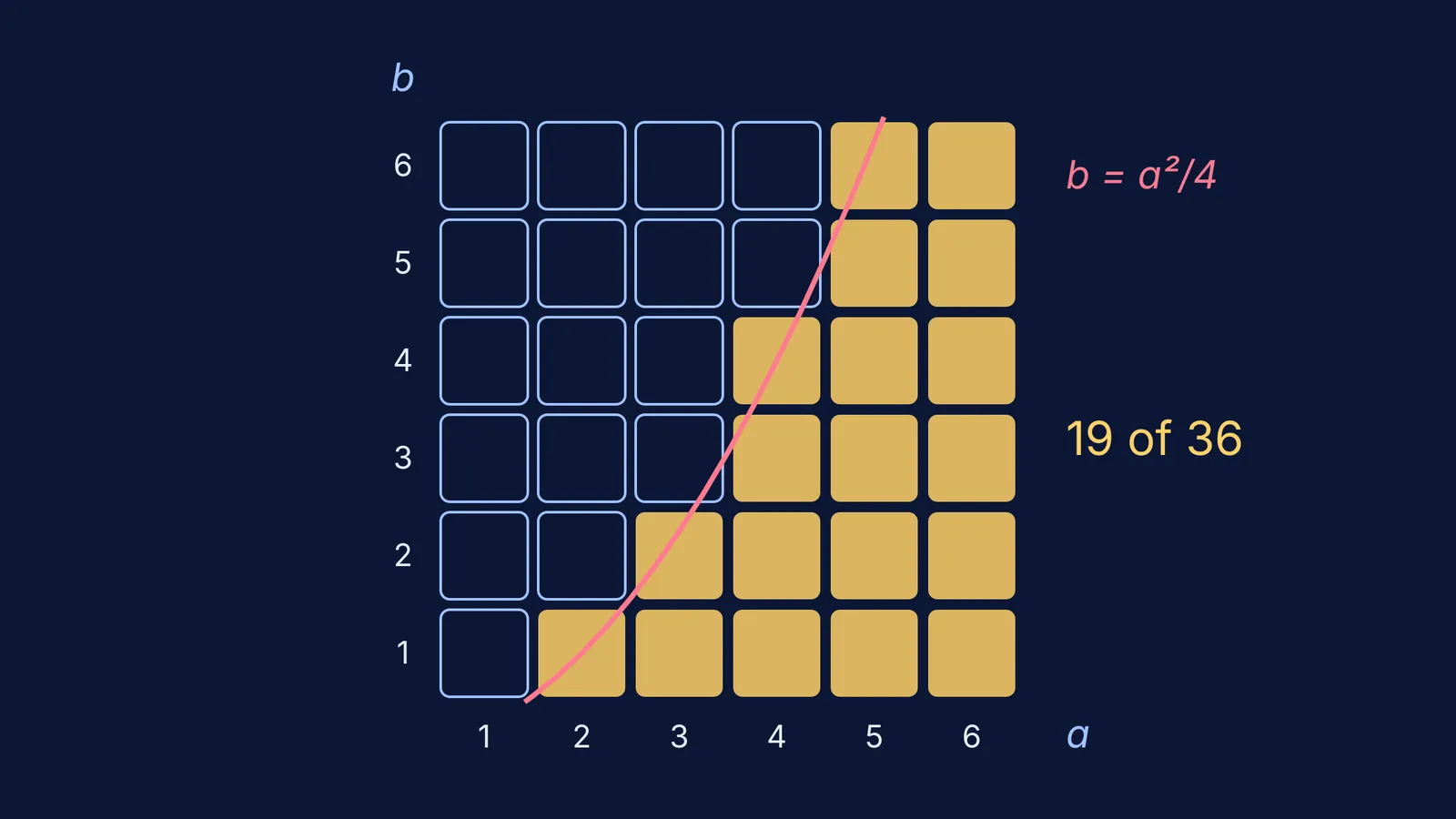
Let a and b be the numbers on two fair dice, and p the probability that x² + ax + b = 0 has real roots. Find 36p.
Solution. You need a² ≥ 4b. For a = 1 to 6, the allowed b count 0, 1, 2, 4, 6, 6. Total 19. Enter 19. Check: the grid at the top shows these 19 cells. Trap: a strict inequality drops the equal-root cases (2, 1) and (4, 4), giving 17.
Q4. Binomial from mean and variance
X is binomial with mean 4 and variance 3. Find P(X = 2)/P(X = 1).
Solution. q = 3/4, p = 1/4, n = 16. The ratio is (n − 1)p/(2q) = 15(1/4)/(3/2) = 5/2. Enter 2.50. Check: npq = 3. Trap: taking variance/mean = 3/4 as p.
What do harder JEE Advanced probability numericals look like?
Q5. The least number of tosses
A fair coin is tossed n times. Find the least n for which P(at least two heads) ≥ 0.95.
Solution. You need (n + 1)/2ⁿ ≤ 1/20. For n = 7, 8/128 is too big; for n = 8, 9/256 works. Enter 8. Check: n = 8 gives 247/256, about 0.965. Trap: forgetting the one-head term n/2ⁿ, which gives 5.
Q6. Alternate throws, different targets
A and B throw two dice in turn, A first. A wins on a sum of 6, B on a sum of 7. Find P(A wins).
Solution. P(6) = 5/36, P(7) = 6/36. A round with no winner has probability (31/36)(30/36) = 155/216. P(A) = (5/36)/(61/216) = 30/61 = 0.4918... Enter 0.49. Check: P(B) = (31/216)/(61/216) = 31/61; they add to 1. Trap: reusing the same-target result from who rolls a six first, and why the first player wins 6/11.
Q7. A changing urn, then Bayes
An urn has 5 red and 5 black balls. A ball is drawn, returned with 2 more of its colour, then a second is drawn. Given the second is red, find P(first was red).
Solution. P(second red) = (1/2)(7/12) + (1/2)(5/12) = 1/2. P(first red given second red) = (7/24)/(1/2) = 7/12 = 0.5833... Enter 0.58. Check: the black case gives 5/12; they add to 1. Trap: treating the draws as independent and entering 0.50.
Q8. Letters and envelopes
Five letters go randomly into five addressed envelopes, one per envelope. Find the probability that exactly two are correct.
Solution. Choose the two correct letters: C(5, 2) = 10. The other three must all be wrong: 2 derangements. That is 20 of 120, so P = 1/6 = 0.1666... Enter 0.17. Check: exactly 0, 1, 2, 3 and 5 correct give 44, 45, 20, 10 and 1, totalling 120. Trap: counting 3! − 1 = 5 for the rest, which lets more letters be correct.
Where do students lose the mark on probability numericals?
Before you type, check:
You counted only inside the conditioning event.
Complementary answers add to 1.
You answered p, 36p or 100p, as asked.
Boundary cases match a strict or non-strict inequality.
Next, try the Probability JEE Advanced practice set with solutions, or warm up with the Probability JEE Main numerical value questions. Stuck on a step? The Fermi Problem Library has a step-by-step solver that explains the reasoning. For your wider JEE Main and Advanced preparation, start at Fermi Test Prep.


