On this page
Eight new JEE Advanced-style questions, easy to hard, every option checked in Python. Each solution ends with the trap: the wrong option that looks most right.
What does JEE Advanced ask from probability and statistics?
The official JEE (Advanced) 2026 syllabus lists conditional probability, independence, total probability, Bayes' theorem, counting-based probability and the mean and variance of a random variable. Theory first? Read our guide on how to prepare probability and statistics for JEE Advanced.
How should you use this set?
Hide the solutions; allow 4 to 8 minutes each.
In multi-correct questions, judge each option on its own.
Write the sample space or tree first.
New to the formats? See JEE Advanced question types.
Easy: counting, corrected data and independence
Q1 (easy, single correct). Cards 1 to 7 are laid in a row in random order. The probability that no two even-numbered cards are next to each other is
(A) 4/35
(B) 2/7
(C) 5/7
(D) 1/35
Answer: (B). The four odd cards leave 5 gaps, ends included; the evens need 3 different gaps. Of the 7C3 = 35 equally likely position sets for the evens, 5C3 = 10 work: 2/7. Trap: (D) uses only the 3 gaps between odd cards and forgets the two ends.
Q2 (easy, numerical value). Ten observations have mean 12 and variance 9. One value was recorded as 18 when it was really 8. The corrected variance is ____.
Answer: 6. Corrected sum 110, mean 11. Sum of squares 10(9 + 144) = 1530 becomes 1530 − 324 + 64 = 1270. Variance = 127 − 121 = 6. Trap: 32, which fixes the mean but not the sum of squares.
Q3 (easy, one or more options correct). For events A and B, P(A) = 1/2, P(B) = 1/3 and P(A ∪ B) = 2/3. Which statements are true?
(A) A and B are independent
(B) A′ and B′ are mutually exclusive
(C) P(exactly one of A, B) = 1/2
(D) P(B | A′) = 1/2.
Answer: (A), (C). P(A ∩ B) = 1/6 = P(A)P(B), so (A) holds. P(A′ ∩ B′) = 1/3, not 0. Exactly one: 1/2 + 1/3 − 2(1/6) = 1/2. P(B ∩ A′) = 1/3 − 1/6 = 1/6, and dividing by P(A′) = 1/2 gives 1/3. Trap: (D) divides by P(B) instead, which is P(A′ | B).
Medium: random variables and updating
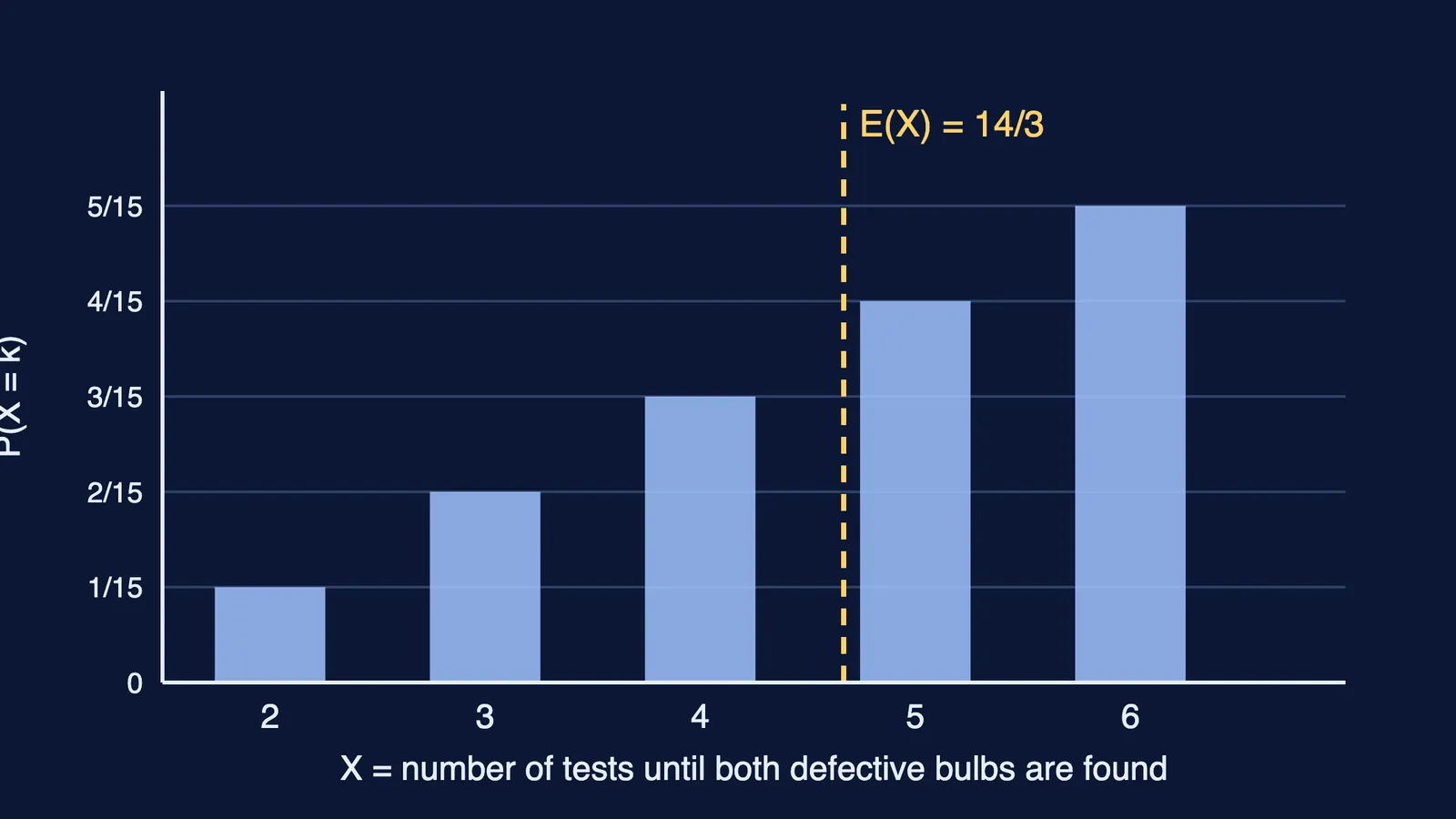
Q4 (medium, single correct). A box holds 4 good bulbs and 2 defective ones. Bulbs are tested one by one, without replacement, until both defectives are found. If X is the number of tests, E(X) is
(A) 7/3
(B) 4
(C) 14/3
(D) 9/2
Answer: (C). X = k puts the second defective at position k and the first in one of k − 1 earlier places, so P(X = k) = (k − 1)/6C2 = (k − 1)/15 for k = 2 to 6. Then E(X) = (2·1 + 3·2 + 4·3 + 5·4 + 6·5)/15 = 70/15 = 14/3. Trap: (B) treats the values 2 to 6 as equally likely.
Q5 (medium, numerical value). A bag has 5 red and 3 black balls. A ball is drawn and put back with 2 more of its colour. A second ball is then drawn and it is red. If p is the probability that the first ball was black, 100p is ____.
Answer: 30. First red, then red: (5/8)(7/10) = 35/80. First black, then red: (3/8)(5/10) = 15/80. So p = 15/50 = 3/10. Trap: 37.5, the prior 3/8, which ignores the red second ball.
Q6 (medium, one or more options correct). A random variable X takes the values 1, 2, 3, 4 with P(X = k) = k/10. Which statements are true?
(A) E(X) = 3
(B) Var(2X + 3) = 4
(C) Mean deviation about the mean = standard deviation
(D) P(|X − E(X)| ≤ 1) = 9/10
Answer: (A), (B), (D). E(X) = 30/10 = 3 and E(X²) = 100/10 = 10, so Var(X) = 1 and Var(2X + 3) = 4 · 1 = 4. Mean deviation = (2 + 2 + 0 + 4)/10 = 0.8, not 1, so (C) fails. Values 2, 3, 4 give 9/10. Trap: rejecting (B) after adding the 3 to get 7.
Hard: conditioning on counted outcomes
Q7 (hard, single correct). Five letters go at random into five addressed envelopes, one each. Given that at least one letter is in its correct envelope, the probability that exactly two are is
(A) 1/6
(B) 5/19
(C) 15/19
(D) 5/11
Answer: (B). With no letter correct there are 44 derangements, so 120 − 44 = 76 have at least one correct. Exactly two: 5C2 = 10 choices, times 2 ways to put the other 3 all wrong, gives 20. So the answer is 20/76 = 5/19. Trap: (A) is 20/120, which ignores the condition.
Q8 (hard, list match). A fair coin decides the box: heads, Box I (2 red, 3 white); tails, Box II (4 red, 1 white). Two balls are drawn from it in turn, without replacement. Match List-I with List-II.
List-I: (P) P(both red), (Q) P(Box II | both red), (R) P(one red and one white), (S) P(second red | first red)
List-II: (1) 7/20, (2) 6/7, (3) 1/2, (4) 7/12, (5) 3/5
(A) P→1, Q→2, R→3, S→3
(B) P→5, Q→2, R→3, S→4
(C) P→1, Q→2, R→3, S→4
(D) P→1, Q→5, R→4, S→3
Answer: (C). P(both red) = (1/2)(1/10) + (1/2)(6/10) = 7/20. Bayes: (6/20)/(7/20) = 6/7. One of each: (1/2)(6/10) + (1/2)(4/10) = 1/2. P(first red) = (1/2)(2/5) + (1/2)(4/5) = 3/5, so S = (7/20)/(3/5) = 7/12. Trap: (A) averages the in-box answers 1/4 and 3/4, forgetting that a red first ball favours Box II.
What should you do after checking your answers?
Count a multi-correct question right only if you chose every true option and no false one.
7 or 8: move on to timed mixed sets.
4 to 6: redo your misses in three days.
3 or fewer: revise conditional probability first.
For a warm-up, try our JEE Main probability practice set.
Stuck on a method? The Fermi Problem Library has worked problems with a step-by-step solver that explains the reasoning rather than printing an answer.