

On this page
You and a friend take turns rolling one die. The first person to roll a six wins. Should you go first? Yes, and the advantage is exact: the starter wins 6 times in 11. Teachoo lists this game as Example 23 of the Class 12 Probability chapter, and its worked solution reaches 6/11 for the player who starts and 5/11 for the other.
How do you set up the series of turns?
Call the players A and B, with A rolling first. On any roll a six comes up with probability 1/6, and anything else with probability 5/6, the setup in Teachoo's solution to the textbook example.
A can win only on rolls 1, 3, 5 and so on. To win on roll 3, A misses, B misses, then A rolls a six. Each extra round adds two misses, so it multiplies the chance by (5/6) × (5/6) = 25/36.
A wins on roll 1: 1/6, about 0.167
A wins on roll 3: (25/36) × (1/6) = 25/216, about 0.116
A wins on roll 5: (25/36)² × (1/6) = 625/7776, about 0.080
Adding every case gives P(A wins) = 1/6 + (25/36)(1/6) + (25/36)²(1/6) + ..., the series Teachoo writes as (1/6) + (5/6)²(1/6) + (5/6)⁴(1/6) + ....
How do you sum the geometric series?
A geometric series is one where the ratio of each term to the one before it is constant (Wolfram MathWorld). For a ratio r between −1 and 1, the infinite sum 1 + r + r² + ... equals 1/(1 − r) (Wolfram MathWorld).
Here every term carries a factor of 1/6 and the ratio is 25/36, so:
P(A wins) = (1/6) × 1/(1 − 25/36)
= (1/6) × 36/11
= 6/11, about 54.5%
Someone wins eventually, because the chance of both players missing forever is zero, a point MIT's 6.042 lecture notes on random processes make about the same game, framed there as a duel between two gunfighters. So P(B wins) = 1 − 6/11 = 5/11.
Is there a shortcut without the infinite sum?
Yes. MIT's 6.042 notes call it a fixed-point approach. Let x be the chance that A wins. In the first round, A rolls a six (probability 1/6) and wins, or B rolls a six and A loses, or both miss (probability 25/36) and the game restarts with A about to roll.
That gives x = 1/6 + (25/36)x. Move the x terms together: (11/36)x = 1/6, so x = 6/11. Two lines, no infinite sum.
Why does the first player have a 6/11 edge?
B can win only if A misses first. Once A misses, B is in exactly the position A was in at the start. So P(B wins) = (5/6) × P(A wins).
Two chances in the ratio 6 to 5 that add up to 1 must be 6/11 and 5/11. The gap is 1/11, about 9 percentage points, all from A getting the first shot. The game is also short: the same MIT notes show the expected number of trials until the first success is 1/p, which is 6 rolls for a die, the rule behind expected tosses until the first head.
What is the general formula for any success probability?
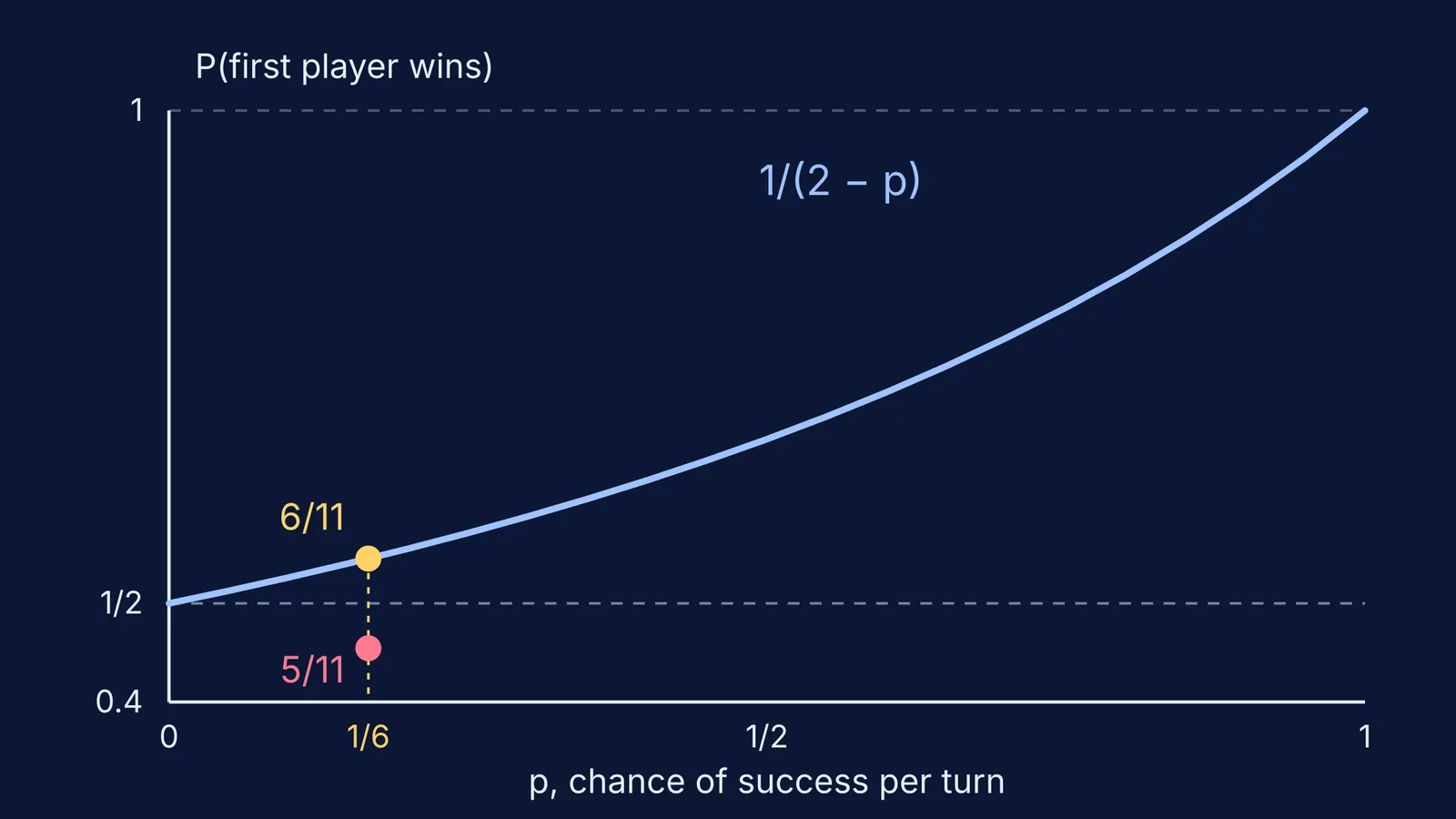
If each turn succeeds with probability p, the first player wins with probability p/(1 − (1 − p)²), which simplifies to 1/(2 − p) (MIT 6.042 lecture notes). The second player wins with probability (1 − p)/(2 − p).
Put in a few values of p:
Coin, heads wins (p = 1/2): first player wins 2/3
Die, a five or six wins (p = 1/3): 3/5
Die, a six wins (p = 1/6): 6/11
Two dice, double six wins (p = 1/36): 36/71, barely over half
When success is rare, 1/(2 − p) is close to 1/2 and turn order hardly matters. When success is likely, the first player almost always wins.
How do you solve these questions in an exam?
Use this check on any "take turns until someone succeeds" question:
List the turns on which your player can win (1st, 3rd, 5th and so on).
Find the first term and the ratio; with two players it is the chance of a miss, squared.
Sum with first term ÷ (1 − ratio), after checking the ratio is below 1.
Cross-check with the restart equation x = first term + ratio × x.
Check the answers add to 1 and the starter is above 1/2.
The restart equation also settles the chance of winning a tennis game from deuce, and expected value tells you whether a dice game is fair.
If setting up the series is where you get stuck, the Fermi Problem Library has worked problems with a step-by-step solver that explains the reasoning rather than printing an answer. To revise geometric series themselves, the Fermi Concept Library gives every mathematics concept its own lesson.


