On this page
Eight original JEE Advanced-level questions on applications of derivatives, graded easy to hard, each with a worked solution and its trap.
The JEE (Advanced) 2026 syllabus lists tangents and normals, increasing and decreasing functions, maxima and minima, and Rolle's and Lagrange's mean value theorems with their geometric meaning. JEE (Advanced) 2027 is on 23 May 2027, per the official JEE (Advanced) website. New to the chapter? Start with our guide on how to prepare applications of derivatives for JEE Advanced.
How should you use this practice set?
Each question is labelled; our explainer on JEE Advanced question types covers the formats.
Allow 30 minutes.
In "one or more options correct" questions, judge each option on its own.
In this set, numerical-value answers are non-negative integers.
Commit to an answer before reading the solution; note each trap you fall into.
Easy: can you differentiate the curve you are given?
Q1 (easy, single correct). The normal to the curve x² + xy + 3y² = 55 at the point (4, 3) meets the x-axis at x =
(A) 5/2 (B) 10 (C) 11/2 (D) 13/6
Answer: (A). Implicitly, 2x + y + xy′ + 6yy′ = 0, so y′ = −(2x + y)/(x + 6y) = −11/22 = −1/2 at (4, 3). The normal y − 3 = 2(x − 4) meets y = 0 at x = 5/2. Trap: (B) is the tangent's intercept, (C) flips the normal's sign and (D) drops the xy′ term.
Q2 (easy, numerical value). The tangent to y = 1/x at x = c (1 < c < 9) is parallel to the chord joining the curve's points at x = 1 and x = 9. Find c.
Answer: 3. The chord has slope (1/9 − 1)/8 = −1/9. Setting −1/c² = −1/9 gives c = 3 (c > 0). Trap: 5, the midpoint; the theorem does not promise the middle.
Medium: how do derivatives give angles, roots and maximum values?
Q3 (medium, single correct). At either intersection of y = x² and y = 2 − x⁴, the acute angle θ between the curves has tan θ =
(A) 6/7 (B) 2/9 (C) 7/6 (D) 6
Answer: (A). x² = 2 − x⁴ gives x² = 1, so the points are (±1, 1). At (1, 1) the slopes are 2 and −4, and tan θ = |(2 − (−4))/(1 + 2 × (−4))| = 6/7; symmetry gives the same at (−1, 1). Trap: (B) loses the minus sign in the slope of 2 − x⁴.
Q4 (medium, one or more options correct). Let f(x) = (x² − 3)eˣ. Then
(A) f is strictly decreasing on (−3, 1) (B) f has a local maximum at x = 1 (C) f(x) = k has exactly three real roots for every k in (0, 6e⁻³) (D) f(x) = 1 has exactly two real roots
Answer: (A), (C). f′(x) = (x + 3)(x − 1)eˣ is negative on (−3, 1): (A) holds, and x = 1 is a local minimum: (B) fails. The graph rises from 0 (as x → −∞) to 6e⁻³ ≈ 0.30 at x = −3, falls to −2e at x = 1, then rises without bound. Any k in (0, 6e⁻³) meets each piece once: (C) holds. The level 1 is crossed only on the last piece: (D) fails. Trap: (D) forgets f → 0 as x → −∞.
Q5 (medium, numerical value). Let M be the maximum value of (ln x)²/x for x ≥ 1. Find e²M.
Answer: 4. The derivative is ln x (2 − ln x)/x², zero at x = 1 and at x = e². It turns from positive to negative at e², so M = 4/e² and e²M = 4. Trap: 0, from stopping at x = 1, which is the minimum.
Hard: how many points, and are you sure?
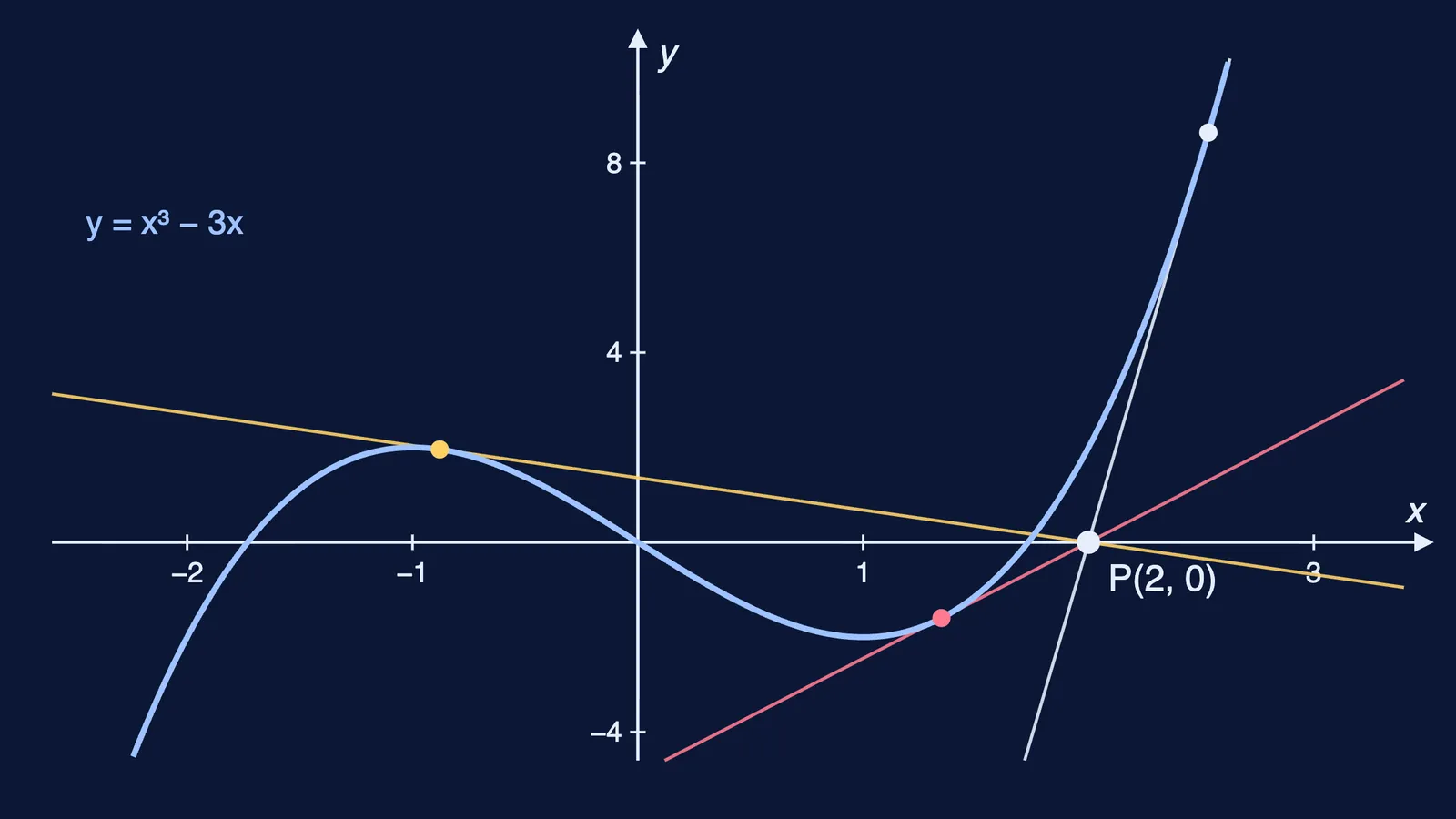
Q6 (hard, numerical value). How many distinct tangents to the curve y = x³ − 3x pass through the point P(2, 0)?
Answer: 3. The tangent at (t, t³ − 3t) passes through (2, 0) when (3t² − 3)(2 − t) + t³ − 3t = 0, that is t³ − 3t² + 3 = 0. For g(t) = t³ − 3t² + 3, g′(t) = 3t(t − 2), g(0) = 3 > 0 and g(2) = −1 < 0, so there are three real roots (about −0.88, 1.35 and 2.53) with different slopes, as the graph above shows. Trap: 1, from not checking g's turning points.
Q7 (hard, single correct). The equation x⁴ − 4x³ + 4x² + k = 0 has four distinct real roots exactly when k lies in
(A) (−1, 0) (B) [−1, 0] (C) (0, 1) (D) (−∞, 0)
Answer: (A). Write it as x²(x − 2)² = −k. The left side has minima 0 at x = 0, 2 and a local maximum 1 at x = 1. The line y = −k cuts it four times only when 0 < −k < 1. Trap: (B) adds the endpoints; k = −1 gives a double root at 1, so only three distinct roots.
Q8 (hard, one or more options correct). f is twice differentiable on ℝ with f(0) = 0, f(2) = 4 and f″(x) > 0 for all x. Then
(A) f(1) < 2 (B) f′(1) > 2 (C) f′(c) = 2 for exactly one c in (0, 2) (D) f′(2) < 2
Answer: (A), (C). The mean value theorem on [0, 1] and [1, 2] gives f(1) − 0 = f′(c₁) and 4 − f(1) = f′(c₂) with c₁ < c₂. Since f″ > 0, f′ is strictly increasing, so f(1) < 4 − f(1), giving f(1) < 2: (A). On [0, 2] some c has f′(c) = 2, and an increasing f′ takes that value once: (C). f(x) = x² fits with f′(1) = 2, so (B) need not hold, and f′(2) > 2 rules out (D). Trap: (B) takes the midpoint as the mean value point.
What should you do after this set?
Set-up slips (Q1, Q3, Q6) need slower differentiation; counting errors (Q4, Q7) need a rough graph first. For Q8, see our visual explainer on the second derivative test and concavity.
For more, the Fermi Problem Library has worked problems with a step-by-step solver that explains the reasoning rather than printing an answer.