On this page
What does the JEE Advanced syllabus say about applications of derivatives?
The official JEE (Advanced) 2026 syllabus lists, under Differential Calculus: "Tangents and normals, increasing and decreasing functions, derivatives of order two, maximum and minimum values of a function, Rolle's theorem and Lagrange's mean value theorem, geometric interpretation of the two theorems, derivatives up to order two of implicit functions, geometric interpretation of derivatives." The document says it is unchanged from 2025. The 2027 syllabus is not yet published (as of 19 November 2026), so prepare from this list and recheck later.
JEE (Advanced) 2027 will be held on 23 May 2027 (Sunday), organised by IIT Delhi, according to the official JEE (Advanced) website. One of the eligibility criteria is being among the top 2,50,000 successful candidates in the B.E./B.Tech. paper of JEE (Main) 2027. JEE (Advanced) 2026 had two compulsory papers of three hours each (2026 Information Brochure). Do not assume 2027 will repeat the 2026 question types or marking.
What is beyond JEE Main in this unit?
NTA's JEE (Main) 2027 syllabus lists rate of change, increasing and decreasing functions, and maxima and minima of functions of one variable. Set against it, these items are named only in the Advanced list:
tangents and normals
Rolle's theorem and Lagrange's mean value theorem
the geometric interpretation of the two theorems
the geometric interpretation of derivatives
If you have not yet worked through the Main-level version, start with our guide to application of derivatives for JEE Main.
How do Advanced problems combine these ideas?
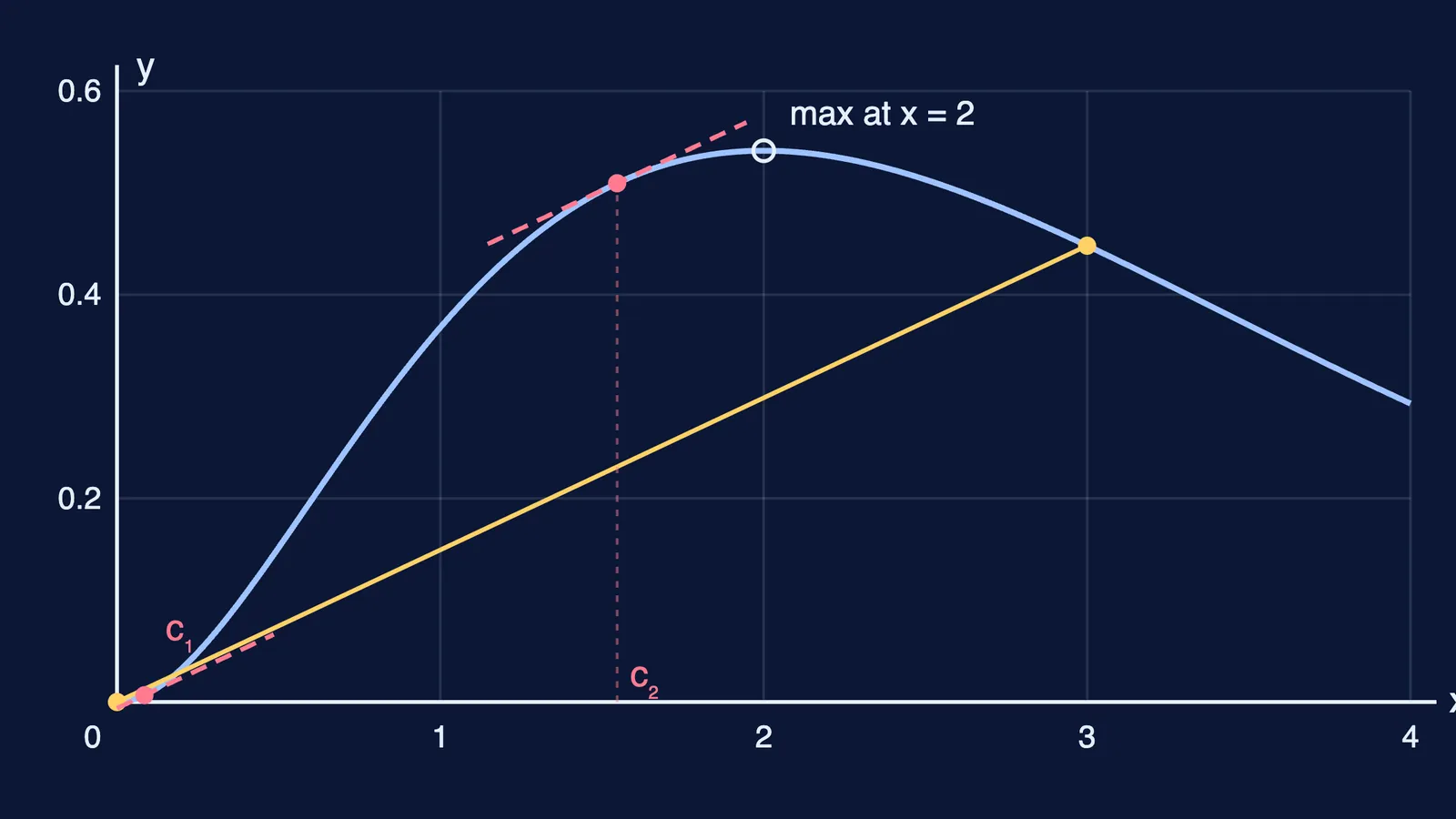
Example 1: one function, four ideas, multiple correct. Let f(x) = x²e⁻ˣ. Which are true? (A) f is strictly increasing on (0, 2). (B) There are exactly two values of c in (0, 3) where the tangent is parallel to the chord joining (0, 0) and (3, 9e⁻³). (C) The greatest value of f on [0, 3] is 9e⁻³. (D) The normal at x = 1 meets the x-axis at x = 1 + e⁻².
f′(x) = x(2 − x)e⁻ˣ, positive on (0, 2). So (A) is true.
The chord has slope 3e⁻³. The mean value theorem promises at least one c, not exactly one. f″(x) = (x² − 4x + 2)e⁻ˣ, so f′ rises until x = 2 − √2 and then falls to −3e⁻³ at x = 3. It crosses 3e⁻³ once each way: c ≈ 0.085 and c ≈ 1.547. So (B) is true.
The only interior critical point is x = 2, and f(2) = 4e⁻² ≈ 0.541 beats f(3) = 9e⁻³ ≈ 0.448. So (C) is false.
At x = 1 the tangent slope is e⁻¹, so the normal through (1, e⁻¹) has slope −e. Setting y = 0 gives x = 1 + e⁻². So (D) is true.
Answer: A, B and D. Mark only options you have checked; see our explainer on partial marking in multiple-correct questions.
Example 2: tangent plus optimisation, numerical answer. The tangent to y = 1/x² at P(t, 1/t²), t > 0, meets the x-axis at A and the y-axis at B. Find the least value of OA + OB, correct to two decimal places.
The slope at P is −2/t³. Putting y = 0 and then x = 0 in the tangent gives OA = 3t/2 and OB = 3/t².
S(t) = 3t/2 + 3/t², so S′(t) = 3/2 − 6/t³ = 0 gives t³ = 4. S″(t) = 18/t⁴ > 0, so this is a minimum.
Using t³ = 4, 3/t² = 3t/4, so S = 9t/4 = (9/4)∛4 ≈ 3.57.
Limiting case: as t → 0, OB grows without bound; as t → ∞, OA does. So a minimum must exist in between, a quick check that you have not found a maximum.
How should you practise for JEE Advanced?
A four-week plan:
Week 1: tangents and normals, including implicit curves.
Week 2: monotonicity from the sign of f′, including isolated zeros of f′.
Week 3: maxima and minima with parameters and geometry; always check endpoints.
Week 4: Rolle's theorem and the mean value theorem, drawn as a chord and a parallel tangent; then timed mixed sets, sorting each error as wrong formula, algebra slip or missed case.
Keep slipping at the same step? The Fermi Problem Library has worked problems with a step-by-step solver that explains the reasoning rather than printing an answer.
Can you solve these practice questions?
Find all local extreme values of f(x) = x⁴ − 18x² + 7. Answer: local maximum 7 at x = 0; local minimum −74 at x = ±3.
For which k does Rolle's theorem apply to f(x) = x² + kx on [−1, 3], and what is c? Answer: k = −2 and c = 1.
Find the normal to y = x³ − 2x at x = 1 and the other points where it meets the curve. Answer: y = −x, meeting the curve again at (0, 0) and (−1, 1).