

On this page
No options means no working backwards: you finish the calculus and type a number.
How do numerical-answer questions work in JEE Advanced?
In the mathematics part of JEE (Advanced) 2026 Paper 1, Section 3 had four numerical-value questions. A correct value earned +4 and anything else 0, with no negative marking. If the value has more than two decimal places, the paper says to truncate or round it to two.
The JEE (Advanced) 2026 syllabus lists tangents and normals, increasing and decreasing functions, maxima and minima, and Rolle's and Lagrange's mean value theorems.
Allow 35 minutes; commit to a number before reading each solution.
Our decimal answers are chosen so that truncating and rounding agree.
For option-based questions, use our JEE Advanced practice set on applications of derivatives.
Easy for Advanced: can you finish without options?
Q1. The tangent to y = x³ at (1, 1) meets the curve again at (p, q). Find −p.
The tangent is y = 3x − 2, and x³ − 3x + 2 = (x − 1)²(x + 2), so p = −2. Exact 2; enter 2. Check: (−2)³ = −8 = 3(−2) − 2. Lost mark: forgetting x = 1 is a double root.
Q2. Water flows at 12 cm³/s into a cone, vertex down, of radius 3 cm and height 6 cm. Find dh/dt, in cm/s, when the depth h is 4 cm.
Similar triangles give r = h/2, so V = πh³/12 and dV/dt = (πh²/4)(dh/dt). At h = 4, 12 = 4π(dh/dt). Exact 3/π ≈ 0.9549; enter 0.95. Check: the units give cm/s. Lost mark: keeping r = 3 fixed, which gives about 0.42.
Medium: where does the sign of f′ decide the answer?
Q3. How many integers a make f(x) = x³ + ax² + 12x + 5 increasing on all real numbers?
f′(x) = 3x² + 2ax + 12 ≥ 0 everywhere needs 4a² − 144 ≤ 0, so −6 ≤ a ≤ 6. Exact 13; enter 13. Check: at a = 6, f′ = 3(x + 2)² is zero only at x = −2. Lost mark: a strict inequality, giving 11.
Q4. Find the shortest distance from (0, 2) to the parabola y = x².
With t = x², D² = t + (t − 2)², least at t = 3/2, where D² = 7/4. Exact √7/2 ≈ 1.3229; enter 1.32. Check: the vertex gives D = 2, a local maximum of distance. Lost mark: entering 2 because the vertex looks closest.
Q5. For how many integers k does 3x⁵ − 5x³ + k = 0 have exactly three distinct real roots?
For g(x) = 3x⁵ − 5x³, g′(x) = 15x²(x² − 1): a local maximum 2 at x = −1, a local minimum −2 at x = 1, and none at x = 0 (no sign change). The line y = −k cuts g three times when −2 < k < 2. Exact 3; enter 3. Check: at k = ±2 one root is double, leaving two distinct roots. Lost mark: including ±2 and entering 5.
Hard: can you handle questions that combine two ideas?
Q6. Find the greatest volume, in cm³, of a right circular cone inscribed in a sphere of radius 3 cm.
For cone height h, the base radius satisfies r² = h(6 − h), so V = (π/3)h²(6 − h). V′ = (π/3)(12h − 3h²) = 0 gives h = 4, and V″ = −4π there. Exact 32π/3 ≈ 33.510; enter 33.51. Check: h = 3 gives 9π ≈ 28.27, smaller. Lost mark: putting the base through the centre and entering 28.27.
Q7. A tangent to x²/9 + y²/4 = 1 at a first-quadrant point meets the axes at A and B. Find the least AB.
At (3 cos θ, 2 sin θ) the intercepts are 3/cos θ and 2/sin θ, so AB² = 9 sec²θ + 4 cosec²θ. The derivative vanishes when tan²θ = 2/3, giving AB² = 15 + 10 = 25. Exact 5; enter 5. Check: θ = 45° gives √26 ≈ 5.10, larger. Lost mark: assuming symmetry and entering 5.10.
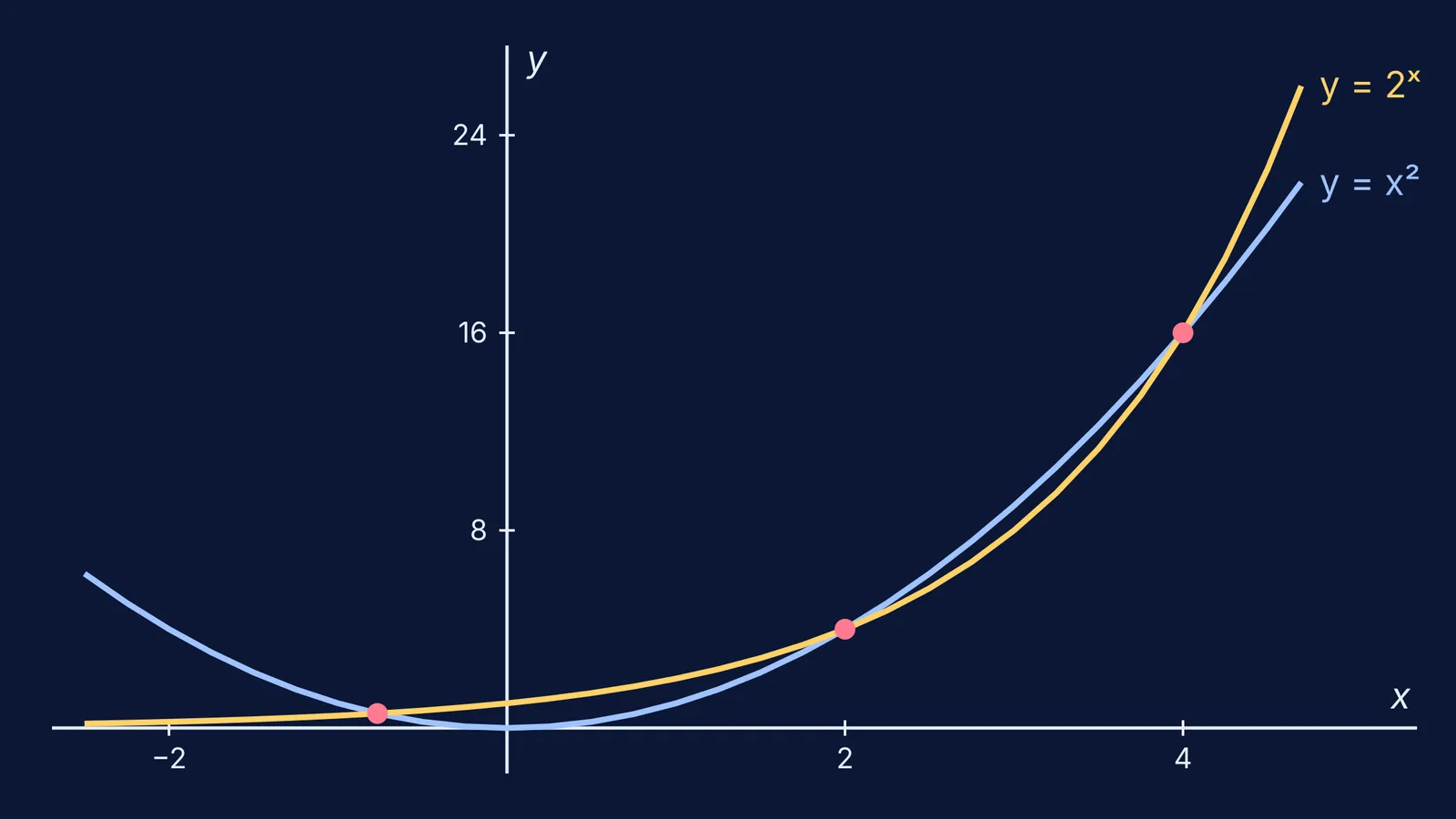
Q8. How many real solutions does 2ˣ = x² have?
Let h(x) = 2ˣ − x². Since h‴(x) = (ln 2)³2ˣ > 0, Rolle's theorem, used three times, allows at most three roots. x = 2 and x = 4 work, and h(−1) = −1/2 < 0 < 1 = h(0) gives one more. Exact 3; enter 3. Check: the graph at the top shows the third crossing near x = −0.77. Lost mark: spotting 2 and 4 and stopping.
What should you do after this set?
Sort your misses: set-up slips (Q2, Q6) need a labelled diagram; boundary slips (Q3, Q5) need the endpoint tested; trusting the picture (Q4, Q7, Q8) needs a derivative check. Warm up with our JEE Main numerical questions on application of derivatives; for a revision order, see how to prepare applications of derivatives for JEE Advanced.
For method slips, the Fermi Problem Library has worked problems with a step-by-step solver that explains the reasoning rather than printing an answer. For JEE Main and Advanced preparation, see Fermi Test Prep.


