On this page
Your textbook says a dominant trait shows up in every generation. Then a pedigree shows an affected grandfather, an unaffected father and an affected granddaughter. The rule has not broken: the father most likely carries the dominant allele without showing it. This is incomplete penetrance, and polydactyly, an extra finger or toe, is the classic example.
Why does a dominant trait skip a generation in a pedigree?
One altered copy of a gene is enough to cause an autosomal dominant condition, according to MedlinePlus Genetics. An affected parent has a 50 percent chance of passing the altered gene to each child, as the MedlinePlus risk page puts it.
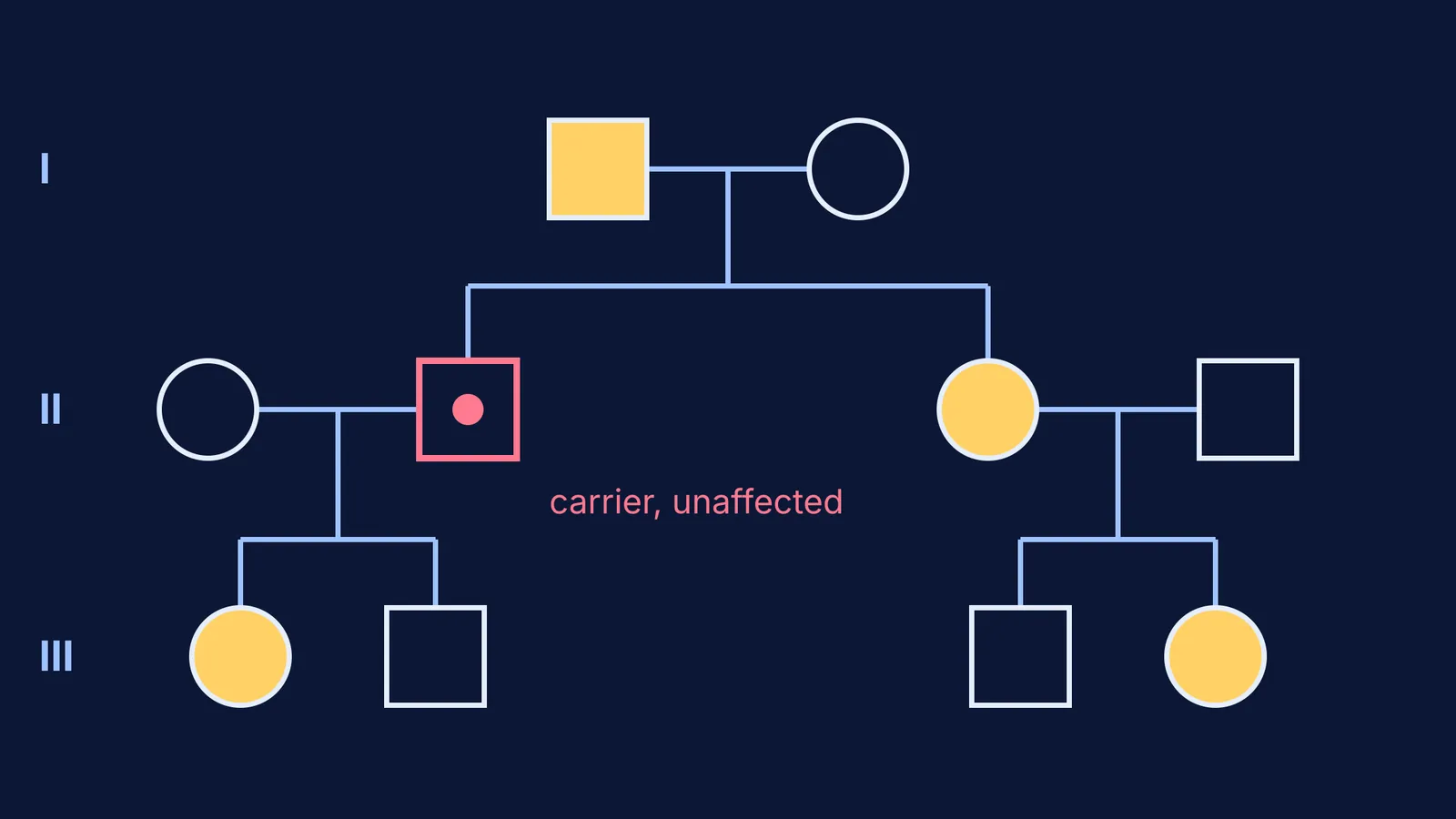
The catch is that carrying the allele does not always mean showing the trait. Some carriers never develop it, yet pass the allele on at the same rate. On the chart they are drawn as an empty shape, so the trait appears to jump over them.
What is incomplete penetrance?
Penetrance is the proportion of people with a particular genetic variant who show signs of the condition, as defined by MedlinePlus Genetics. If some people with the variant do not develop its features, the condition has reduced, or incomplete, penetrance. The same page separates this from variable expressivity, where people with the same condition show it to different degrees. MedlinePlus says both probably come from a mix of genetic, environmental and lifestyle factors, many of them still unknown.
Remember it this way: penetrance asks whether a carrier shows the trait at all; expressivity asks how strongly.
How does polydactyly show incomplete penetrance?
Polydactyly means having more than the normal number of fingers or toes, and it can be inherited or arise on its own, according to the NHGRI genetics glossary.
A 1976 study by Scott-Emuakpor and Madueke in Human Heredity found polydactyly in 22.78 per thousand people in Nigeria, all of it on the little-finger side. They concluded it was inherited as an autosomal dominant trait with a penetrance of 64.9% and highly variable expressivity. In plain terms, about one carrier in three in that population had no extra digit.
A study published online in 2019 in Human Mutation tested the GLI1 gene in 95 unrelated people with isolated postaxial polydactyly and found single-copy harmful variants in 11.57% of them; the family patterns fitted dominant inheritance with incomplete penetrance.
The clearest skipped generation comes from a 2003 report in the American Journal of Medical Genetics on Greig cephalopolysyndactyly, a condition that includes extra digits. In one four-generation family, it skipped a generation through a woman who carried the GLI3 mutation but had no clinical signs.
How do you read a pedigree where a carrier looks unaffected?
Use the chart at the top. New to the shapes? See our guide to what squares, circles and lines mean in a pedigree. Numbering runs left to right in each generation. Grandfather I-1 has polydactyly. His son II-2 does not. II-2's daughter III-1 does, and so do his sister II-3 and her daughter III-4. Work through it like this:
Find the gap. II-2 is unaffected but sits between two affected relatives in a direct line of descent.
Test recessive. III-1 would need two copies, so II-2 and his wife II-1, who married into the family, would both have to be carriers. II-3 being affected would need grandmother I-2 to be a carrier too, and III-4 would need II-3's husband to be one. Three unrelated carriers of a rare allele is a stretch.
Test X-linked. Fathers cannot pass X-linked traits to sons, as MedlinePlus notes, so II-2 would need another unaffected carrier, his mother I-2. Set it aside.
Accept dominant with incomplete penetrance. II-2 must have inherited the allele from I-1 and passed it to III-1. Mark him as an obligate carrier.
Write the conclusion in one line: "Autosomal dominant with incomplete penetrance; II-2 is a non-penetrant carrier."
Our post on telling a dominant pedigree from a recessive one has more practice charts. In most textbook problems, assume full penetrance unless the question says otherwise.
Both figures use the penetrance estimate from the 1976 Nigerian study. Our walkthrough of pedigree probability and carrier chance covers the conditional step in more detail.
What else can make a trait look like it skipped?
Mild expressivity: postaxial type B is a more rudimentary extra digit, per the 2019 GLI1 study, so a small one removed in infancy may go unnoticed.
Recessive inheritance, as tested in step 2 above.
A new variant in the child, which MedlinePlus lists as a cause of dominant conditions with no family history.
If penetrance, expressivity and dominance still blur together, the Fermi Concept Library gives every biology concept its own lesson and its place in the map.