On this page
A common idea in textbooks and online is that the left and right ovaries take turns: one egg from each side in alternate months. It is a tidy idea. But when researchers watched ovaries cycle after cycle with ultrasound, the pattern did not show up.
Do ovaries take turns releasing eggs each month?
Not in any regular way. In a 2000 study in Human Reproduction, R. Ecochard and A. Gougeon followed 80 normally fertile women through 199 cycles and used ultrasound to see which ovary ovulated each time.
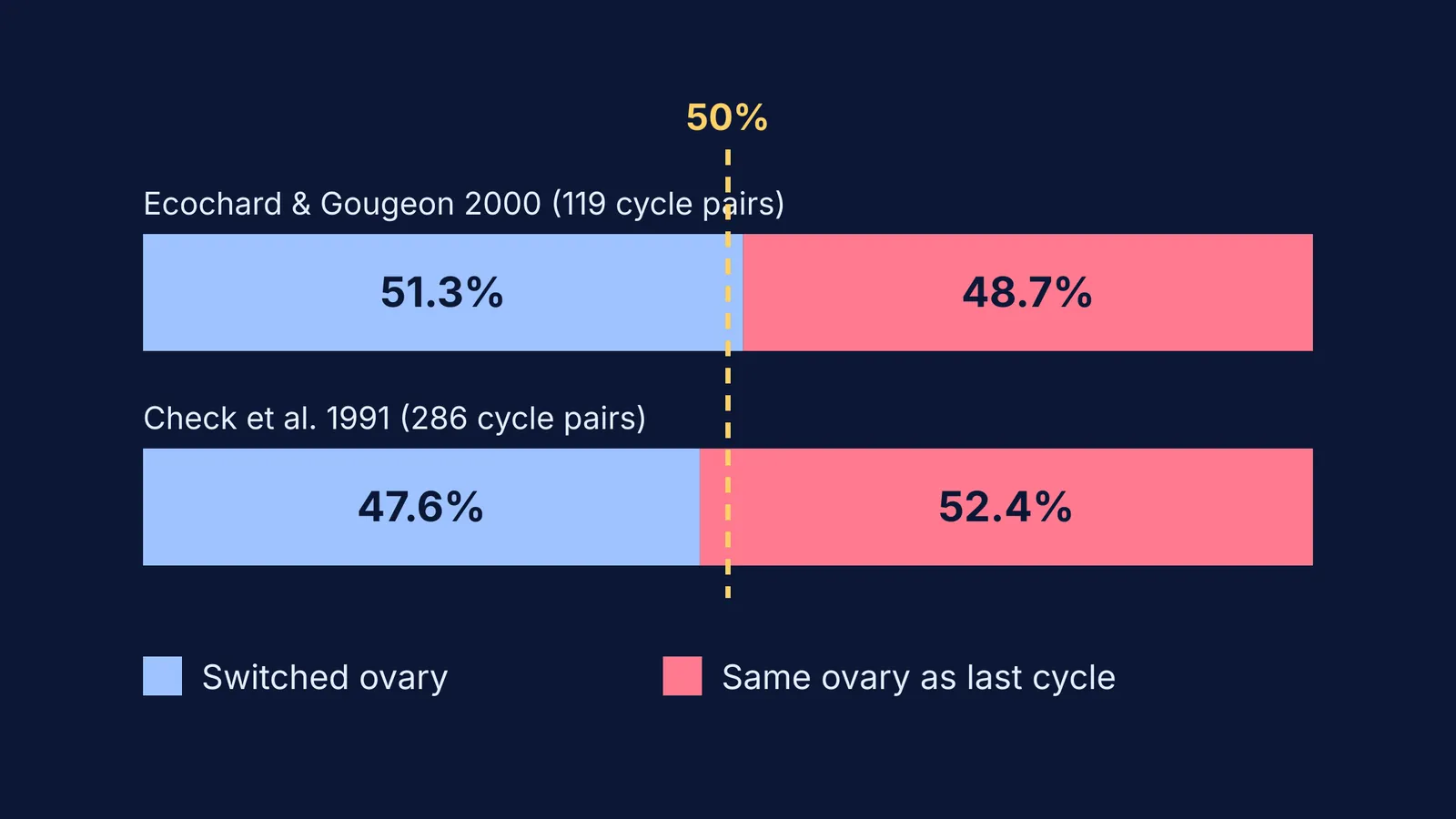
Ovulation switched sides in 61 of 119 pairs of back-to-back cycles, or 51.3%, which was not significantly different from chance (Ecochard and Gougeon, 2000).
The right ovary ovulated in 104 of the 199 cycles (52.3%), again not significantly different from 50%. The authors concluded that the site of ovulation is "most probably random", and that cycle length and hormone levels did not depend on which side it came from.
An earlier study pointed the same way. Check and colleagues (1991) looked at 286 pairs of natural cycles and found ovulation on the same side as the previous cycle 52.4% of the time and on the opposite side 47.6% of the time. They wrote that their data "suggest that the side of ovulation in successive cycles is not influenced by the side of ovulation in the preceding cycle."
Is one ovary more likely to ovulate than the other?
Possibly, by a little. A larger dataset from Fukuda and colleagues (2000) covered 2,090 cycles in 1,114 women, 856 fertile and 258 infertile, and found ovulation from the right ovary in 55% of cycles against 45% from the left. Check and colleagues (1991) also saw right-sided ovulation in 54.5% of cycles.
Ecochard and Gougeon's smaller group of fertile volunteers showed no significant tilt. A fair summary: there may be a slight lean to the right, but there is no monthly rhythm you could predict.
So what decides which follicle ovulates?
A competition between follicles. The ovary is simply where the winner happens to sit.
A group of follicles starts growing. Daily ultrasound of 50 healthy women by Baerwald, Adams and Pierson (2003)00544-2) showed follicles grow in waves: between one ovulation and the next, 68% of the women had two waves and 32% had three.
FSH opens the gate. A follicle needs FSH above "a critical concentration" to begin its final growth, as Anthony Zeleznik explains in a 2004 review of follicle selection.
The leader closes the gate behind it. The most mature follicle makes oestrogen, which pushes FSH below the level the smaller follicles need.
The leader needs less to keep going. It has become less dependent on FSH, and its granulosa cells can respond to LH as well, so it keeps growing while FSH falls.
The rest stop. The follicles left behind undergo atresia, the normal breakdown of follicles that do not ovulate.
Generally a single dominant follicle is selected in the middle of the follicular phase and ovulates at mid-cycle, according to a 2012 review by Baerwald and colleagues. Nothing in these steps checks which ovary released last month's egg, which fits the coin-flip results above.
If the stages from primary to Graafian follicle are hazy, start with our guide to follicle stages. For what the empty follicle does next, see how the corpus luteum makes progesterone.
What would a coin flip look like over a year?
Here is a quick worked example that uses the maths you already know. Treat each cycle as a fair coin toss for left or right, which is close to what the studies above found.
In 12 cycles there are 11 changeovers, so you would expect about 11 × 0.5 = 5.5 switches, not 11.
The chance of perfect alternation all year, L R L R and so on, is (1/2) to the power 11, which is 1 in 2,048, about 0.05%.
A run such as L L R L R R is what randomness normally looks like.
Compare that with the real data: 51.3% switches in Ecochard and Gougeon's study and 47.6% in Check and colleagues' study. Both sit close to the 50% a coin would give.
How should you write this in a NEET-UG or board answer?
Use this checklist when a question asks about ovulation or the ovarian cycle:
Name the structure: the egg is released from the Graafian (mature) follicle.
Name the hormones in order: FSH drives follicle growth, oestrogen from the growing follicle feeds back on FSH, and an LH surge triggers ovulation.
Say "usually one dominant follicle" per cycle, not one from each ovary.
Do not write that the ovaries alternate. The evidence does not support it.
If FSH and oestrogen feedback still feels tangled, the Fermi Concept Library gives each biology concept its own lesson and shows its place in the map. For practice, the Fermi Problem Library has worked problems with a step-by-step solver that explains the reasoning rather than printing an answer.
If you are tracking your own cycle for health reasons, irregular periods or one-sided pain are questions for a gynaecologist or your family doctor, not a textbook.