On this page
Typically, human females and female fruit flies have two X chromosomes, while males of both species have one. Left alone, XX cells would carry two doses of every X-linked gene and XY cells only one. Both species fix this, in opposite ways, and that contrast is what exam questions test.
What is dosage compensation?
Dosage compensation is the process that equalises gene expression from the X chromosome between males (XY) and females (XX), as defined in a review by Gelbart and Kuroda in Development (2009).
The problem is not small. The X chromosome likely carries 900 to 1,400 protein-coding genes, according to MedlinePlus Genetics from the US National Library of Medicine. In XY species the Y has degenerated, so the XY sex is partly aneuploid for X genes, explains Christine Disteche's review in the Annual Review of Genetics (2012). The same review notes that strategies for dosage compensation differ between species: some upregulate the single X, others repress in the XX sex.
How do humans compensate for the extra X?
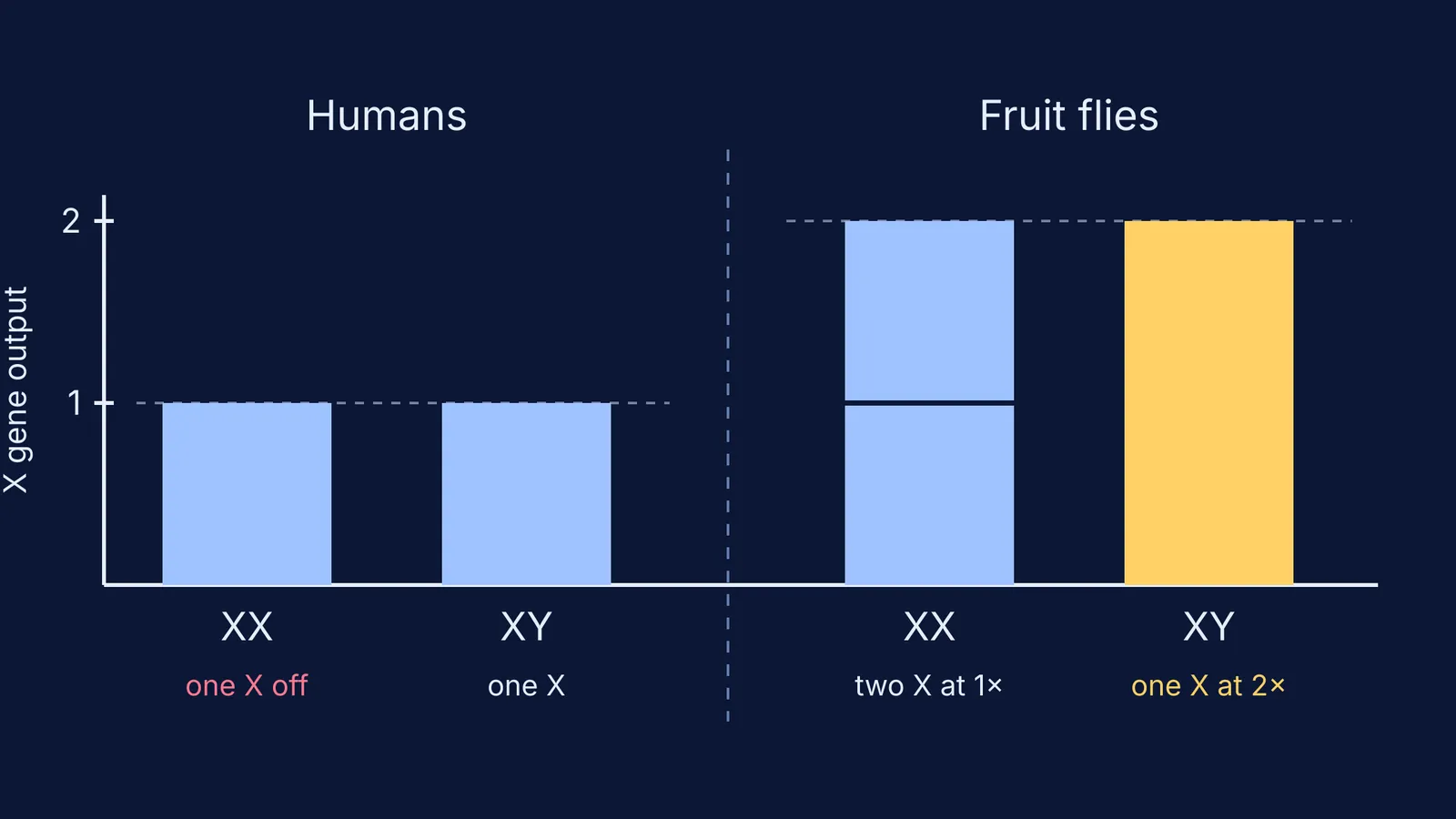
Mammals use X inactivation. Early in embryonic development, one X chromosome in people with two X chromosomes is randomly and permanently inactivated in cells other than egg cells, per MedlinePlus Genetics. Because the choice is usually random, the mother's X is active in some cells and the father's X in others, so a female's body is a mosaic of the two kinds of cell.
Mary Lyon proposed this idea in a 1961 paper in Nature; our post on how Mary Lyon discovered X inactivation tells that story.
The switch is a noncoding RNA called Xist. It acts in cis, affecting only the chromosome from which it is transcribed, because it accumulates over that chromosome's territory instead of leaving the nucleus, as Neil Brockdorff's 2019 review in Open Biology describes.
The silencing is not total. In a profile of the human X chromosome, about 15% of X-linked genes escaped inactivation to some degree, and another 10% showed variable patterns, found Carrel and Willard in Nature (2005).
How do fruit flies compensate?
Drosophila does the reverse. The male-specific lethal (MSL) complex upregulates transcription from the single male X chromosome approximately twofold, according to Gelbart and Kuroda (2009).
The same review lists the parts:
At least five proteins: MSL1, MSL2, MSL3, MOF and MLE.
Two noncoding RNAs, roX1 and roX2, both encoded on the X.
MOF is a histone acetyltransferase that acetylates histone H4 at lysine 16 (H4K16ac), a mark that stimulates transcription.
The complex is essential for male viability, which is why the genes are called male-specific lethal.
Females do not compensate this way, because MSL2, the limiting part of the complex, is repressed in females.
What is the difference between dosage compensation in Drosophila and humans?
Here is the comparison, feature by feature (humans first, fruit flies second), based on MedlinePlus Genetics and Gelbart and Kuroda (2009):
Which sex adjusts: females (XX) / males (XY).
Direction: one X switched off / the single X turned up about twofold.
Which X: usually chosen at random in each early cell / the only X there is.
Key RNA: Xist / roX1 and roX2.
How it works on the chromosome: Xist RNA accumulates over the X it comes from / the MSL complex binds the male X and MOF adds H4K16ac.
End result: one working X dose in both sexes / two X doses in both sexes.
If a question moves on to Barr bodies, our post on counting Barr bodies in XXY, XXX and XO shows the X minus 1 rule with worked cases.
How should you write this in an exam answer?
Use this four-line frame for a short answer, with the fly figure taken from Gelbart and Kuroda (2009):
State the problem: XX has two doses of X genes, XY has one.
Humans: in females, one X is randomly inactivated early in development, guided by Xist RNA.
Drosophila: in males, the MSL complex raises transcription of the single X about twofold, with MOF adding H4K16 acetylation.
Conclude: both reach equal X expression between sexes, by opposite routes.
Avoid these five slips:
Saying human males double their X. They do not; that is the fly strategy.
Saying female flies inactivate one X. They do not; MSL2 is repressed, so they do not form the MSL complex.
Saying the father's X is always the one silenced. In humans the choice is usually random.
Calling inactivation complete. Escape genes exist.
Mixing this up with sex determination. That is a separate question, covered in our guide to XO, XY and ZW sex determination.
If sex chromosomes, X inactivation and X-linked inheritance feel scattered, the Fermi Concept Library has a lesson for every concept in biology, each with its place in the map, so you can see how they connect.