

On this page
A female mammal has two X chromosomes in each body cell and a male has one. So why don't females make twice as much of every X-linked protein? In 1961 the British geneticist Mary Lyon answered in a two-page paper.
What is lyonisation?
Lyonisation is the process in which one of the two X chromosomes in female mammals becomes condensed and genetically inert, so XX females and XY males end up with matching doses of X-linked genes. That is the definition in the Royal Society's biographical memoir of Mary Lyon; today it is usually called X-chromosome inactivation.
Lyon's proposal had three features, summarised by the Embryo Project Encyclopedia and a 2015 review in the Journal of Genetics:
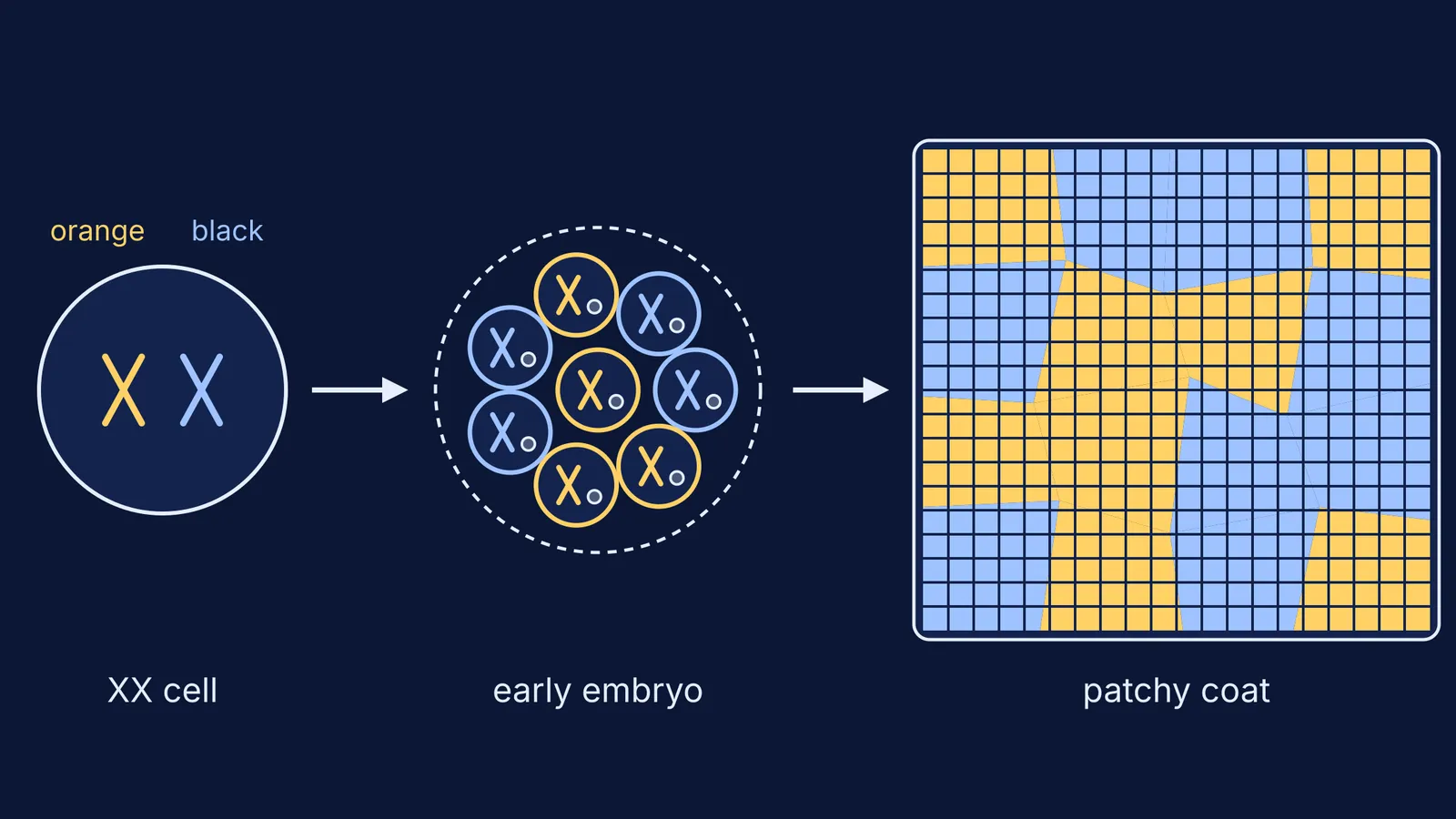
One X is switched off early. In each female cell, one X is silenced during early development.
The choice is random. In some cells the X from the mother is switched off, in others the X from the father.
The choice is inherited. Lyon read mottled coats as clones of cells, so every cell descended from an early cell keeps the same X switched off.
The silenced X is visible down a microscope as a small, dark lump in the nucleus called the Barr body. A 2014 study in Epigenetics and Chromatin describes the Xist RNA-coated Barr body as the structural hallmark of the compacted inactive X.
How did Mary Lyon discover X-inactivation?
Mary Lyon was born on 15 May 1925 and died on 25 December 2014, according to the Royal Society memoir. The Royal Society's account of her life says she read zoology at Cambridge from 1943, began a PhD on mouse genetics there and continued in Edinburgh, before the mouse lab moved to the Medical Research Council's Harwell site in Oxfordshire. Some of the new strains carried sex-linked coat mutations that looked different in females and males.
She joined three clues. The Embryo Project summary of the paper describes how she used them:
Mice with only one X (XO) develop as normal females. So a female needs only one working X.
Female cells carry a condensed X. Murray Barr and Ewart Bertram had reported a dark body in the nerve cells of female cats in Nature in 1949, and later work by Ohno and Hauschka found that one X chromosome in female cells looked different from the other.
Females with one normal and one mutant coat-colour gene look mottled. They are a patchwork of both colours, not a blend.
Her conclusion fitted all three. If one X is shut down at random in each early cell, a female is a mosaic. She published it alone as "Gene Action in the X-chromosome of the Mouse (Mus musculus L.)" in Nature, volume 190, pages 372-373, in April 1961.
Why are calico cats almost always female?
In cats, the gene for orange versus black fur sits on the X chromosome. Lyon herself cited the tortoiseshell cat's black and yellow mosaic, according to the Embryo Project. A female with one orange X and one black X switches one off in each early cell, and each cell's descendants form a patch. The Mary Lyon Centre at MRC Harwell notes that nearly all tortoiseshell cats are female. A calico cat is the same black and orange mix with white added, so the same rule applies.
An XY tomcat has one X, so he can be orange or black but not both. A 2013 case report in Cytogenetic and Genome Research found a male tortoiseshell cat with a 39,XXY karyotype. He was sterile.
How do you solve Barr body questions in exams?
One rule follows from Lyon's idea: one X stays active, so the number of Barr bodies is the number of X chromosomes minus one. Wikipedia's entry on the Barr body states this rule for humans. Work through it like this:
Count the X chromosomes in the karyotype and ignore the Y.
Subtract one for the X that stays active.
For a patchy coat, check that there are two X chromosomes carrying different alleles.
46,XX (typical female): 1 Barr body; can be a mosaic.
46,XY (typical male): 0 Barr bodies; no X mosaic.
47,XXY (Klinefelter): 1 Barr body; the cat version, 39,XXY, is how a male cat can be tortoiseshell.
47,XXX: 2 Barr bodies.
45,X (Turner): 0 Barr bodies.
For where an extra X comes from, see our guide to how nondisjunction adds a chromosome in meiosis. If X-linked inheritance itself feels shaky, the Fermi Concept Library gives each biology concept its own lesson and its place in the map, so you can fill that gap first.
Why does X-inactivation still matter?
The Mary Lyon Centre credits her discovery with great advances in understanding X-linked conditions, including haemophilia, Duchenne muscular dystrophy and fragile X syndrome. The Journal of Genetics review notes that in 1962 and 1964 papers she suggested a centre from which inactivation spreads and a region that escapes it, both later found.
Next, try our colour blindness X-linked inheritance simulation, or read how Joe Hin Tjio counted 46 human chromosomes.


