

On this page
In 1956 two scientists working in Lund, Sweden, published a six-page paper that changed a textbook number. Joe Hin Tjio and Albert Levan reported in Hereditas that human cells carry 46 chromosomes, not the 48 that scientists had accepted for three decades. The fix did not come from a new theory. It came from how they prepared the cells.
Why did scientists believe humans had 48 chromosomes?
The figure of 48 came from Theophilus Painter at the University of Texas, who published a full report on human testis cells in 1923. Historian Daniel Kevles, writing in Caltech's Engineering & Science in 1985, puts it plainly: “For the next 30 years, just about everyone believed the human chromosome number to be 48, for both sexes.”
The trouble was the slides. Kevles explains that cells were sliced into thin sections, so fragments of one chromosome could turn up in two slices and be counted twice, and the crowded chromosomes looked “something like the noodles suspended in a soup”.
In 1952 the cytologist Tao-Chiuh Hsu found, by accident, that rinsing cells in a dilute (hypotonic) salt solution made them swell and scattered the chromosomes. Even so, Hsu still reported 48. As Kevles records, Hsu later recalled: “I had difficulty in getting the count to equal 48.”
Who was Joe Hin Tjio?
Tjio was born on 2 November 1919 in Pekalongan, Java, then part of the Dutch East Indies, and trained in agronomy at Bogor, according to his biography on Wikipedia. During the Second World War he was imprisoned and tortured by the Japanese, as the Genetics Unzipped podcast recounts. After the war he studied plant chromosomes in Zaragoza, Spain, and made regular visits to Lund to work with Levan, who had pioneered the use of colchicine on chromosomes.
How did Tjio and Levan count 46 chromosomes?
Their paper sets out the method (Tjio and Levan, 1956). They used lung fibroblasts grown in culture from four human embryos obtained after legal abortions. Kevles describes four techniques working together:
Tissue culture gave a steady supply of dividing cells, the only cells whose chromosomes can be counted.
Colchicine, added to the culture 12 to 20 hours before fixing, held many cells mid-division and made the chromosomes contract, so fewer overlapped.
A short hypotonic soak of only one or two minutes spread the chromosomes apart. The pair found that Hsu's longer treatment made chromosome outlines “somewhat blurred and vague”.
A very mild squash flattened whole cells instead of slicing them. Often a single cell was squashed under the microscope with slight pressure from a needle, and “it was directly observed that no chromosomes escaped”.
Genetics Unzipped says Tjio took the decisive photograph at 2am on 22 December 1955. The published paper reports 261 exact counts from 22 cultures across the four embryos. “We were surprised to find that the chromosome number 46 predominated in the tissue cultures from all four embryos,” they wrote, with “only single cases deviating from this number.”
They stayed cautious: until sperm-forming cells were checked, they would not claim 2n = 46 outright, “but it is hard to avoid the conclusion that this would be the most natural explanation of our observations.”
How was the number 46 confirmed?
Within days of publication, Kevles writes, Charles Ford had read the paper in England. He and his Harwell colleague John Hamerton swiftly confirmed the count of 46 using fresh human testicular tissue, the same kind of tissue Painter had relied on. A reliable count made it possible to link an extra or missing chromosome to a condition, as our guide to sex determination, pedigrees and chromosomal disorders covers for NEET. For an earlier chapter of the same story, read how Nettie Stevens used a chromosome count to show how sex is set.
How can you use the 46 versus 48 story in your biology prep?
When a count in a practical does not match what you expected, ask the questions Tjio and Levan answered:
Am I looking at cells that are actually dividing?
Are the chromosomes condensed enough to tell apart?
Are they spread out, or piled on top of each other?
Could I be counting one piece twice, or missing one that slipped away?
Am I counting what I see, or what I expect to see?
Then test yourself on the facts that grew out of their paper:
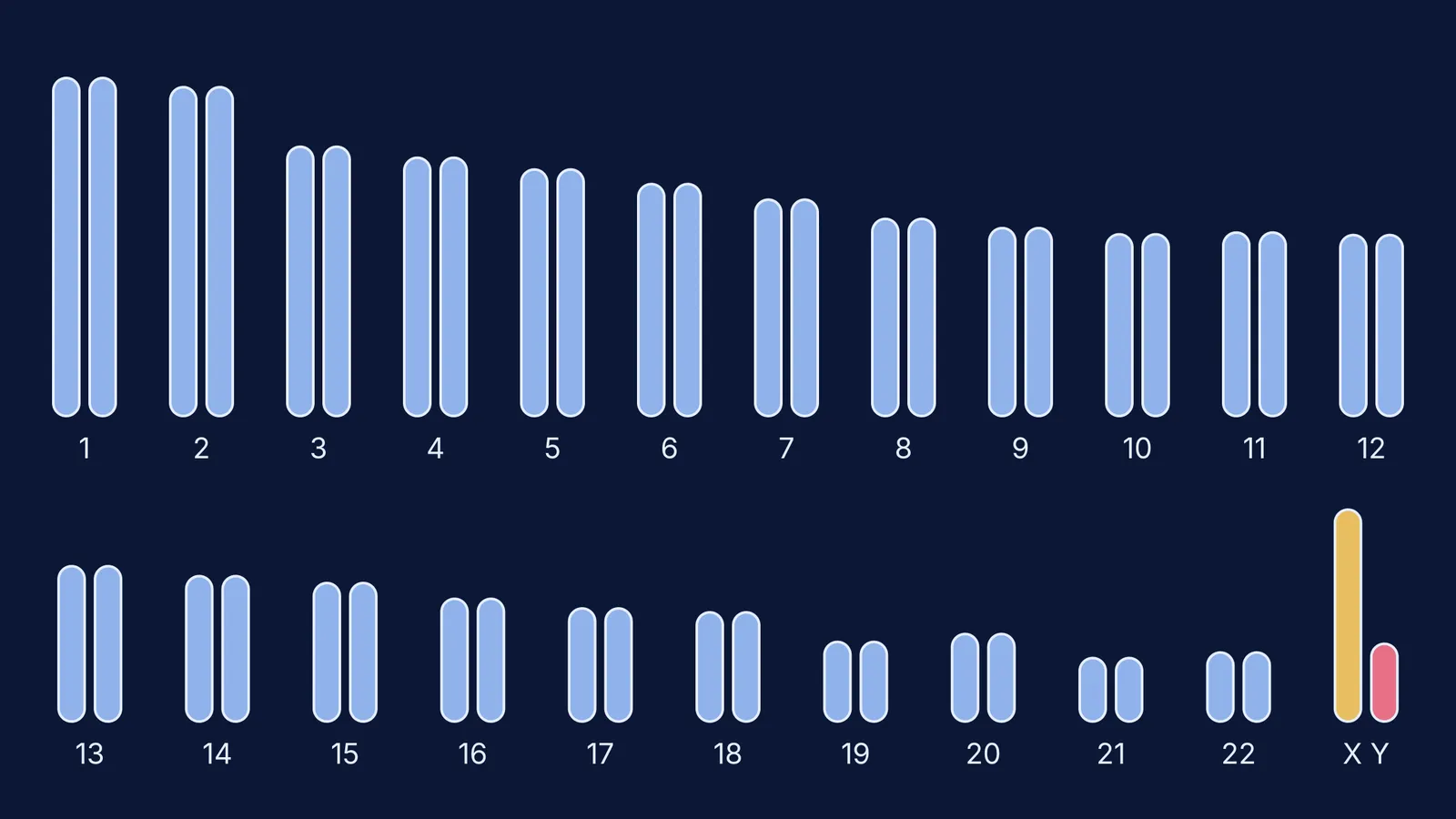
A human body cell has 46 chromosomes: 22 pairs of autosomes plus XX in females or XY in males, as Kevles summarises.
A sperm or egg carries half that number, 23. Our post on the cell cycle, mitosis and meiosis tracks the count through each stage.
If words like centromere, autosome or hypotonic still feel hazy, the Fermi Concept Library gives every biology concept its own lesson and shows its place in the map. And if you are not sure where to begin with genetics revision, Fermi's AI tutor can work out what you already know and build a plan for the session.
Next time you write 2n = 46, remember the gentle squash behind it.


