On this page
Donated blood in India does not go straight to a patient. A sample is tested first, and the unit is used only if the tests are clear. Knowing what each test looks for helps in the Human Health and Disease chapter, and explains why blood centres ask donors so many personal questions.
Which tests are done on donated blood in India?
India requires mandatory screening of all blood donations for five transfusion-transmissible infections: HIV, hepatitis B, hepatitis C, syphilis and malaria, as the Directorate General of Health Services states. A 1989 notification under the Drugs and Cosmetics Act made the HIV test mandatory, and hepatitis C antibody testing became mandatory from 1 June 2001, as a 2005 paper in the Medical Journal Armed Forces India80170-4) records.
The same paper quotes the rule: each unit is tested for HIV I and II antibodies, hepatitis B surface antigen, hepatitis C antibodies, malarial parasites and other tests listed in the Indian Pharmacopoeia. In plain terms:
HIV 1 and 2: antibodies the donor's immune system has made against the virus.
Hepatitis B: HBsAg, the surface protein of the virus itself, whose presence means a person is infectious, as the CDC Pink Book explains.
Hepatitis C: antibodies against the virus.
Syphilis: antibodies, either against lipid antigens found in both the bacterium and the body's own cell membranes (RPR, VDRL) or against antigens specific to the bacterium *Treponema pallidum*, as the CDC's 2024 syphilis laboratory recommendations describe.
Malaria: the parasite, seen on a blood smear, or its proteins picked up by a rapid test.
On malaria, one Delhi blood centre screened 11,736 donated units with a rapid test that detects the parasite proteins HRP2 and pLDH, and found 3 positive (0.03%), all confirmed under the microscope, according to a 2010 study in the Asian Journal of Transfusion Science.
Antibody or antigen: what is the difference?
An antigen is a piece of the germ itself, such as a surface protein. An antibody is a protein your own immune system makes in response to that germ. So an antigen test catches the invader, and an antibody test catches the body's reaction. Our explainer on how to tell antigen, antibody and antibiotic apart sorts them out.
What is the window period in blood testing?
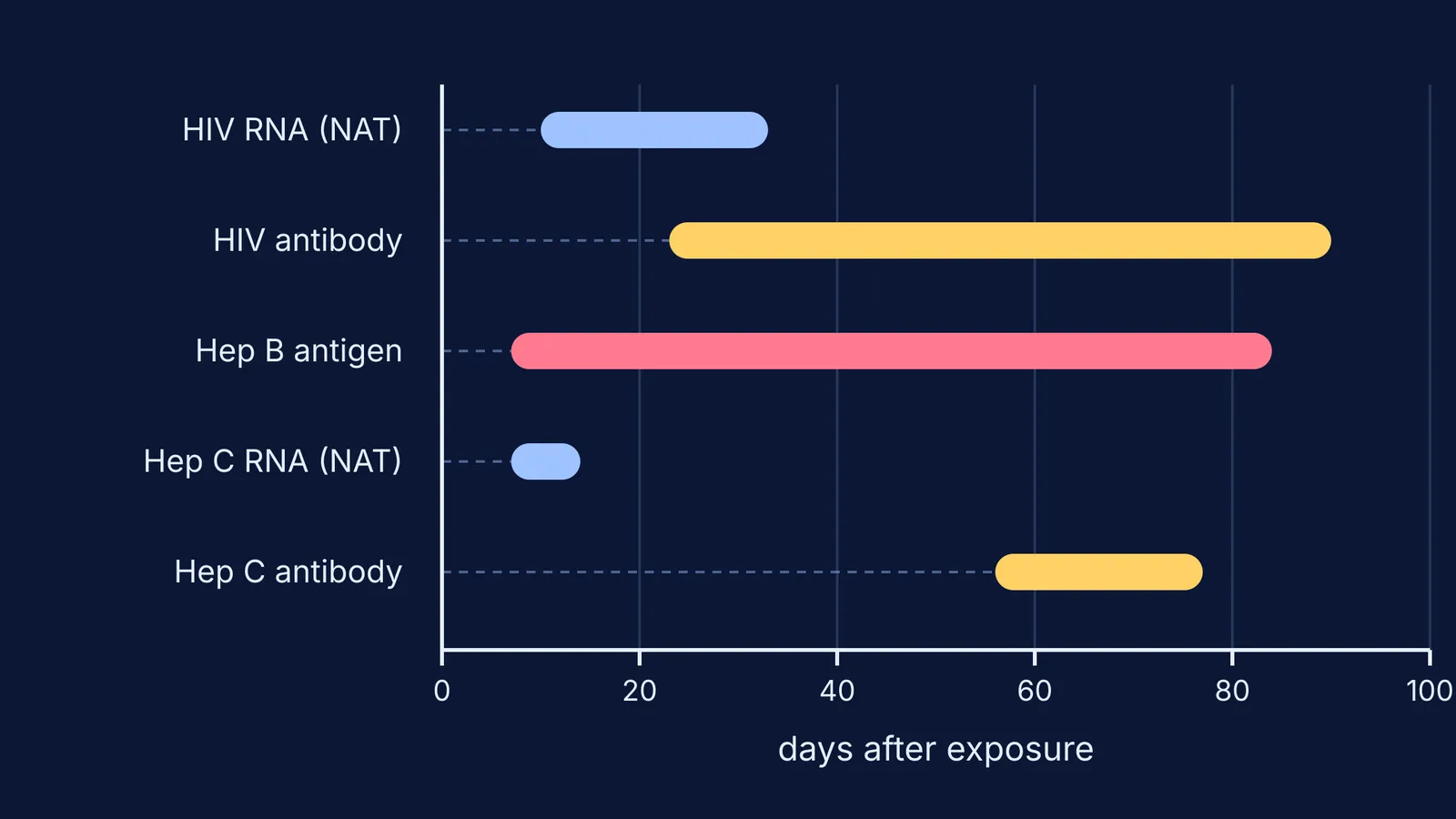
The window period is the time between when a person becomes infectious and when a test can first detect a marker of the infection, as a review of blood supply testing defines it. Antibodies take time to build up, so antibody tests have long windows:
HIV antibody tests can usually detect HIV 23 to 90 days after exposure, while nucleic acid tests (NAT) can do so in 10 to 33 days, according to the CDC.
HBsAg can be detected as early as 1 to 2 weeks and as late as 11 to 12 weeks after exposure to hepatitis B, according to the CDC Pink Book.
Hepatitis C antibodies usually take 8 to 11 weeks to appear, while the virus's RNA is detectable after 1 to 2 weeks, according to the CDC.
Adding NAT, which looks for the germ's genetic material much as RT-PCR does (see rapid antigen test vs RT-PCR), shrinks the gap: Australia's blood service, Lifeblood, puts its HIV window at 5 days and hepatitis C at 3 days. It never reaches zero.
How can an infected unit pass the screen?
Imagine a donor who caught hepatitis C 30 days ago, feels fine, and gives blood at a centre that screens for hepatitis C antibodies only. Using the CDC's hepatitis C testing figures:
Day 30 is past the 1 to 2 weeks RNA usually needs, so the virus is in their blood.
Day 30 is short of the 8 to 11 weeks antibodies usually need, so the antibody test most likely reads negative.
The unit passes a screen working exactly as designed.
That is why the donor questionnaire is part of the safety system: it catches risk the lab cannot yet see.
What does this mean for you as a student or a donor?
For revision, write a five-row list from memory: infection, germ type, what the test detects, rough window. If antigens and antibodies are the weak spot, the Fermi Concept Library gives every biology concept its own lesson and its place in the map.
If you donate:
Answer every screening question truthfully, even awkward ones.
Never donate to get yourself tested; a negative result inside the window proves nothing.
If you are worried about an exposure, see a doctor, who can choose the right test for the timing.
Curious what happens next? Read how the body replaces blood after donation. And if the whole chapter feels too big to start, Fermi's AI tutor can work out what you already know and build a plan for the session.