On this page
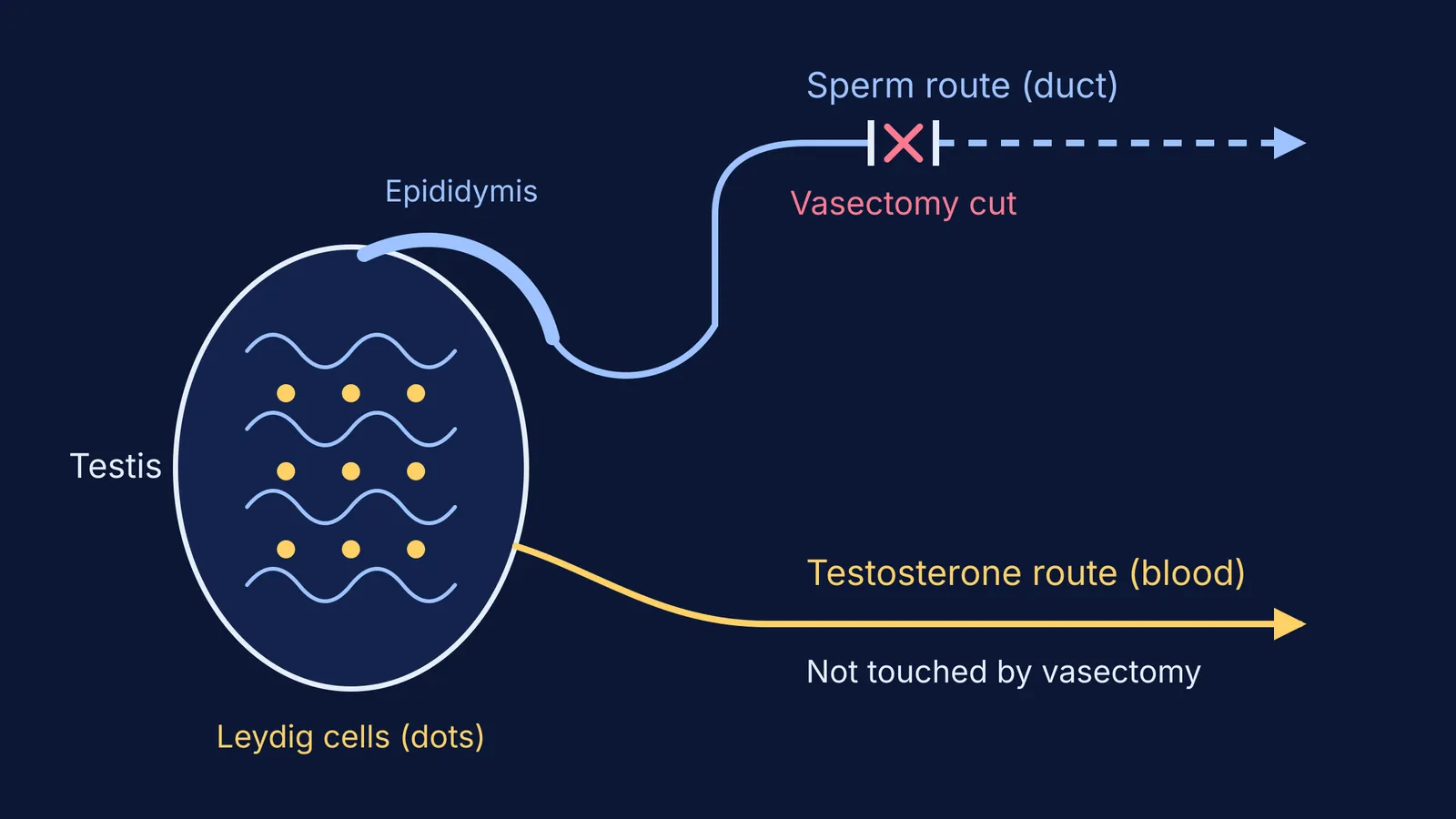
The worry is common: if a surgeon cuts something in the scrotum, surely testosterone, the hormone behind male traits, must drop. The biology says otherwise, and you can work it out from two NCERT Biology chapters. The testis makes two different products and sends them out by two different routes. A vasectomy closes only one of them.
What does a vasectomy actually cut?
NCERT's Class 12 chapter on Reproductive Health describes vasectomy as the male sterilisation procedure in which "a small part of the vas deferens is removed or tied up through a small incision on the scrotum". The vas deferens is a duct: a tube that carries sperm away from the epididymis towards the urethra. Our walk-through of the path of sperm from testis to urethra traces every duct in order.
Sperm are made inside the seminiferous tubules of the testis and then travel into the epididymis to mature, as the StatPearls review Histology, Spermatogenesis explains. Cutting and tying the vas stops sperm reaching the semen. That is the whole job of the operation.
Where is testosterone made, and how does it leave the testis?
The NCERT Class 11 chapter Chemical Coordination and Integration says the testis is both a primary sex organ and an endocrine gland. The same chapter states that the Leydig cells, or interstitial cells, in the spaces between the tubules produce androgens, mainly testosterone. It also defines endocrine glands as ductless glands whose hormones are released into the blood.
So sperm leave by a duct, and testosterone leaves by the blood. The difference between Sertoli and Leydig cells is worth revising here, because exam questions often swap the two.
Do blood tests show testosterone falling after a vasectomy?
Anatomy predicts no change, but researchers have checked with blood tests.
In a prospective study in Fertility and Sterility43996-8), Whitby and colleagues followed 54 men for 5 years after vasectomy and found no significant continuing change in testosterone or LH. LH rose in the first year and then stopped rising, and a stimulation test at 4 years confirmed acceptable Leydig cell reserve.
An Indian study in the Indian Journal of Medical Research tested 180 men aged 35 to 45 who had had a vasectomy 1 to 10 years earlier. Testosterone showed no change in the 35 to 40 group and a statistically significant increase, not a fall, in the 41 to 45 group.
A 2018 study in Scientific Reports compared 485 men with a vasectomy and 1,940 men without one in China and concluded that vasectomy had no long-term effect on sex hormone levels.
The American Urological Association vasectomy guideline, approved in 2012, reviewed the published literature and found no evidence of significant effects of vasectomy on testosterone, FSH or LH at follow-ups ranging from 1 to 21 years.
Does a vasectomy make a man less masculine?
The NCERT chapter on chemical coordination lists what androgens do: they stimulate muscular growth, facial and axillary hair and a low-pitched voice, and they influence sexual drive. With testosterone levels unchanged, these traits have no hormonal reason to change.
Studies of sexual function point the same way. A 2025 systematic review in Translational Andrology and Urology found male sexual desire was assessed in 13 papers: 3 reported improvement and 10 reported no change. The AUA guideline says patients may be reassured that there is no evidence vasectomy causes erectile problems, reduced sexual interest or diminished pleasure.
The 2018 Chinese study did find one difference: men with a vasectomy scored lower on some quality-of-life and mental-health measures, and the authors suggested professional counselling could help. Feelings matter even when hormones do not change. Anyone weighing the procedure should talk it through with a urologist or family-planning doctor, and if worry is affecting sleep or mood, the government's Tele MANAS helpline (14416) offers free support.
How do you answer this in an exam, or at home?
Use this three-step check whenever a question asks what a procedure blocks:
Name the product: sperm, egg or hormone.
Name its exit: a duct, or the bloodstream.
Ask whether the procedure touches that exit.
Worked example: "Why does vasectomy not affect secondary sexual characters?" Product: testosterone. Exit: the blood, from the Leydig cells. Procedure: cuts the vas deferens, a duct. So testosterone still reaches its target organs, and the characters it maintains stay as they were.
If a relative says a vasectomy "makes a man weak", a calm reply is: "It only cuts the sperm tube. Testosterone goes into the blood from different cells, and long-term blood tests show it stays the same."
To see how the testis, pituitary and feedback loops fit together, the Fermi Concept Library gives every biology concept its own lesson and its place in the map, so you can follow one idea into the next. Then read how FSH and LH control sperm and testosterone in males.