On this page
Yes, a little. Your stomach makes its own fat-splitting enzyme, gastric lipase. It plays a small part, but the one textbook line about it is exactly the detail that turns up as an MCQ option.
Does the stomach digest fat at all?
It does, in a limited way. Human gastric lipase is secreted by the chief cells in the fundic part of the stomach, according to a review of digestive lipases in Biochimie. The same review calls pancreatic lipase the major enzyme in the digestion of dietary triglycerides.
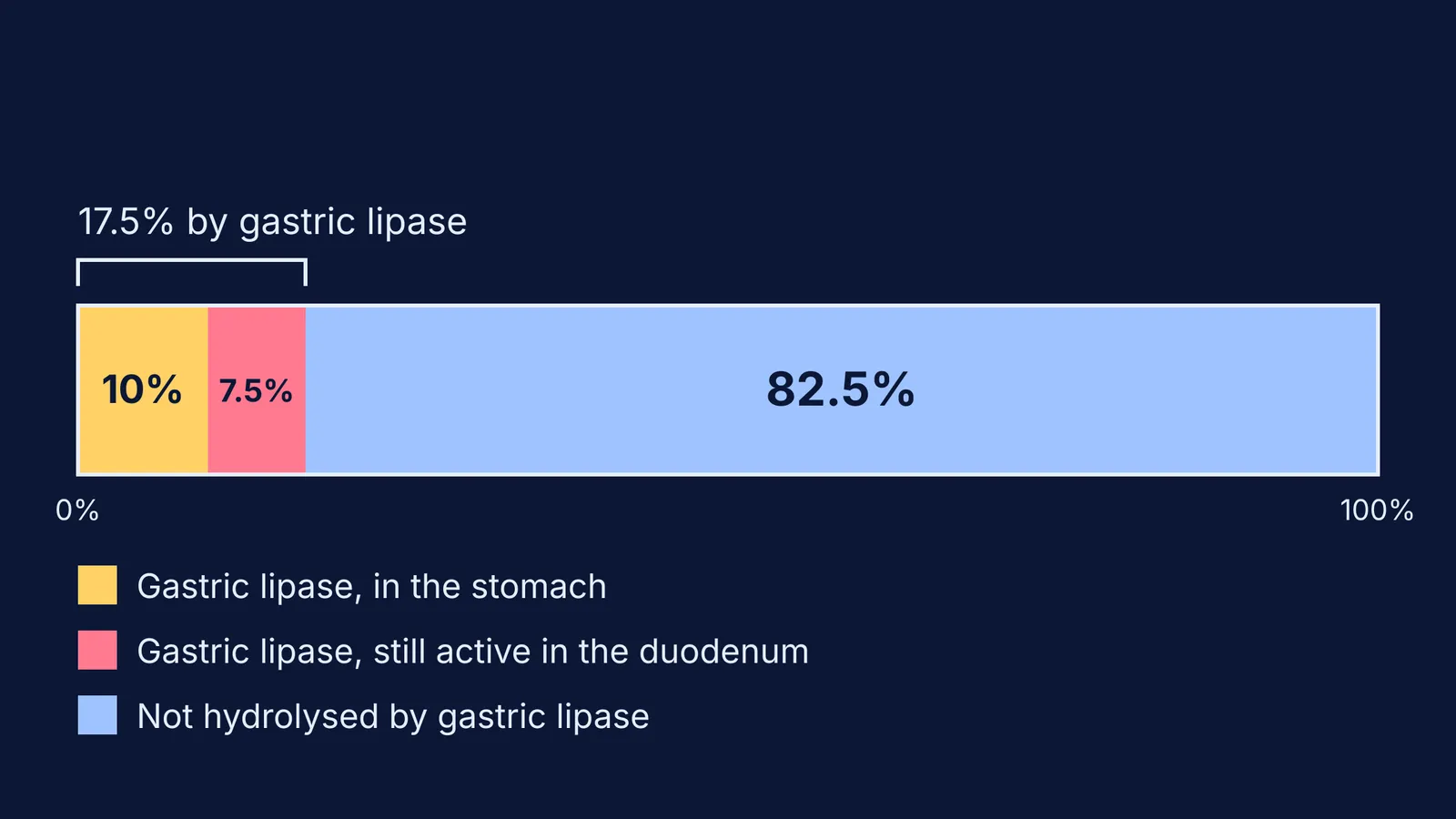
How small? A Marseille team measured it in healthy volunteers given a liquid test meal (Carrière and colleagues, Gastroenterology, 1993). They found:
About 10% of the fatty-acid chains in the meal's triglycerides were released in the stomach.
Gastric lipase kept working in the duodenum, where it might release another 7.5%.
Across the whole of digestion, gastric lipase might hydrolyse about 17.5% of the meal's triglyceride chains.
By weight, the pancreas secreted about four times as much lipase as the stomach over 3 hours of digestion.
So the stomach starts the job, and the small intestine finishes it.
Why does most fat digestion wait for bile and pancreatic lipase?
Fat does not dissolve in water, so it sits in large globules that enzymes can only attack at the surface. The NCERT Class 10 chapter Life Processes puts it simply: bile salts break large fat globules into smaller ones, which makes enzyme action more efficient, and pancreatic juice contains lipase for breaking down emulsified fats. The same chapter calls the small intestine the site of the complete digestion of carbohydrates, proteins and fats.
The small intestine has three things the stomach lacks:
Bile, which emulsifies fat into small droplets with far more surface.
Pancreatic lipase, secreted in much larger amounts than gastric lipase.
An alkaline medium: the same chapter notes that bile makes the acidic food alkaline so pancreatic enzymes can act.
Gastric lipase is unusual because it copes with acid. A 2016 review in Food & Function reports that it is stable and active from pH 2 to 7, works best around pH 4 to 5.4, and resists pepsin and bile salts, so it works in the stomach and the duodenum.
For the order in which a meal's carbohydrate, protein and fat are handled, see our dal-rice-ghee digestion timeline.
What does NCERT say about gastric lipase?
One sentence. The older NCERT Class 11 Biology chapter 16, Digestion and Absorption (2020-21 text, archived), lists what the gastric glands release (HCl, pepsinogen, mucus, intrinsic factor, and rennin in infants) and adds: “Small amounts of lipases are also secreted by gastric glands.” It then says bile contains no enzymes but emulsifies fats and activates lipases.
Check which book you use. The current Class 11 reprint no longer has that chapter; its chapter 16 is now Excretory Products and their Elimination. Class 10 Life Processes names only pepsin as the stomach's enzyme. Before drilling this for an entrance exam, check the current syllabus on the official NEET-UG site.
How do MCQs test gastric lipase?
Mostly through three traps.
“Gastric juice contains...” The old NCERT exercise offers: (i) pepsin, lipase and rennin; (ii) trypsin, lipase and rennin; (iii) trypsin, pepsin and lipase; (iv) trypsin, pepsin and renin. The answer is (i): trypsin is pancreatic, so every option with it is out. Watch the spelling too: renin is released by the JG cells of the kidney, while rennin acts on milk proteins in infants.
“Fat digestion begins in...” If the stomach is an option, the research supports it: a 2018 review in Pharmaceutical Research states that lipid digestion is initiated in the stomach by human gastric lipase. If the question asks where *most* fat is digested, the answer is the small intestine.
“Bile digests fats” (true or false). False as worded. Bile has no enzymes; it emulsifies fats and activates lipases. The digesting is done by lipase.
Many slips here come from blurring digestion with absorption. Our post on digestion vs absorption vs assimilation separates the three by following one glucose molecule.
How can you lock this in before a test?
Draw the gut as three boxes (mouth, stomach, small intestine) and write each enzyme under its box. Lipase appears twice: small under the stomach, large under the intestine.
Explain bile's role without the word “digest”: it emulsifies and activates.
Write one trap MCQ of your own for each pattern above and swap with a friend.
If the chapter feels like a list of disconnected names, the Fermi Concept Library gives every biology concept its own lesson and its place in the map, so you can see gastric lipase next to bile and pancreatic juice. For practice, the Fermi Problem Library has worked problems with a step-by-step solver that explains the reasoning rather than printing an answer.