On this page
Stepping on a rusty nail is the classic tetanus scare, and it is half right. The nail matters. The rust does not.
Does a rusty nail cause tetanus?
Not because of the rust. Tetanus is caused by *Clostridium tetani*, which the CDC Pink Book describes as a spore-forming, gram-positive, anaerobic rod. Iron oxide plays no part in the infection.
The WHO tetanus fact sheet says the spores are found in soil, ash, animal and human faeces, on skin, and on rusty tools such as nails, needles and barbed wire. A rusty tool has usually spent a long time outdoors, near dirt, which is a likely reason it carries spores.
Where do tetanus spores actually live?
Almost everywhere outdoors. According to the ECDC factsheet, the spores are found in soil, house dust and animal and human faeces, remain viable for years, and resist boiling and freezing.
A spore is a dormant, armoured form of the bacterium that waits until conditions suit it. Our post on how Ferdinand Cohn discovered bacterial endospores explains how scientists first saw them.
Why are deep puncture wounds the risky ones?
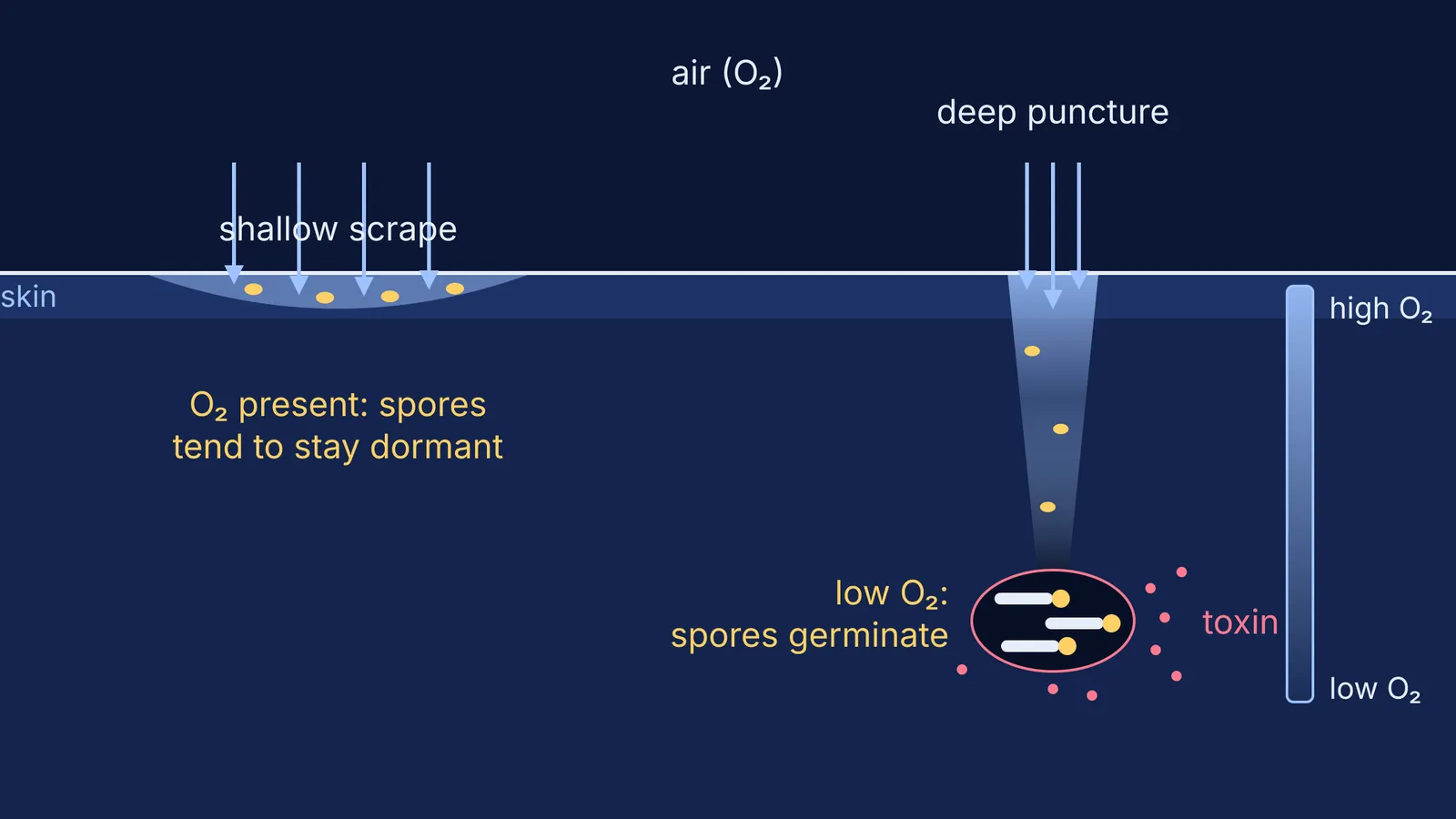
Because *C. tetani* is anaerobic: it grows where there is little oxygen. The CDC clinical overview says the spores germinate in anaerobic conditions, including those inside the body.
A shallow scrape is open to the air, which makes it a poorer home for the bacteria, although no wound is risk-free. A nail driven into your heel makes a narrow, deep track that air cannot reach, often with dirt packed in. The CDC's tetanus page says to consult a healthcare provider if a wound:
is a puncture or is deep, such as from stepping on a nail
contains dirt, soil, faeces or saliva, such as an animal bite
contains dead tissue, including from burns, fractures, crush injuries or frostbite
What does tetanus toxin do to your nerves?
Once the spores germinate, the bacteria release a toxin called tetanospasmin. The ECDC factsheet explains that it blocks the release of the inhibitory neurotransmitters glycine and GABA in the central nervous system, leaving excitatory nerve impulses unopposed.
Think of each muscle as having an accelerator and a brake. Excitatory nerves press the accelerator; inhibitory nerves press the brake. Tetanus toxin cuts the brake line, so muscles lock into painful spasms. The Pink Book notes that the first sign is usually trismus, a locked jaw, which gives the disease its old name, lockjaw. The WHO fact sheet puts the incubation period at 3 to 21 days, with most cases appearing within 14 days.
The brake idea comes from real neuroscience: our post on John Eccles and the synapse that tells a neuron to stop explains inhibitory synapses. If synapses still feel abstract, the Fermi Concept Library gives each concept in biology its own lesson and shows where it sits in the map.
Why does the tetanus vaccine protect you if the disease doesn't?
The CDC Pink Book states that because the toxin is so potent, tetanus disease does not result in immunity. It estimates the minimum lethal dose for a human at 2.5 nanograms per kilogram of body weight.
Work it out for a 50 kg student: 2.5 × 50 = 125 nanograms, or about 0.000000125 grams. An amount that small can do harm without giving the immune system enough to learn from.
The vaccine solves this with a toxoid. The Pink Book explains that a method for inactivating tetanus toxin with formaldehyde was developed in the early 1920s. Toxoid cannot cause the disease, but your body still makes antibodies (antitoxin) against it that neutralise the real toxin. After a primary series of three properly spaced doses (plus a toddler booster for infants), essentially all recipients reach antitoxin levels well above the protective level of 0.1 IU/mL. Our explainer on live attenuated, killed and toxoid vaccines compares the three types.
Protection fades: the Pink Book says that by 10 years after the last dose, most people's antitoxin levels only approach the minimal protective level. In India, the National Immunization Schedule gives Pentavalent vaccine at 6, 10 and 14 weeks, DPT boosters at 16 to 24 months and 5 to 6 years, and Td at 10 and 16 years, plus Td doses in pregnancy.
What should you do after stepping on a nail?
This is everyday guidance, not medical advice. A doctor decides on any injection.
Clean the wound and apply first aid; the CDC advises first aid even for minor wounds.
Ask: is it deep, dirty, or full of soil? If yes, the CDC says to consult a healthcare provider.
Check the vaccination card for the last tetanus or Td dose and take it with you.
Watch for jaw stiffness or muscle spasms in the following weeks, and get urgent care if they appear.
Tonight, find your family's vaccination cards and check the date of everyone's last tetanus dose.