On this page
John Carew Eccles was born in Melbourne on 27 January 1903 and died on 2 May 1997, according to his Nobel Prize facts page. He shared the 1963 Nobel Prize in Physiology or Medicine with Alan Hodgkin and Andrew Huxley "for their discoveries concerning the ionic mechanisms involved in excitation and inhibition in the peripheral and central portions of the nerve cell membrane". Eccles' part was the synapse, the junction where one nerve cell passes a message to the next. He showed that the message can mean "fire" or "don't fire", and that chemicals carry both.
The twist is that for years he argued the other side.
Who was John Eccles and what did he discover?
Eccles graduated in medicine from Melbourne University in 1925 and went to Oxford as a Rhodes Scholar to study under Charles Sherrington, who named the synapse, as his Nobel biography records. His 1929 Oxford thesis was on Excitation and Inhibition.
In the 1930s scientists argued about whether signals cross synapses as electricity or as chemicals. The same biography says Eccles resisted "many aspects of the chemical transmitter story" being built by Henry Dale and his colleagues. That story began with Otto Loewi's frog heart experiment.
As a professor at the University of Otago in New Zealand (1944 to 1951), Eccles met the philosopher Karl Popper, who taught him to state bold hypotheses and test them hard. His biography says that afterwards he could "rejoice even in the falsification of a cherished theory, because even this is a scientific success."
How did Eccles record from inside a nerve cell?
In 1951 Brock, Coombs and Eccles became the first to insert microelectrodes into nerve cells of the central nervous system. They recorded what excitatory and inhibitory synapses did to those cells (Nobel biography). The method was published in 1952 in The Journal of Physiology.
His 1963 Nobel lecture describes the electrode as a glass pipette with a tip about 0.5 micrometre across, filled with concentrated potassium chloride solution. The cells were motoneurones, the spinal cord cells that drive muscles, and their resting voltage was about −70 mV. His biography says the chemical theory's decisive victory had to wait for intracellular recordings like these: most synapses are chemical.
How do excitatory and inhibitory synapses work?
The figures below come from the Nobel lecture.
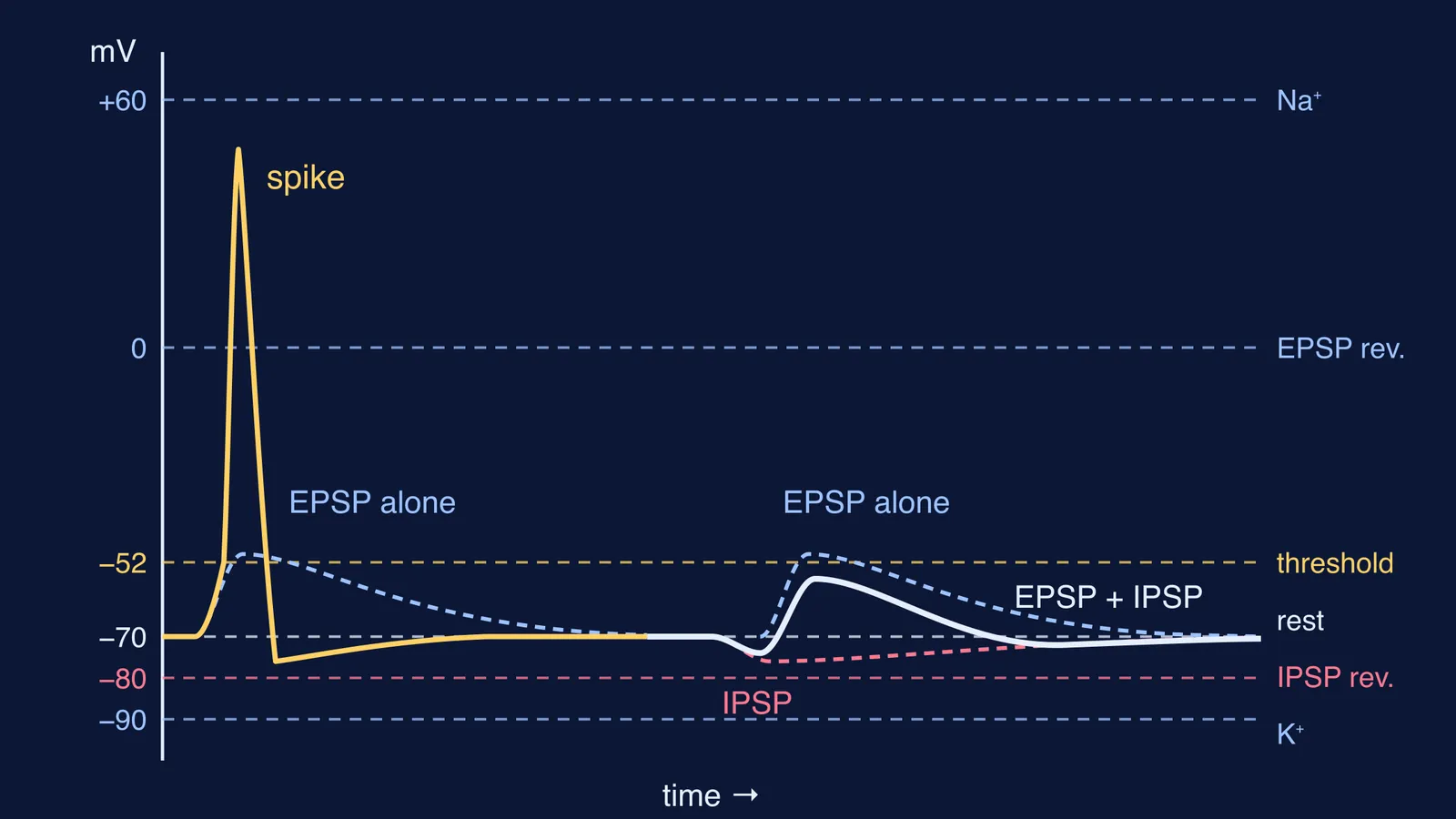
Excitatory synapses make the inside of the cell less negative. This shift is called an excitatory postsynaptic potential (EPSP). In the recordings shown in the lecture, an impulse arose in every case when this depolarisation reached 18 mV.
Inhibitory synapses do the opposite. The inhibitory postsynaptic potential (IPSP) is "virtually a mirror image" of the EPSP: it makes the inside more negative, and its current reverses at about −80 mV.
Summation: the effects of separate synapses add up, and inhibition works by pulling the voltage the opposite way to excitation.
To find which ion carries the inhibitory current, his team injected ions into cells through the electrode. Adding chloride turned the IPSP into a depolarising response. A larger injection of sulphate left it unchanged (Nobel lecture). So the inhibitory transmitter briefly opens the membrane to chloride. His Canberra colleagues tested some 33 anions and found that only small ones passed, those no wider than about 2.85 Å when hydrated. His biography calls this the "ionic sieve hypothesis" of inhibition.
Will this neuron fire if inhibition comes first?
Here are simplified sums. Rest and threshold come from Eccles' Nobel lecture; the EPSP and IPSP sizes are illustrative. Real neurons don't add voltages perfectly, but the logic holds.
Start at rest: −70 mV.
Threshold is 18 mV above rest: −70 + 18 = −52 mV.
Suppose one burst of excitation gives an EPSP of +20 mV: −70 + 20 = −50 mV. That is past −52, so the cell fires.
Now an inhibitory synapse acts first, with an IPSP of −6 mV. The same EPSP now peaks at −70 − 6 + 20 = −56 mV. That is 4 mV short of threshold, so there is no spike.
The diagram above draws both cases. If you find voltage traces hard to picture from numbers alone, the Fermi Simulation Lab has interactive simulations for ideas that are easier to see than to read.
What can students learn from John Eccles?
The science lesson fits a four-line exam answer:
Transmission at most synapses is chemical.
An excitatory transmitter depolarises the next cell (EPSP) towards threshold.
An inhibitory transmitter hyperpolarises it (IPSP), for example by letting chloride in.
The neuron fires only if the sum of all inputs reaches threshold.
The second lesson is about being wrong. Eccles resisted much of the chemical story for years, then intracellular recordings, including his own, helped settle it. When a mock test shows one of your methods is wrong, treat it the same way: find the step that failed, then test the fix on a fresh problem.
If threshold or reversal potential is still fuzzy, the Fermi Concept Library has a lesson for each concept. Then label a synapse structure diagram and mark where the transmitter acts.